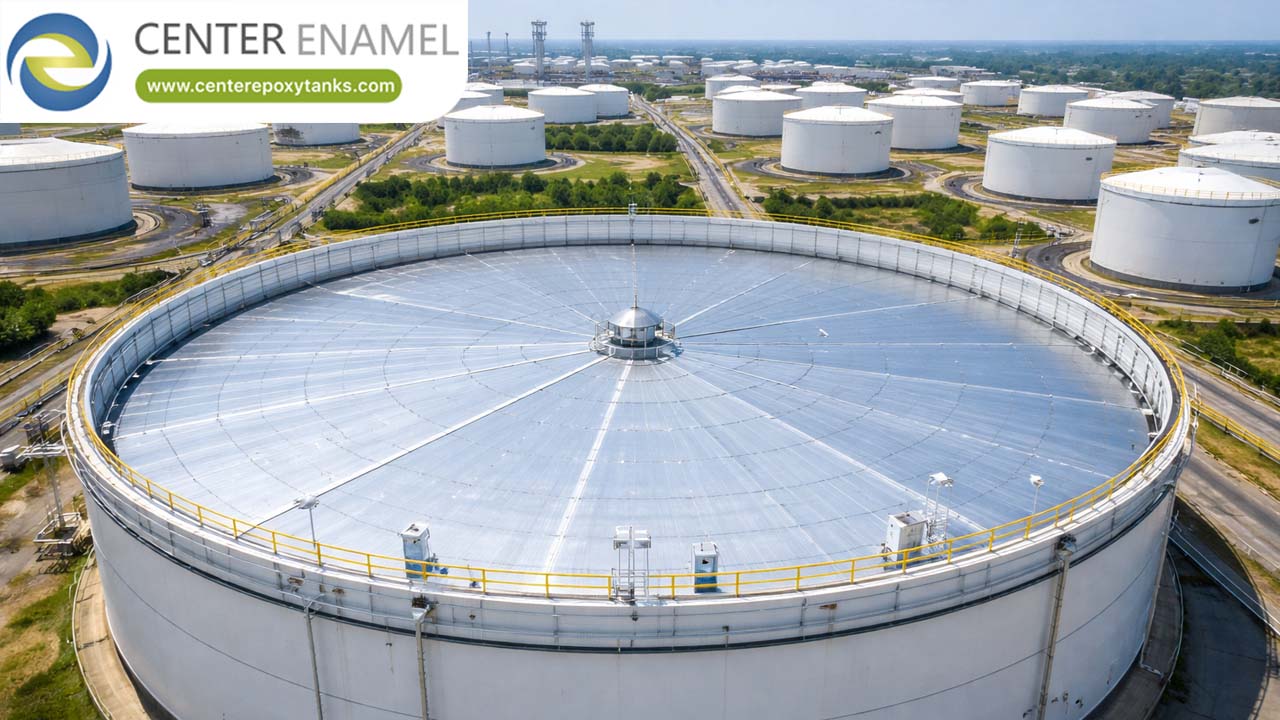
External Floating Roofs for Oil Storage: Pontoon and Double-Deck Design
The external floating roof is crude storage's defining image: a steel pancake riding the product surface inside an open-top tank, rising and falling with every receipt and shipment. Its enemy is weather — rain, snow, and wind — and its engineering is the discipline of staying afloat, sealed, and drained through decades of exactly that.
External floating roofs (EFRs) are decks floating on the liquid surface inside open-top storage tanks, built as pontoon (outer pontoon ring plus center deck) or double-deck (full buoyant sandwich) steel designs to API 650, cutting evaporative losses by up to 95% on crude oil and volatile products, with rim-seal systems, center drains, and wind-driven design details defining their performance.
1. Pontoon or Double-Deck — Which EFR Design Fits?
Deck architecture is a buoyancy-versus-budget decision.
· Pontoon roofs: An annular ring of sealed pontoons carries a single-skin center deck — the economical standard across most diameters.
· Double-deck roofs: Two full plates separated by bulkheads form a buoyant sandwich — heavier, stiffer, superior in snow regions and on large diameters where center-deck sag governs.
· Buoyancy requirements: API 650 floating-roof rules require decks to remain afloat on specified punctures — the safety case behind compartment design.
· Sizing crossover: Pontoon roofs dominate below roughly 60 m diameter; double-decks claim the largest crude tanks and heavy-snow climates.
2. How Is the Roof-Shell Annulus Sealed?
The 150-250 mm gap between deck and shell is where product meets atmosphere.
· Primary rim seals: Mechanical shoe seals (wiper plates held by springs against the shell) or resilient foam or liquid-filled seals — the first line of vapor containment.
· Secondary seals: A second barrier above the primary, mandatory in most emission regimes, cutting residual annular losses dramatically.
· Weather shields: Flexible metallic or fabric sheets block wind and rain from the seal zone, protecting seal performance and reducing VOC stripping.
· Pontoon and deck details: Sealed compartments, gauging wells with covers, and foam dams round out the deck's compliance hardware.
3. What Rainwater and Safety Systems Keep EFRs Reliable?
Free water on a floating deck is a sinking risk; ignition at the rim is the classic fire scenario.
· Primary drains: Swivel-joint or flexible-pipe drains carry roof rainwater to the tank exterior, sized for design rainfall with safety factor.
· Emergency drainage: Slotted or emergency drain capability prevents water accumulation beyond design events that could depress the deck.
· Fire protection: Foam dams and rim-area foam application points address the seal-zone fires that account for most EFR incidents; cooling water protects exposed shell.
· Rotation and inspection: Roof drain function, seal condition, and pontoon integrity are inspected on scheduled outages — drain failures are the leading cause of EFR sinking.
Data Table: Pontoon vs Double-Deck EFR
Criterion | Pontoon Roof | Double-Deck Roof |
Structure | Pontoon ring + single center deck | Two plates, full buoyant sandwich |
Weight and cost | Lower | Higher |
Snow / rain resilience | Moderate | Excellent |
Large diameter fit | To ~60 m typical | Preferred for largest tanks |
Deck rigidity | Center-deck sag limits | High |
Maintenance | Compartment checks | Compartment checks, heavier |
Frequently Asked Questions (FAQ)
Q1: What is the difference between a pontoon and double-deck floating roof?
A pontoon roof floats on a ring of sealed pontoons with a single-plate center deck, while a double-deck roof is a complete two-plate buoyant sandwich. Pontoon designs are lighter and cheaper; double-decks offer superior stiffness, snow-load capacity, and safety margin on the largest crude tanks.
Q2: Why do crude oil tanks use external floating roofs?
To eliminate the vapor space that drives evaporation: the deck rises and falls with the liquid, cutting breathing losses by up to 95% on volatile crudes. At terminal scale, that saving is measured in tonnes per tank per week — alongside the emission-permit compliance floating roofs deliver.
Q3: What causes external floating roof failures?
Mostly water: blocked or failed roof drains let rainwater accumulate and sink the deck, while frozen drain systems compound the risk. The second family of incidents is rim-seal fires from lightning — mitigated by secondary seals, foam dams, and shunt bonding between deck and shell.
Q4: How are external floating roofs inspected?
In-service visual checks of seal condition, drain flow, and deck position from the platform; out-of-service inspections land the deck on legs for pontoon integrity, seal replacement, and weld surveys per API 653 frameworks. Roof drain testing is a scheduled item because drains are the dominant failure path.


