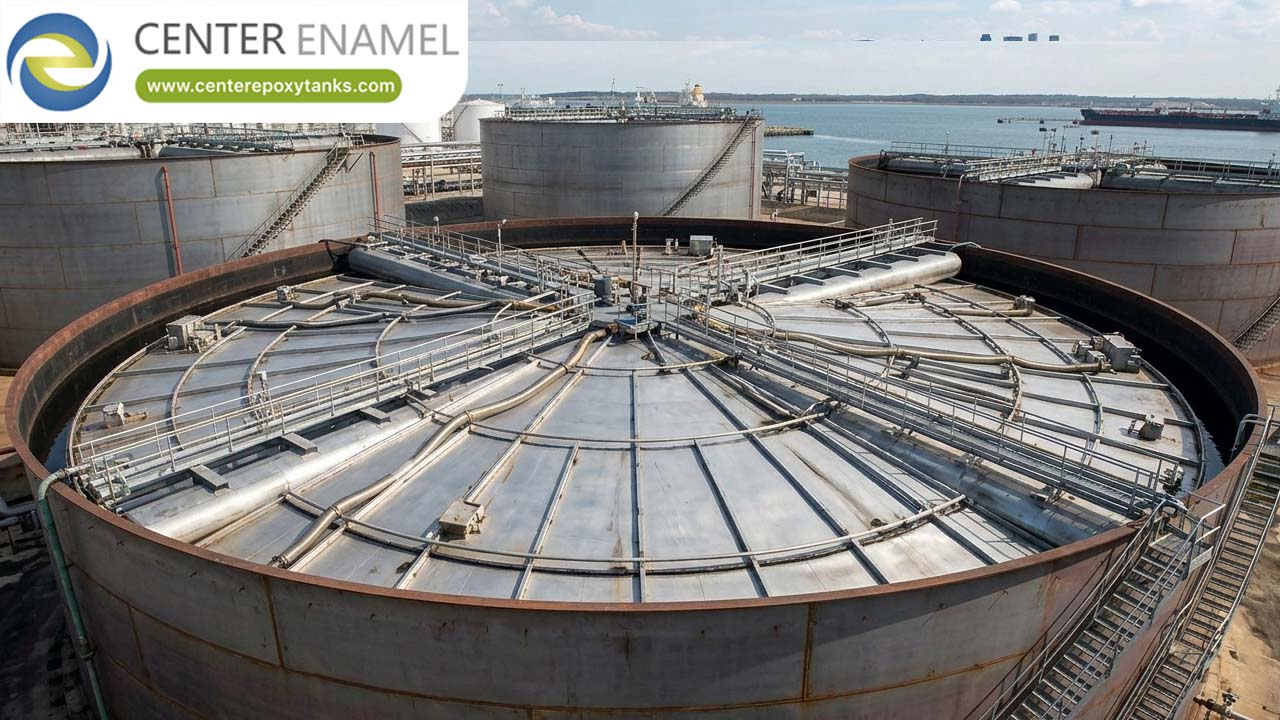
Floating Roof Tank Design: Engineering Policy & Principles
Floating roof tank design is a critical discipline in industrial engineering. Whether designing for crude oil, refined products, or hazardous chemicals, the primary policy is emission suppression through buoyancy. By engineering a roof that maintains constant contact with the liquid, facilities can achieve up to 99% reduction in Volatile Organic Compound (VOC) emissions.
1. Core Engineering Fundamentals
The Buoyancy Calculation
The roof must be designed with sufficient buoyancy to support its own dead weight plus the weight of all attachments (rim seals, instrumentation, manways).
● Engineering Policy: API 650 requires a buoyancy safety factor. The roof must remain afloat even if the peripheral rim and two adjacent structural compartments are punctured. This ensures the asset remains safe even under abnormal load conditions.
Rim Seal Systems
The "seal" is the most critical mechanical component. It is the interface between the floating deck and the tank shell.
● Design Policy: Seals must be designed to accommodate the inevitable out-of-roundness (ovality) of the tank shell.
● Mechanical Primary/Secondary Seals: Engineers often specify a two-tier seal system: a primary "shoe" seal (a metal plate that presses against the shell) and a secondary "wiper" seal (a rubber/polymer wiper) to provide maximum containment efficiency.
2. Differentiating Design: IFR vs. EFR
Engineers must choose between Internal Floating Roofs (IFR) and External Floating Roofs (EFR) based on local climate and product volatility.
Feature | Internal Floating Roof (IFR) | External Floating Roof (EFR) |
Environmental Exposure | Protected by a fixed outer roof | Exposed to wind, rain, and snow |
Wind/Snow Loads | Minimal (Shielded) | Significant (Requires structural roof bracing) |
Maintenance | Lower (Less debris accumulation) | Higher (Requires complex roof drainage) |
Primary Use | High-volatility refined products | Crude oil & high-volume storage |
Design Standard | API 650, Appendix H | API 650, Appendix C |
3. Engineering Constraints & Challenges
The "Binding" Problem
The greatest risk in floating roof design is "binding"—where the roof tilts and catches on the tank shell, preventing it from moving up or down.
● Design Mitigation:
○ Annular Space: Designing the correct gap between the roof edge and the shell.
○ Column Guidance: Ensuring cable-stayed or pole-guided designs are aligned to prevent lateral sway.
○ Support Legs: Adjustable legs are mandatory to maintain the roof in a level position during tank drainage or maintenance.
Drainage Systems (EFR Only)
For External Floating Roofs, rain accumulation is a major threat to buoyancy.
● Policy: EFRs must be equipped with articulated drainage pipes or heavy-duty flexible hoses that can handle high flow rates of rainwater while maintaining flexibility as the roof moves.
4. Engineering Compliance Checklist
To ensure your floating roof design meets global standards and best practices, verify the following:
1. Material Compatibility: Ensure deck materials (aluminum, stainless steel, or carbon steel) are compatible with the stored product to prevent galvanic corrosion.
2. Electrical Continuity: Mandate stainless steel shunts to dissipate static electricity—a non-negotiable fire safety requirement.
3. Hydrostatic Testing: Post-fabrication, the tank must undergo water-fill testing to verify shell integrity and roof flotation performance.
4. Seal Inspection Ports: Integrate sufficient access hatches to allow for routine "gap measurements" required by environmental regulatory bodies.
Designing for Lifecycle Integrity
Floating roof tank engineering is an exercise in balancing structural buoyancy with dynamic environmental loads. By strictly adhering to API 650 guidelines and prioritizing rim seal integrity, engineers create assets that not only comply with environmental regulations but also provide decades of safe, high-efficiency storage.
Does your engineering team require a deeper dive into the specific buoyancy calculation formulas for a specific tank diameter, or are you currently evaluating a retrofit project for an existing tank?


