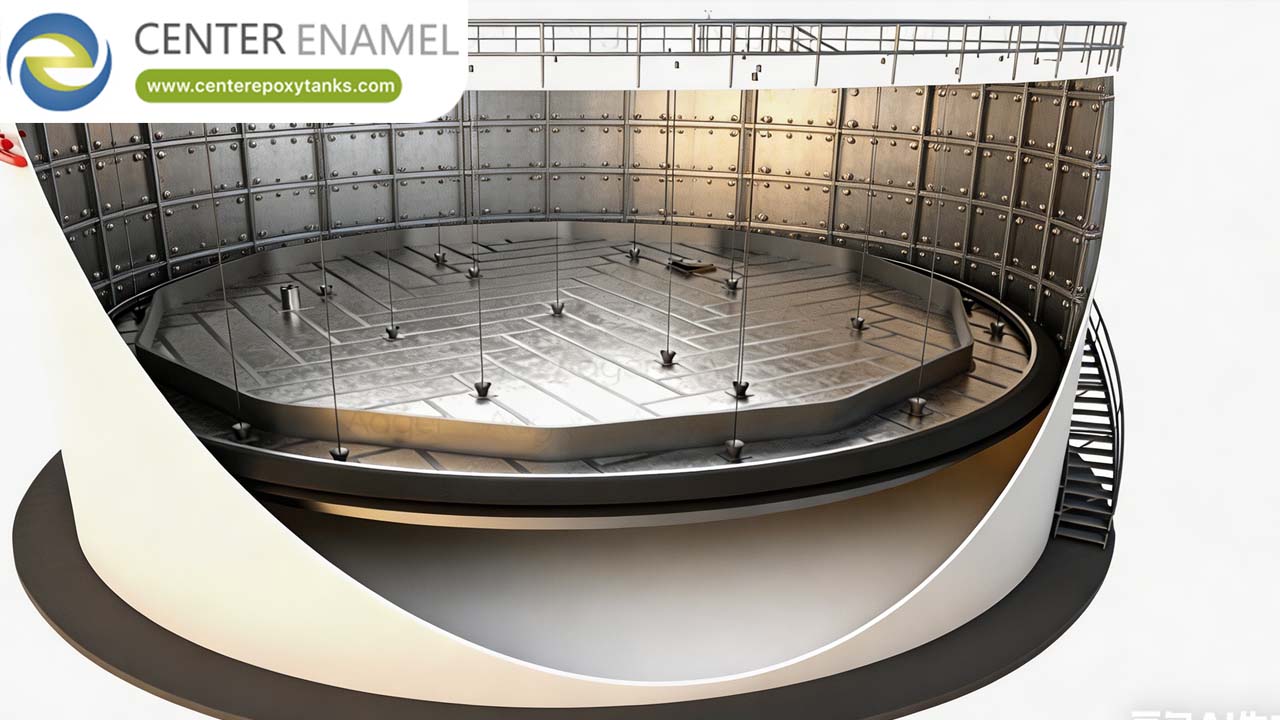
Engineering Guide to ASCE 7 Full-Contact Stainless Steel Floating Roofs
In industrial storage, the choice of material is as critical as the design geometry. When storing hazardous, high-temperature, or highly corrosive products, the industry standard shifts from aluminum to Full-Contact Stainless Steel Floating Roofs.
These systems are engineered not only for chemical resistance but for structural survival under the rigorous environmental load profiles defined by ASCE 7. By eliminating the vapor headspace—the "ullage"—and using high-grade stainless alloys, engineers create a containment system capable of decades of trouble-free operation in the world's most demanding facilities.
1. Why Stainless Steel? (Material Superiority)
Unlike aluminum honeycomb panels, which are excellent for refined fuels, stainless steel decks are the heavy-duty workhorses of the industry.
● Corrosion Resistance: For products containing high concentrations of H2S (sour crude), various acids, or industrial effluents, stainless steel (304L/316L/Duplex) provides superior metallurgical resilience.
● High-Temperature Tolerance: Stainless steel decks retain their structural strength at temperatures exceeding 500°F (260^circ C), where other materials would soften or undergo thermal fatigue.
● Seal-Welded Monolithic Integrity: Unlike mechanically jointed panels, stainless steel decks are typically field-welded into a single, seamless, monolithic floor, ensuring 100% liquid-tight containment.
2. Managing ASCE 7 Environmental Loads
Any internal floating roof is susceptible to seismic "binding"—where the deck catches on the tank shell during ground acceleration. ASCE 7 mandates the analysis of Hydrodynamic Sloshing Forces to prevent this.
Seismic Hydrodynamic Analysis
When a tank experiences ground acceleration, the stored liquid interacts with the floating roof in two distinct ways:
1. Impulsive Mode: The liquid mass moving in unison with the tank shell.
2. Convective (Sloshing) Mode: The upper liquid mass that oscillates, creating low-frequency waves.
ASCE 7 provides the mathematical framework to calculate the wave amplitude (dc). A stainless steel full-contact roof must be engineered with sufficient lateral clearance and a high-strength rim seal mechanism to accommodate these wave pressures without losing the seal’s contact with the tank wall.
Wind Uplift and Shell Ovalization
Even with a fixed outer roof, the tank shell itself is subject to wind-induced "ovalization"—a temporary distortion where the circular shell becomes slightly elliptical. The floating roof must be engineered to flex slightly with this deformation, or it will bind. ASCE 7 wind-load modeling is used to determine if the shell thickness and stiffeners are sufficient to limit this ovalization to within the floating roof’s seal tolerance.
3. Structural Benchmarks for Compliance
To satisfy both API 650 and ASCE 7, every stainless steel full-contact roof must meet these critical structural mandates:
● 2.0x Flotation Safety Factor: The deck must possess a buoyancy reserve capable of supporting at least twice the total combined dead weight of the roof structure—including peripheral rim seals and heavy-duty stainless instrumentation—ensuring the deck remains afloat during shell deformation.
● Two-Compartment Puncture Survival: The buoyancy pontoons (if integral to the deck) must be calculated to remain level and afloat even if the outer rim and two adjacent internal compartments are breached.
● Static Dissipation: Stainless steel is conductive, but the roof must still incorporate flexible stainless steel bonding cables (shunts) to maintain constant contact with the tank shell, ensuring static electricity is safely dissipated to prevent spark ignition.
Technical Performance Profile: Stainless vs. Alternative Alloys
Engineering Metric | Aluminum Honeycomb | Carbon Steel (Coated) | Stainless Steel (316L) |
Corrosion Resistance | Moderate | Low (Requires Coating) | Maximum |
Heat Resistance | Low | High | Very High |
VOC Suppression | 98%+ | 98%+ | 99%+ |
Maintenance | Low | High (Coating Failure) | Minimal |
Seismic Resilience | Moderate | Moderate | High (Structural Grade) |
4. The "Clearly Superior" Integration
For facilities requiring stainless steel full-contact roofs, the operational environment is often too harsh for traditional steel fixed roofs. The best practice is to pair the stainless steel IFR with an ASCE 7-compliant clear-span Aluminum Geodesic Dome (ADR).
● Synergy: The dome shields the stainless IFR from wind/snow loads, effectively removing the external environmental variables from the roof's structural equation.
● Internal Integrity: By removing internal support columns (which often require problematic penetrations in the IFR), the stainless deck can move freely during seismic events, drastically reducing the risk of binding or seal abrasion.
Conclusion: Strategic Value and Lifecycle
Investing in an ASCE 7-compliant Full-Contact Stainless Steel Floating Roof is an infrastructure-grade decision. By combining the chemical resistance of stainless steel with the rigorous seismic load analysis of ASCE 7, operators secure a "set-and-forget" containment asset that maximizes safety and emission suppression for the facility’s entire service life.
Given your interest in full-contact floating roofs, are you currently evaluating a project involving high-temperature product storage or sour crude service that requires specific metallurgical testing for the stainless steel deck?


