Floating Roof Tank Design: Engineering for Safety and Emission Control
What are the core principles of floating roof tank design? The design of a floating roof tank is centered on the elimination of the vapor-air headspace. By utilizing a buoyant deck that maintains constant contact with the liquid surface, the design prevents evaporation and mitigates fire risks. For modern refineries and terminals, Floating Roof Tank Design must balance structural rigidity with vertical mobility, strictly adhering to international standards like API 650 to ensure 30-year operational integrity.
1. Structural Architecture: IFR vs. EFR Design
Designers must first determine the roof configuration based on the volatility of the stored medium and environmental exposure.
Internal Floating Roof (IFR) Design
Installed inside a fixed-roof tank, the IFR design focuses on maximizing vapor suppression without the need to handle heavy environmental loads (rain/snow).
● Engineering Focus: Lightweight buoyancy and chemical compatibility.
● Standard: Strictly follows API 650 Appendix H.
External Floating Roof (EFR) Design
Designed as the primary cover for large-diameter crude oil tanks. The design must be robust enough to handle high wind, rain, and snow.
● Engineering Focus: Structural rigidity and complex drainage systems.
● Standard: Strictly follows API 650 Appendix C.
2. The Physics of Buoyancy and Stability
The most critical aspect of the design is ensuring the roof remains level and buoyant under all operational conditions.
● Pontoon Design: Most modern designs utilize individual, airtight pontoons. Engineering protocols require the roof to remain buoyant even if two adjacent pontoons are punctured—a fail-safe known as "damaged buoyancy."
● Double-Deck Design: For massive tanks, a double-deck steel design provides a hollow air chamber across the entire surface. This offers superior insulation, reducing solar heat gain and further suppressing evaporation.
● Anti-Rotation Systems: To prevent the roof from spinning and damaging the seals, designers integrate guide poles and anti-rotation cables.
3. Rim Seal Engineering: The Vapor Barrier
The effectiveness of a floating roof is only as good as its seal. The design must account for the "rim space"—the gap between the roof edge and the tank shell.
● Primary Seals: Options include Mechanical Shoe Seals (metal plates held against the shell by springs) or Foam-Filled Seals.
● Secondary Seals: A wiper-style seal installed above the primary seal to capture any trace vapors.
● Design Tolerance: The system must account for the tank shell being slightly "out-of-round" while maintaining a gas-tight fit.
4. Environmental and Safety Design Features
Modern Floating Roof Tank Design includes several specialized components to manage external stressors:
● Roof Drainage Systems (EFR only): To prevent water from sinking the roof, articulated pipe drains or flexible hoses carry rainwater from the deck to the tank exterior without contaminating the product.
● Support Legs: Adjustable or fixed legs that hold the roof at a specific height (usually 2 meters) during maintenance to allow for floor inspection.
● Vapor Vents: Pressure-vacuum vents that allow the tank to "breathe" only when the roof is resting on its legs.
5. Why Choose Center Enamel for Your Design Needs?
With a 150,000 m² automated facility and a history of engineering excellence since 1989, Shijiazhuang Zhengzhong Technology Co., Ltd (Center Enamel) is a global leader in floating roof technology.
● CNC Precision: We ensure perfectly uniform panels and pontoons, eliminating the risk of roof "binding" or tilting.
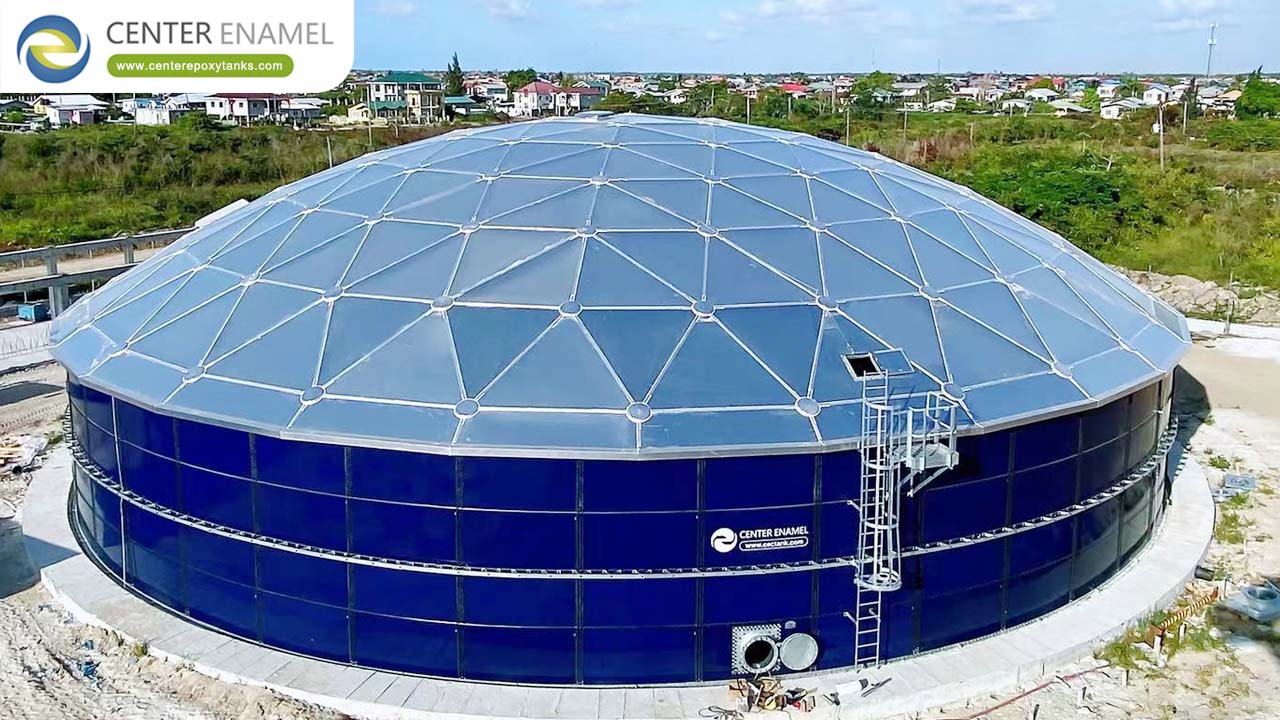
● Integrated Solutions: We offer the unique ability to pair internal floating decks with Aluminum Geodesic Domes, creating a column-free, maintenance-free storage environment.
● Global Logistics: Our modular, bolted designs are shipped to 100+ countries, allowing for rapid, weld-free assembly on-site.


