Floating Roof Tank: Components, Types, & Industrial Benefits
A floating roof tank is an industrial storage vessel engineered to eliminate the "vapor headspace" above stored volatile liquids. By utilizing a roof structure that rests directly on the product's surface and rises or falls with the liquid level, these tanks prevent the accumulation of flammable or hazardous vapors. The primary engineering goal is to minimize Volatile Organic Compound (VOC) emissions, prevent product evaporation, and mitigate fire risks. These tanks are the global industry standard for storing hydrocarbons, crude oil, and solvents, typically constructed in accordance with API 650 standards to ensure structural integrity and regulatory compliance.
Core Components: The Anatomy of the Roof System
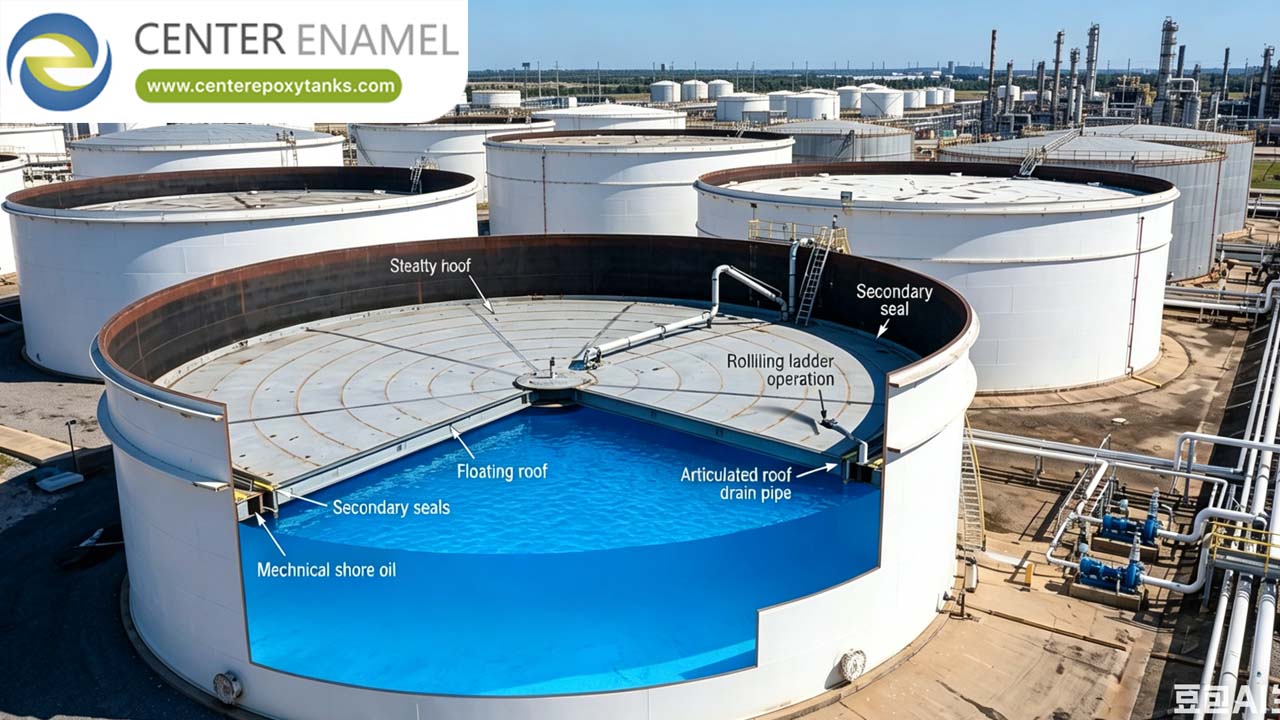
To achieve effective vapor suppression, a floating roof tank utilizes a coordinated assembly of precision-engineered components:
● The Roof Deck: The structural core, usually comprised of pontoon chambers or full-contact panels that provide the necessary buoyancy to float on the liquid surface.
● Rim Seal System: The critical barrier preventing vapors from escaping the tank wall interface. It typically features a Primary Seal for initial containment and a Secondary Seal (Wiper) to ensure "best available" emission control.
● Guide Poles & Anti-Rotation: These structural members maintain the roof’s vertical alignment, preventing rotation or tilting that could compromise the seal integrity during filling or discharge cycles.
● Bleeder Vents: Automatic valves that equalize pressure by allowing air to escape or enter during tank operations, preventing structural collapse or gas entrapment.
● Inspection Manways: Access points that allow for maintenance and seal inspections without requiring a full tank decommission.
Types of Floating Roof Tanks
1. Internal Floating Roof Tank (IFRT)
The IFRT consists of a floating roof installed inside a fixed-roof tank. The fixed outer roof acts as a weather shield, protecting the internal floating deck from rain, snow, and wind.
● Best For: Long-term emission compliance, general chemical storage, and refined petroleum products. It is the most common modern configuration due to its high reliability and low maintenance.
2. External Floating Roof Tank (EFRT)
The floating roof is exposed directly to the environment. It requires an articulated or flexible drainage system to safely remove accumulated rainwater and snow from the roof deck.
● Best For: Very large-diameter tanks (often used in crude oil terminals) where the scale makes a fixed roof structurally complex or cost-prohibitive.
Comparative Overview: Floating Roof Configurations
Feature | Internal Floating Roof (IFR) | External Floating Roof (EFR) |
Weather Protection | High (Fixed Outer Roof) | None (Exposed) |
Drainage Needs | Minimal | High (Articulated System) |
Maintenance | Low | Moderate/High |
Best Application | Chemicals, Fuels, Refined | Large Crude Storage |
Emission Control | Excellent | Excellent |
Industrial Benefits: Why Invest in Floating Roofs?
1. VOC Emission Control: By eliminating the vapor headspace, these tanks significantly reduce the release of harmful VOCs, helping facilities meet stringent environmental air-quality mandates.
2. Fire Safety: Floating roofs reduce the contact between the product and oxygen in the headspace, dramatically lowering the risk of ignition and fire spread.
3. Product Loss Prevention: Direct contact between the roof and the liquid prevents the evaporation of light-end hydrocarbons, protecting the value of your stored inventory.
4. Operational Longevity: Constructed to API 650 standards, these tanks offer a service life of 30+ years, providing a durable solution for critical industrial infrastructure.
Frequently Asked Questions (FAQ)
Q: Can a fixed-roof tank be retrofitted with a floating roof?
A: Yes. This is a common upgrade for existing storage facilities looking to meet modern emissions standards without replacing the entire tank structure.
Q: Are floating roof tanks suitable for water storage?
A: Generally, no. They are designed for volatile liquids (hydrocarbons/chemicals). For water, standard fixed-roof designs are usually sufficient unless specific vapor management is required.
Q: Which seal type provides the best emission control?
A: A combination of a Mechanical Shoe Seal (Primary) and a Wiper Seal (Secondary) is considered the "gold standard" for VOC reduction.
Partnering for Reliable Infrastructure
Selecting a floating roof configuration is a strategic decision that balances environmental compliance, maintenance costs, and operational needs. Whether your facility requires the rugged reliability of an IFR or the high-capacity flexibility of an EFR, precision engineering is the foundation of your safety and success.
Are you currently evaluating storage solutions for an upcoming project?
[Contact our engineering team] to discuss your project’s capacity, regional climate challenges, and emission control goals. We can provide a structural feasibility assessment and a comparative proposal tailored to your specific application.
Would you like a detailed technical brief on the difference between mechanical shoe seals versus liquid-mounted seals for high-volatility product storage?


