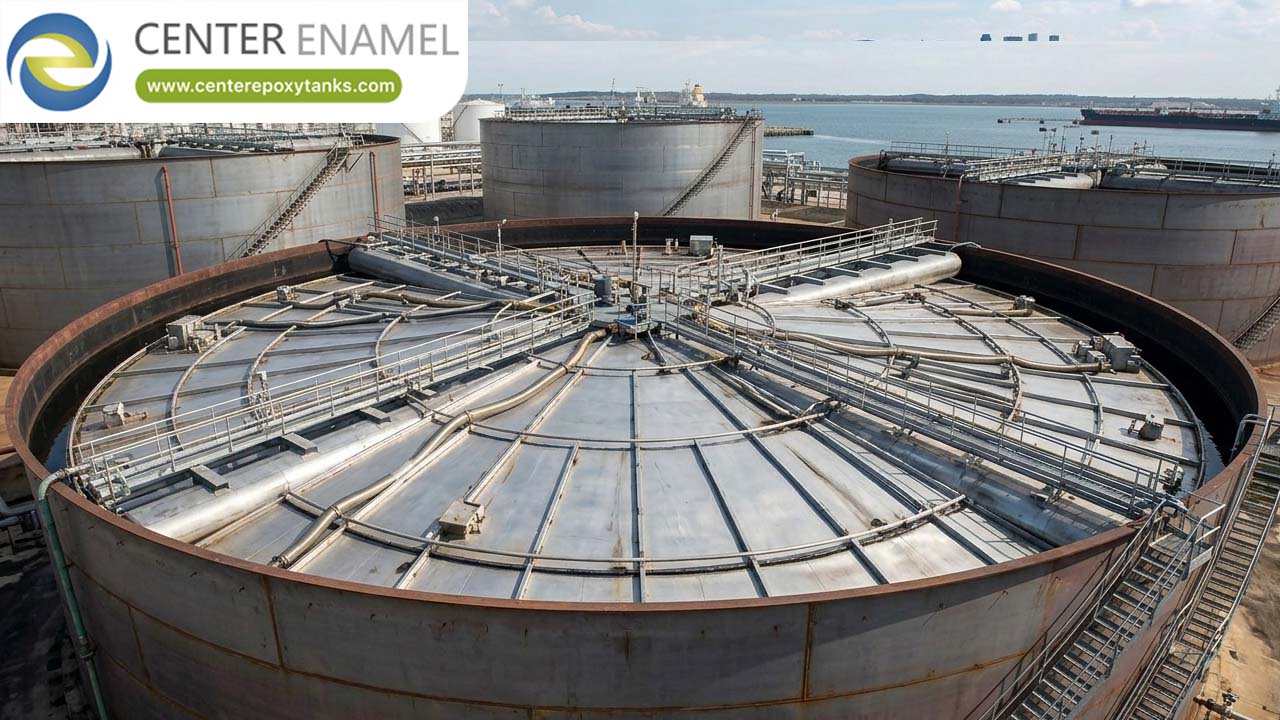
Components of an External Floating Roof (EFR): Engineering & Safety Breakdown
An External Floating Roof (EFR) is a critical storage tank assembly comprised of a buoyant deck that floats directly on the liquid surface, exposed to the atmosphere. Its primary components are designed to create a hermetic seal against the tank wall to eliminate vapor headspace, thereby suppressing Volatile Organic Compound (VOC) emissions and reducing fire risk. The system consists of the Roof Deck (providing buoyancy), the Rim Seal System (the vapor barrier), the Articulated Drainage System (for water management), and Anti-Rotation/Guide Poles (for vertical stability). Unlike internal roofs, an EFR requires robust, weather-hardened hardware to handle direct exposure to rain, snow, and wind while maintaining seal integrity under API 650 structural standards.
Essential Components of an EFR System
Understanding the anatomy of an EFR is vital for specifying, inspecting, and maintaining industrial storage assets.
● The Deck Structure (Pontoon/Pan): The deck is the buoyancy core. It is typically constructed from steel (or aluminum in specific retrofits) and is divided into buoyant chambers (pontoons) and a central pan. This design ensures the roof remains level and afloat even if a specific section is compromised.
● Rim Seal System: This is the most critical component for environmental compliance.
○ Primary Seal: Usually a mechanical shoe seal or liquid-mounted seal that bridges the gap between the roof edge and the tank shell.
○ Secondary Seal: An additional "wiper" seal that clears product residue from the tank wall, providing the final barrier against VOC escape.
● Articulated Drainage System: The "Achilles' heel" of an EFR. Because the roof is exposed to the elements, rainwater must be removed from the deck to prevent sinking. This system uses flexible hoses or articulated steel pipes that move with the roof, allowing water to drain outside the tank shell without spilling or kinking.
● Bleeder Vents (Vacuum Breakers): These mechanical valves open and close automatically as the roof travels. They allow air to enter or exit the space under the roof (if necessary) or, more commonly, allow trapped gases to release during filling, preventing the roof from binding.
● Anti-Rotation Guides & Gauge Poles: These structural members keep the roof from spinning or tilting as it rises or falls. Gauge poles are often perforated to allow for accurate level measurement and sampling without breaking the seal integrity.
Component Functionality Table
Component | Engineering Function | Critical Performance Requirement |
Pontoon Deck | Buoyancy & Stability | Must remain watertight under load. |
Mechanical Shoe Seal | Vapor Barrier | Must maintain contact despite shell irregularities. |
Articulated Drain | Rainwater Management | Must be leak-free and flexible (no kinking). |
Bleeder Vents | Pressure Equalization | Must respond instantly to liquid level changes. |
Anti-Rotation Guide | Horizontal Alignment | Must prevent roof binding against the shell. |
Technical Benchmarks & Compliance
When evaluating the components of an EFR, compliance with global standards is non-negotiable:
1. API 650 (Appendix C): The gold standard for tank design. All EFR components—specifically the seal design and deck deflection limits—must meet these structural specifications.
2. Corrosion Resistance: Given that EFR components are exposed to the elements, high-performance coatings or corrosion-resistant materials (like stainless steel) are standard for fasteners, drains, and structural joints.
3. Hydrostatic Drain Testing: Before commissioning, the articulated drain system must undergo rigorous hydrostatic testing to ensure it can handle heavy precipitation without failing or leaking into the stored product.
Frequently Asked Questions (FAQ)
Q: Why is the drainage system the most critical component?
A: In an EFR, if the drain fails, rainwater accumulates on the roof deck. If enough water accumulates, the added weight can sink the roof, leading to a catastrophic structural failure of the entire tank. This is why drain maintenance is a top priority for facility safety managers.
Q: Can I use an EFR in cold climates?
A: Yes, but components must be specifically engineered. In freezing climates, drainage systems require heat tracing to prevent ice blockage, and the deck structure must be reinforced to handle the "snow load" (the weight of accumulated snow).
Q: What is a "Mechanical Shoe Seal"?
A: It is a specific type of primary rim seal that uses a metal "shoe" pressed against the tank wall by springs or levers. It is preferred for EFRs because it effectively spans the gap between the roof and the tank shell, even if the tank is not perfectly round.
Partnering for Reliable Infrastructure
The integrity of an External Floating Roof depends entirely on the quality of its components. From the flexibility of the drain hose to the precision of the rim seal, every part plays a role in environmental compliance and operational safety.
Are you evaluating containment solutions or maintenance requirements for an EFR tank?
[Contact our engineering team] to review your current roof component specifications, request a structural integrity assessment, or obtain a proposal for EFR retrofitting or seal replacement.
Would you like a detailed technical brief on the difference between mechanical shoe seals versus liquid-mounted seals for high-volatility product storage?


