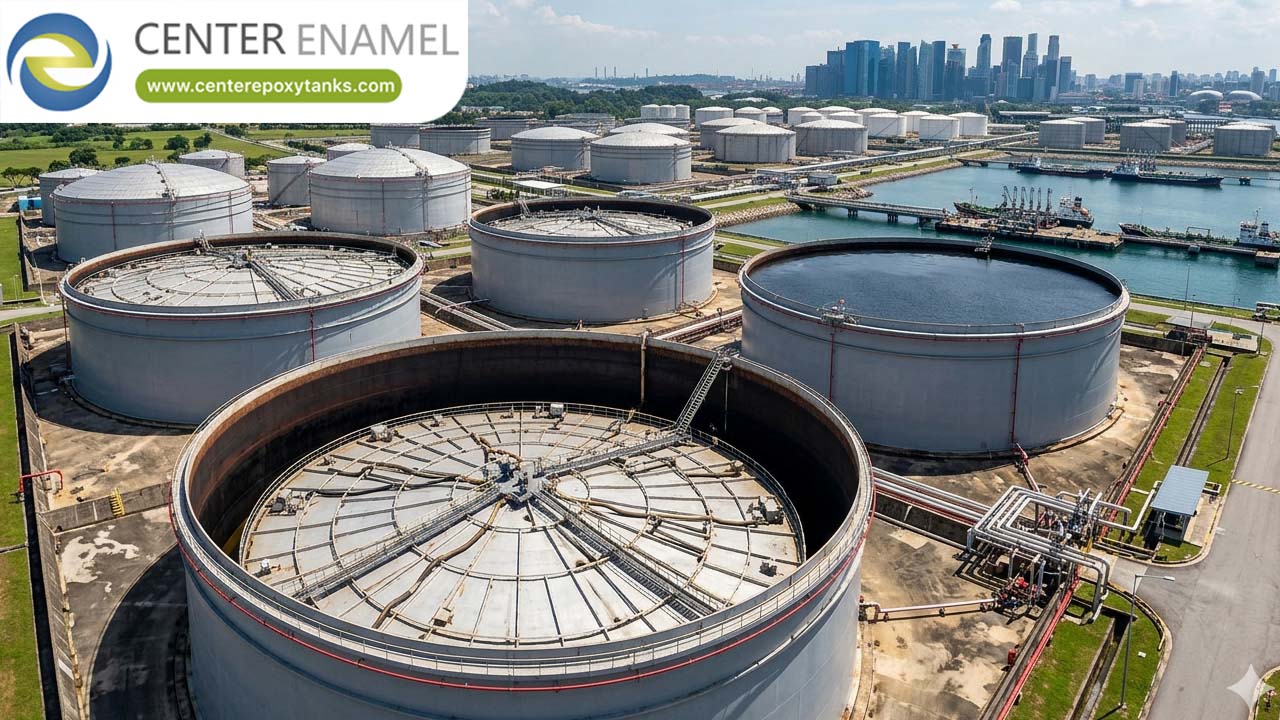
Floating Roof vs. Fixed Roof Tanks: Technical Selection Guide
The fundamental difference between a fixed roof tank and a floating roof tank is the presence of a vapor headspace. A fixed roof tank is a static vessel with a permanent roof, which creates a volume of air (headspace) between the liquid surface and the top of the tank. This space allows for the accumulation of flammable or toxic vapors. In contrast, a floating roof tank utilizes a deck that rests directly on the liquid surface, moving vertically to track liquid levels. This eliminates the vapor headspace entirely, making it the industry standard for minimizing Volatile Organic Compound (VOC) emissions, reducing evaporation, and enhancing fire safety for volatile products like gasoline, crude oil, and organic solvents.
Fixed Roof Tanks: The Reliable Standard
Fixed roof tanks are the most common and cost-effective solution for large-scale storage where the medium is non-volatile.
● Mechanism: The roof is permanently attached to the shell, often in a conical or dome shape.
● Ideal Applications: Storage of water, heavy fuel oils, asphalt, and non-volatile chemicals.
● Primary Benefits:
○ Cost-Effective: Simple design leads to lower capital expenditure (CAPEX).
○ Maintenance: Few moving parts result in lower long-term maintenance costs.
○ Simplicity: No complex seal systems or drainage requirements.
● Limitations: Since air exists above the liquid, volatile products will evaporate into this space, creating potential environmental compliance issues and safety risks.
Floating Roof Tanks: The Engineered Solution
Floating roof tanks are specialized vessels designed specifically to handle high-volatility products where emission control and fire safety are mission-critical.
● Mechanism: The roof deck floats on the liquid surface. It is equipped with peripheral rim seals that maintain a tight, flexible fit against the tank shell to prevent vapor escape.
● Types:
○ Internal Floating Roof (IFR): A floating roof inside a fixed-roof tank (provides weather protection).
○ External Floating Roof (EFR): A floating roof exposed directly to the atmosphere (common in massive crude oil tanks).
● Primary Benefits:
○ VOC Suppression: Near-zero vapor headspace dramatically limits emissions.
○ Fire Safety: Less oxygen contact reduces ignition risk in the vapor zone.
○ Product Conservation: Dramatically reduces inventory loss due to evaporation.
Comparative Overview: Selection Matrix
Feature | Fixed Roof Tank | Floating Roof Tank |
Vapor Headspace | Large (Air pocket exists) | Near Zero (No air pocket) |
VOC Emissions | High (Requires vapor recovery) | Minimal (Compliant) |
Capital Cost | Lower | Higher (Complex seals/deck) |
Maintenance | Minimal | Moderate (Seal/Drain inspection) |
Ideal Contents | Water, Heavy Oils, Non-Volatile | Gasoline, Crude, Solvents |
Fire Risk | Higher (Vapor accumulation) | Lower (Suppressed surface) |
Selection Criteria: Which Should You Choose?
Deciding between a fixed roof and a floating roof involves analyzing your operational environment:
1. Chemical Volatility: If your stored medium is highly volatile (high vapor pressure), environmental regulations usually mandate a floating roof or a vapor recovery system.
2. Environmental Compliance: If your site must adhere to strict VOC emission limits (e.g., EPA or EU standards), the floating roof is the most efficient technical solution.
3. Site Location: In climates with heavy snow or high rainfall, Internal Floating Roofs (IFR) are preferred over External Floating Roofs (EFR) because the fixed outer roof provides a shield, simplifying drainage and maintenance.
4. Operational Budget: For water or heavy, low-volatility liquids, the capital expenditure of a floating roof system is usually unnecessary. A fixed-roof tank provides the best Return on Investment (ROI).
Frequently Asked Questions (FAQ)
Q: Can a fixed roof tank be converted to a floating roof tank?
A: Yes. Retrofitting an existing fixed-roof tank with an internal floating roof (IFR) is a standard industrial procedure to upgrade an asset for modern emission standards without building a new tank.
Q: Are floating roof tanks always better?
A: No. They are only "better" if your operational goals include vapor suppression and emission compliance. For many storage applications (like firefighting water reserves), a fixed roof is safer, cheaper, and more durable.
Q: Which design is more resistant to fire?
A: Floating roof tanks are generally considered safer for flammable liquids because they eliminate the "vapor zone" where ignition occurs.
Partnering for Efficient Storage Engineering
Whether your project demands the straightforward reliability of a fixed-roof design or the high-performance emission control of a floating-roof system, selecting the right containment solution is the foundation of your plant's safety and environmental success.
Are you evaluating storage solutions for an upcoming project?
[Contact our engineering team] to discuss your stored medium, capacity requirements, and regulatory goals. We can provide a feasibility assessment to determine which tank configuration provides the best balance of safety, cost, and compliance for your specific site.
As you consider the right infrastructure for your site, would you like a detailed technical brief on the difference between "contact" floating roofs versus "non-contact" floating roofs for high-viscosity product storage?


