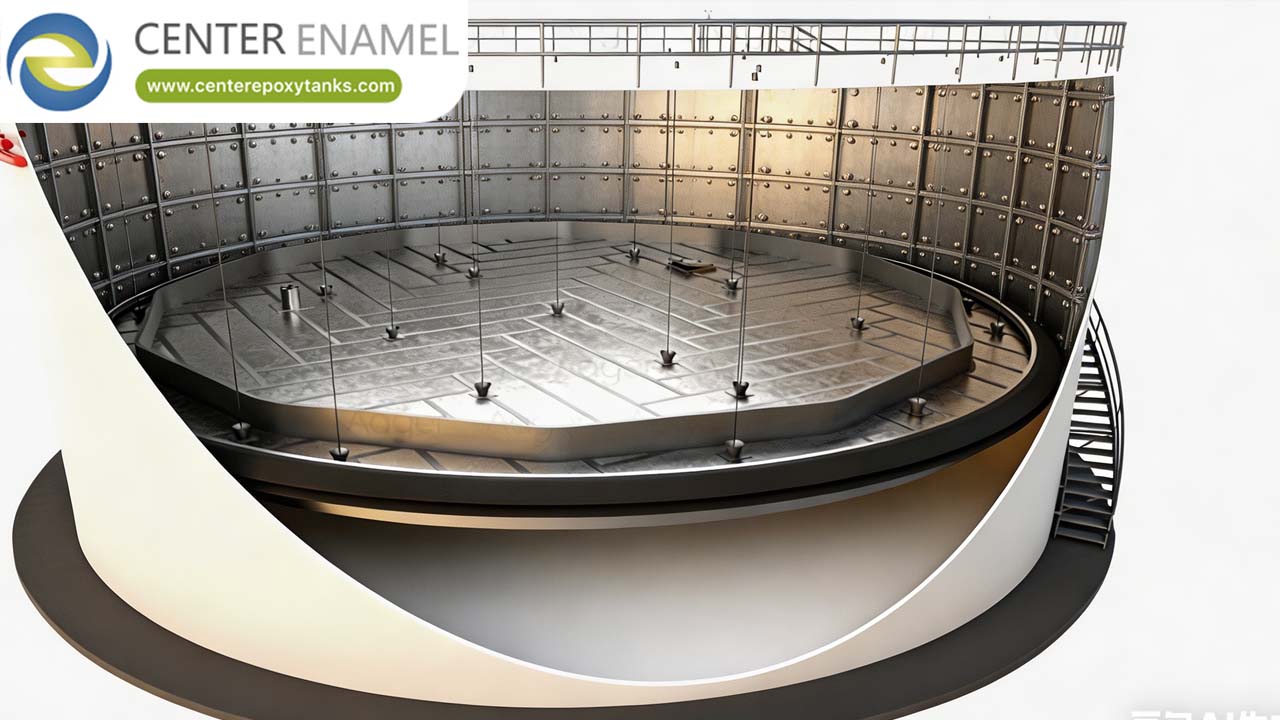
Floating Roof Tank Components, Types, and Industrial Benefits: A Complete Engineering Guide
In the global industrial bulk liquid storage sector, managing volatile organic compounds (VOCs) and mitigating fire risks are paramount engineering priorities. A floating roof tank is an advanced aboveground storage vessel engineered to eliminate the vapor headspace (ullage) above stored volatile liquids.
By utilizing a movable roof deck that rests directly on the product's surface and rises or falls dynamically with inventory levels, these tanks prevent the accumulation of flammable gases. Built in accordance with rigorous standards like API 650, floating roof tanks represent the global benchmark for safely containing crude oil, refined petroleum products, and volatile chemical solvents.
1. Core Components: The Anatomy of a Floating Roof System
To achieve effective vapor suppression and mechanical stability, a floating roof tank relies on a coordinated assembly of precision-engineered components:
The Roof Deck: The structural core providing buoyancy. It can be constructed as a pontoon-type deck (featuring independent airtight compartments) or a full-contact honeycomb panel resting completely on the liquid surface.
Rim Seal System: The critical barrier closing the annular gap between the moving roof edge and the vertical tank shell wall. It typically features a Primary Seal (such as a mechanical shoe or liquid-filled seal) for initial containment and a Secondary Wiper Seal for optimized environmental compliance.
Guide Poles & Anti-Rotation Devices: Structural piping members that maintain the roof's precise vertical alignment, preventing hazardous rotation or tilting during aggressive filling and discharge cycles.
Bleeder Vents & Automatic Air Vents: Self-actuating valves that equalize pressure beneath the deck during initial tank filling or complete drainage, preventing structural deformation or gas entrapment.
Rolling Ladders & Roof Drains: Articulated drainage systems (on external roofs) and hinged rolling ladders that safely accommodate the vertical travel of the deck while granting operator access.
2. Primary Types of Floating Roof Tanks
Floating roof configurations are categorized based on their environmental exposure and integration with fixed outer structures:
Internal Floating Roof Tanks (IFRT): An IFRT houses a movable floating deck inside a closed-top cylindrical tank capped by a permanent fixed outer roof or geodesic dome. The fixed outer roof acts as a primary weather shield, protecting the internal deck from rain, snow, and wind-induced turbulence. They are the preferred choice for refined fuels and chemical storage in strict environmental zones.
External Floating Roof Tanks (EFRT): An EFRT features an open-top cylindrical shell where the floating roof is directly exposed to the ambient atmosphere. Widely utilized in massive crude oil storage terminals (often exceeding 50 meters in diameter), EFRTs require specialized rainwater drainage systems and robust secondary rim seals to withstand direct weathering.
Data Table: Internal vs. External Floating Roof Tanks Comparison
Engineering Parameter | Internal Floating Roof Tank (IFRT) | External Floating Roof Tank (EFRT) |
Governing Standard | API 650 Appendix H | API 650 Appendix C |
Weather Protection | High (Shielded by fixed outer roof or dome) | None (Roof deck exposed directly to precipitation) |
Rainwater Management | Minimal drainage requirements | Requires articulated swing-joint roof drainage systems |
Wind & Evaporation Impact | Minimal wind distortion; superior vapor retention | Exposed to wind turbulence; requires high-integrity dual seals |
Typical Capacity & Application | Small-to-medium bulk terminals, chemicals, jet fuel | Very large crude oil storage and major trading terminals |
3. Key Industrial Benefits
Investing in floating roof tank architecture delivers measurable operational, safety, and environmental advantages across industrial processing plants:
Drastic VOC Emission Reduction: By eliminating the vapor headspace, floating roofs suppress product evaporation, reducing volatile organic compound emissions by up to 99% and helping facilities comply with clean-air mandates.
Enhanced Fire Safety: Removing the flammable vapor-air mixture above the liquid surface drastically diminishes the risk of lightning-induced or static spark ignition.
Inventory Loss Prevention: Preventing light-end hydrocarbons from flashing off into the atmosphere preserves product volume and chemical integrity over long storage periods.
Long-Term Structural Durability: Designed and erected under strict API 650 guidelines, these tanks offer decades of reliable service life when paired with proactive maintenance and rim seal inspections.
Frequently Asked Questions (FAQ)
Q: What is the primary function of a floating roof tank?
A: A floating roof tank is designed to eliminate the vapor headspace (ullage) above stored volatile liquids by utilizing a deck that rests directly on the liquid surface, effectively curbing product evaporation and VOC emissions.
Q: What is the difference between an internal and external floating roof tank?
A: An internal floating roof tank operates inside a closed vessel covered by a fixed outer roof or dome, protecting it from weather. An external floating roof tank has an open-top shell where the deck is directly exposed to the atmosphere and requires specialized rainwater drainage.
Q: Why are rim seals critical in floating roof tank design?
A: Rim seals bridge the annular gap between the floating deck and the vertical tank shell wall, preventing fugitive hydrocarbon vapors from escaping into the atmosphere and stopping rainwater or debris from contaminating the product.
Q: What standard governs the engineering of floating roof tanks?
A: Floating roof tanks are primarily designed, fabricated, and inspected in accordance with API 650 standards (specifically incorporating Appendix C for external roofs and Appendix H for internal floating roofs).


