What Is the Difference Between Internal and External Floating Roof Tanks?
In the design of bulk liquid containment terminals, selecting the appropriate storage asset is vital for controlling volatile organic compound (VOC) emissions, preventing evaporative losses, and ensuring long-term structural safety. Both Internal Floating Roof Tanks (IFRTs) and External Floating Roof Tanks (EFRTs) utilize a movable deck that rests directly on the liquid surface to eliminate the hazardous vapor space (ullage) characteristic of fixed-roof tanks.
However, their structural configuration, weather exposure profile, and operational limitations differ significantly. Understanding these differences is critical for engineering teams and asset managers evaluating safety, capital expenditure, and environmental compliance.
1. Structural Design and Configuration
·
Internal Floating Roof Tanks (IFRTs): An IFRT functions as a "roof within a roof." It consists of a permanent fixed outer roof (such as a conical steel roof or geodesic aluminum dome) bolted or welded over a movable internal floating deck. The outer shell and fixed roof shield the floating deck entirely from external elements.
·
·
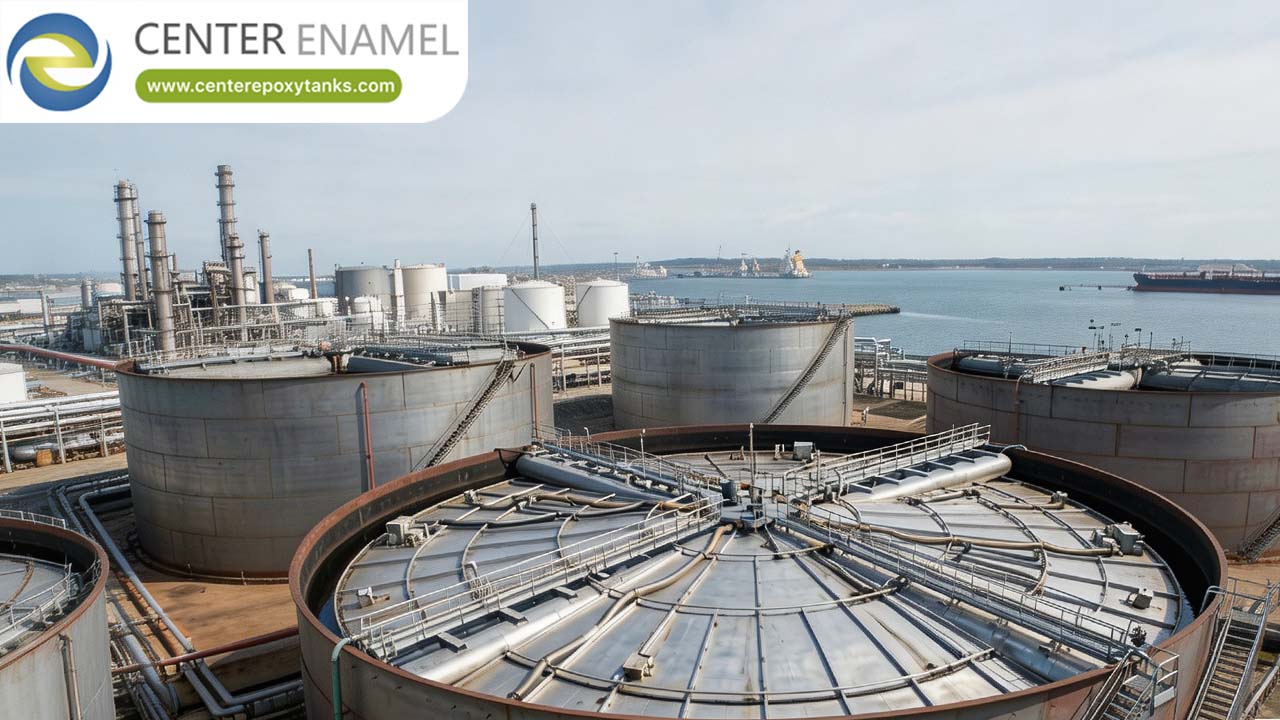
External Floating Roof Tanks (EFRTs): An EFRT features an open-top cylindrical steel shell. The heavy pontoon or double-deck roof sits directly on the liquid surface with no fixed protective covering above it, leaving the entire deck exposed to the open atmosphere.
·
2. Weather Exposure and Rainwater Management
·
Weather Resilience: Because an IFRT is enclosed by a fixed outer roof, rain, snow, debris, and solar radiation cannot reach the internal floating deck. Conversely, an EFRT is fully exposed to precipitation.
·
·
Drainage Systems: EFRTs require complex roof drainage infrastructure—including articulated rolling ladders, deck sumps, and flexible internal drain piping—to safely channel rainwater off the floating deck and prevent sinking hazards. IFRTs eliminate drainage requirements entirely since precipitation never enters the vessel.
·
3. Scale and Diameter Economics
·
Small-to-Medium Diameters (IFRT): IFRTs are typically constructed for small-to-moderate storage capacities where weather shielding and tight emission controls are paramount.
·
·
Massive Diameters (EFRT): As tank diameters exceed 60 to 80 meters, constructing a stable fixed outer roof becomes structurally or economically prohibitive. Consequently, the world's largest crude oil terminals overwhelmingly utilize EFRTs due to the economics of scale.
·
Data Table: Internal vs. External Floating Roof Tanks Technical Comparison
Technical Parameter | Internal Floating Roof Tank (IFRT) | External Floating Roof Tank (EFRT) |
Tank Top Architecture | Closed top (Fixed outer roof over floating deck) | Open top (Floating deck exposed to atmosphere) |
Weather Exposure | Fully protected by fixed outer roof | Fully exposed to rain, snow, and sunlight |
Drainage Requirements | None (Fixed roof blocks precipitation ingress) | Critical (Articulated drain pipes, sumps, and flexible hoses) |
VOC Emission Control | Superior dual-barrier containment | Effective, though wind shear can impact rim seals |
Maintenance Overhead | Lower (Sheltered deck environment minimizes wear) | Higher (Requires continuous drain and rim seal maintenance) |
Scale Suitability | Small to large-diameter bulk storage | Ultra-large-diameter crude oil tanks (>60m) |
Frequently Asked Questions (FAQ)
Q: Which tank type provides better environmental and VOC emission control?
A: Internal Floating Roof Tanks (IFRTs) generally offer superior emission stability. The combination of a floating deck and a fixed outer roof creates a dual-barrier system that prevents wind currents from stripping vapors past the rim seals.
Q: Why do external floating roof tanks carry a higher risk of roof sinking?
A: Because EFRTs have an open top, rainwater and snow pool directly on the floating deck. If the mechanical roof drains or flexible hoses clog or fail during a heavy storm, the accumulated water weight can cause the deck to tilt and sink.
Q: When should an engineering team choose an EFRT over an IFRT?
A: EFRTs are selected primarily for massive crude oil storage applications where tank diameters exceed 60 meters, making a fixed outer roof economically impractical, and in temperate climates with minimal heavy rainfall or snowfall.
Q: Do internal floating roofs require lightning protection systems?
A: While both types require standard grounding, EFRTs are more vulnerable to lightning-induced rim seal fires because any stray spark near an open-top vapor pocket can ignite flammable gases, whereas IFRTs enclose the vapor space beneath a grounded metal or aluminum dome.


