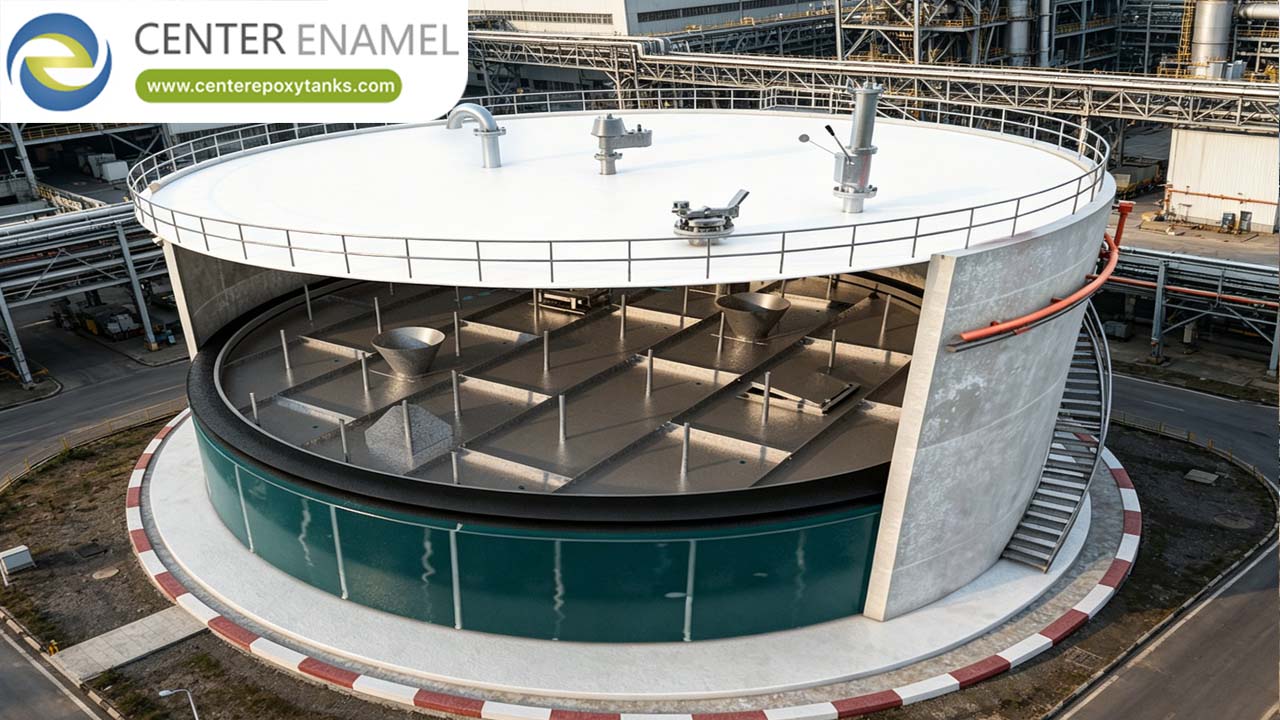
Floating Roof Design Standards: A Technical Guide to 2026 Compliance
In the 2026 industrial landscape, the design of floating roofs for atmospheric storage tanks is governed by rigorous international standards focused on three pillars: structural integrity, fire safety, and Environmental, Social, and Governance (ESG) compliance. For operators storing volatile hydrocarbons, adhering to these standards is a mechanical necessity to eliminate the air-liquid interface and reduce Volatile Organic Compound (VOC) emissions by up to 99%.
Shijiazhuang Zhengzhong Technology Co., Ltd (Center Enamel), with over 30 years of manufacturing excellence, engineers floating roof systems that exceed API 650 and AWWA requirements for global energy terminals.
1. Primary Global Standards for Floating Roofs
A. API 650 Appendix C: External Floating Roofs (EFR)
This standard governs the design of roofs exposed to the atmosphere.
● Buoyancy Requirement: The roof must remain buoyant with the primary deck and any two adjacent pontoon compartments punctured.
● Load Compliance: Must withstand specific rainfall and snow loads (typically 10 inches of rain in 24 hours) without sinking.
● Drainage: Mandatory primary and emergency drainage systems are required to prevent structural overloading.
B. API 650 Appendix H: Internal Floating Roofs (IFR)
This standard applies to floating decks inside fixed-roof tanks.
● Buoyancy Requirement: Must remain buoyant with two adjacent pontoons punctured (for pontoon types) or under specific puncture scenarios for full-contact decks.
● Vapor Suppression: Focuses on the "gas-tight" integrity of the rim seal and the minimization of penetrations.
● Material Types: Recognizes five distinct types, ranging from metallic pan-types to aluminum sandwich panels.
2. Technical Design Requirements Matrix
Feature | Standard Requirement | Strategic Operational Value |
Material Thickness | Minimum 4.76mm ($3/16$ in) for steel | Ensures structural longevity against corrosion. |
Rim Seal Gap | < 3.2mm ($1/8$ in) for primary seals | Critical for meeting 2026 zero-leakage VOC targets. |
Buoyancy Margin | Minimum 100% reserve buoyancy | Prevents sinking during product turbulence or leaks. |
Venting | Automatic bleeder vents | Prevents vacuum/over-pressure during initial fill/empty. |
3. 2026 Innovations in Design Standards
As global air quality regulations tighten, "standard" designs have evolved to include enhanced vapor recovery features:
● Zero-Penetration Decks: Modern designs minimize the number of support legs and guide poles that penetrate the deck, as each penetration is a potential source of vapor leakage.
● Secondary Seal Mandates: In many jurisdictions, the "Standard" now requires a secondary resilient seal to be installed above the primary shoe seal to achieve 99.9% vapor suppression.
● Aluminum Geodesic Dome Integration: While not always a code requirement, pairing an IFR with an Aluminum Geodesic Dome (per API 650 Appendix G) is the 2026 "Best Practice" for eliminating rainwater management and seal UV degradation.
4. Material Selection and Structural Analysis
Standards dictate that the choice of material must be compatible with the stored product.
● Carbon Steel: Standard for bulk crude oil (API 650 Appendix C).
● Aluminum Alloys: Preferred for refined products like gasoline and jet fuel due to lightweight buoyancy and corrosion resistance (API 650 Appendix H).
● Stainless Steel: Used for highly corrosive chemicals or "sour" crude environments.
Center Enamel utilizes Finite Element Analysis (FEA) to verify that every design meets site-specific seismic and wind load requirements, ensuring the roof does not "bind" or rotate during high-speed fill cycles.
5. Why Choose Center Enamel for Compliant Infrastructure?
Partnering with a premier manufacturer ensures that your storage assets are future-proofed against evolving regulations.
1. 30+ Years of Expertise: Proven track record in over 100 countries.
2. Turnkey Compliance: We provide the tank shell, the floating roof, and the dome cover as a single, technically compatible, and API-certified package.
3. Advanced Fabrication: Automated CNC production ensures that tolerances for seal gaps and pontoon integrity are met with surgical precision.
The Strategic Value of Design Standards
Adhering to floating roof design standards is a commitment to safety, profitability, and environmental protection. In 2026, a compliant roof is not just a lid; it is a precision instrument designed to protect your product's market value and your facility's operational license.
Ensure your storage infrastructure meets the highest global standards. Contact Center Enamel today for a technical consultation and an API-compliant floating roof quote.


