External Floating Roof Tank Design Standards: A Technical Guide for 2026
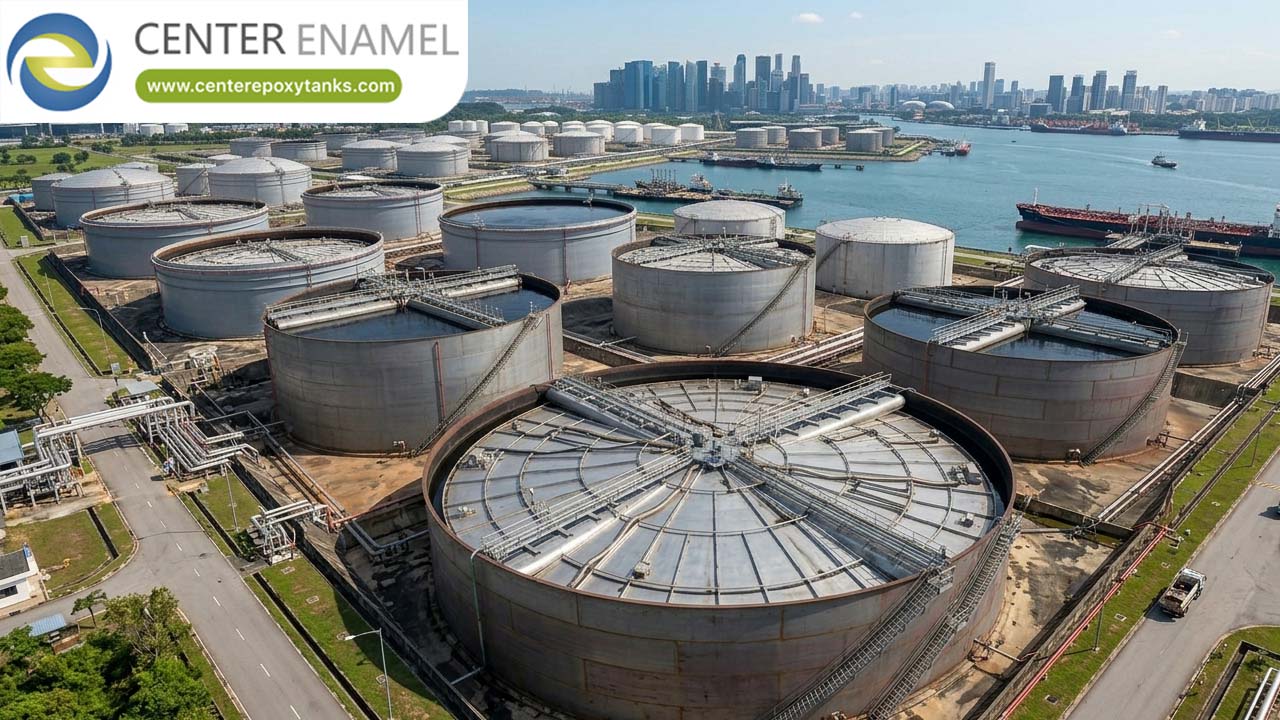
In the 2026 industrial landscape, the design of External Floating Roof (EFR) tanks is defined by high-capacity structural integrity and rigorous environmental protection. Designed for large-scale storage of crude oil and volatile hydrocarbons, the EFR eliminates the vapor space (ullage) by floating directly on the liquid surface. Because these roofs are exposed to the atmosphere, they must adhere to the world's most stringent engineering codes to survive extreme weather while maintaining near-zero emissions.
Shijiazhuang Zhengzhong Technology Co., Ltd (Center Enamel), with over 30 years of global expertise, engineers EFR systems that set the benchmark for API 650 and ESG (Environmental, Social, and Governance) compliance.
1. The Definitive Standard: API 650 Annex C
The primary global authority for EFR design is API Standard 650, Annex C (formerly Appendix C). This standard dictates the minimum requirements for materials, design, fabrication, and testing of floating roofs that are open to the atmosphere.
Core Design Benchmarks
Engineering Feature | Requirement (API 650 Annex C) | Strategic Operational Value |
Buoyancy Safety | Must float with deck and 2 adjacent pontoons punctured | Failsafe protection against localized structural damage. |
Environmental Load | Must withstand 250mm (10 in) of rain in 24 hours | Prevents sinking during extreme monsoon or storm events. |
Rim Seal Gap | < 3.2mm (1/8 in) for primary seals | Critical for meeting 2026 zero-leakage VOC mandates. |
Material Strength | Minimum 4.76mm (3/16 in) plate thickness | Ensures decades of service in corrosive environments. |
2. Technical Categories of EFR Design
API 650 Annex C recognizes two primary structural types for external floating roofs:
A. Single-Deck Pontoon Roofs
The industry standard for large tanks. It features a center deck made of steel plates, supported by a ring of air-tight pontoons around the perimeter. The deck is engineered to flex slightly to manage rainwater drainage.
B. Double-Deck Floating Roofs
Consists of two complete decks (top and bottom) separated by bulkheads.
● Superior Stability: Offers the highest level of structural rigidity and buoyancy.
● Thermal Insulation: The "dead air" space between decks prevents solar heat from causing product "boil-off," preserving the chemical integrity of light crudes.
3. Essential Mechanical Sub-Systems
To meet 2026 standards, an EFR must integrate specialized hardware to handle atmospheric exposure:
Advanced Drainage Systems
Because EFRs are open to rain, they must shed water rapidly. Standards require:
● Primary Drains: High-strength flexible hoses or articulated pipes with swivel joints.
● Emergency Overflows: To ensure that if the primary drain is blocked, the roof remains buoyant even during catastrophic rainfall.
Secondary Rim Seals
In the 2026 regulatory climate, a single primary seal is often insufficient. Most global standards now mandate a secondary resilient seal mounted above the primary shoe seal to achieve 99.9% vapor suppression.
Guide Poles and Anti-Rotation
Guide poles must be engineered to withstand wind-induced torque. These poles prevent the roof from rotating as it moves vertically, which is vital for the integrity of gauging systems and rolling ladders.
4. 2026 Innovations
● VOC Detection Integration: 2026 designs often include automated VOC sensors at the rim seal to provide real-time emission data.
● Aluminum Geodesic Dome Retrofitting: A significant trend for 2026 is the installation of an Aluminum Geodesic Dome (per API 650 Annex G) over existing EFRs. This effectively converts the EFR into an Internal Floating Roof (IFR) environment, eliminating rainwater management issues and reducing maintenance costs by up to 60%.
5. Why Partner with Center Enamel?
Selecting a manufacturer that masters the complexities of API 650 Annex C is essential for long-term terminal security.
● 30+ Years of Excellence: Proven reliability across 100+ countries.
● Precision CNC Fabrication: Automated production ensures that pontoon compartments are hermetically sealed and shell-to-seal tolerances are surgically accurate.
● Turnkey Support: Center Enamel provides the tank shell, the EFR deck, and the seal systems as a unified, technically compatible, and API-certified package.
The Strategic Value of EFR Standards
Adhering to external floating roof tank design standards is a commitment to asset protection and environmental stewardship. By implementing API-compliant EFR technology, operators ensure their infrastructure is robust enough to survive extreme climate events while satisfying the rigorous environmental transparency of the future.
Future-proof your storage operations today. Contact Center Enamel for a technical consultation and an API-compliant project quote.


