Internal Floating Roof Tank Design Standards: A Technical Guide for 2026
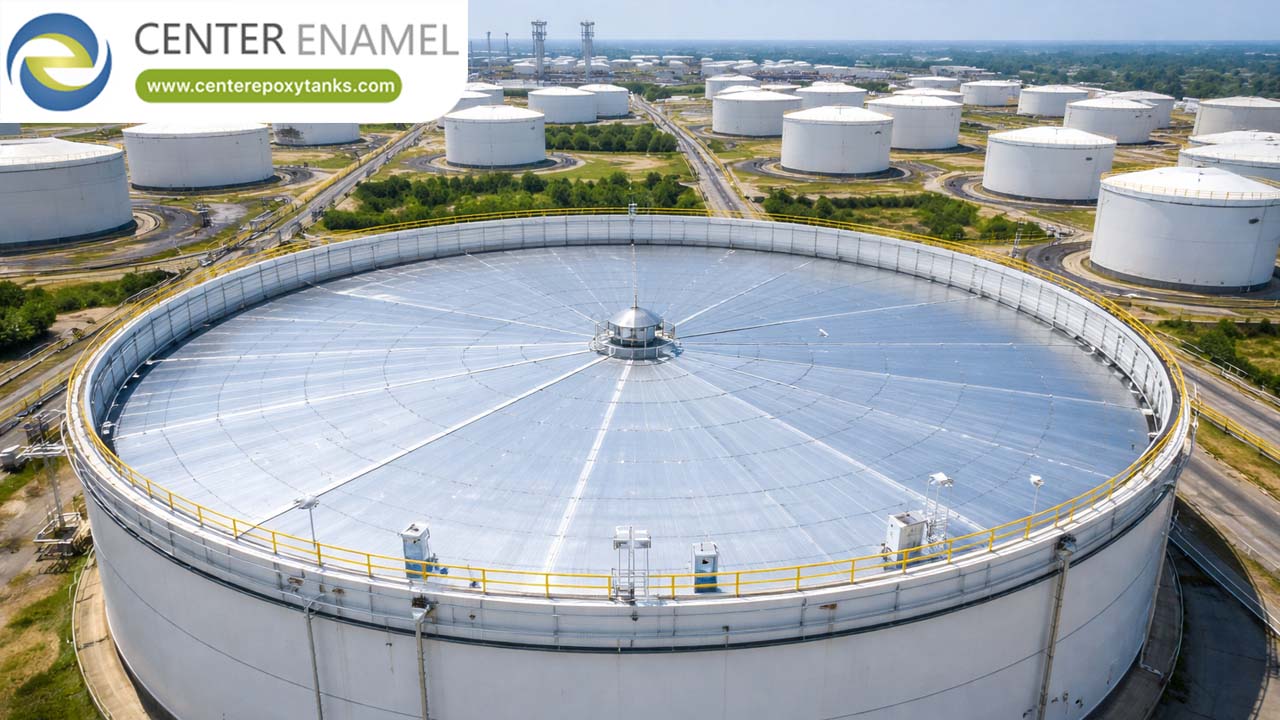
In the 2026 industrial landscape, the design of Internal Floating Roof (IFR) tanks is governed by a focus on structural safety and near-zero emission targets. For facilities storing volatile hydrocarbons, the IFR is the definitive engineering solution to eliminate the air-liquid interface, reducing Volatile Organic Compound (VOC) emissions by up to 99%.
Shijiazhuang Zhengzhong Technology Co., Ltd (Center Enamel), with over 30 years of global expertise, engineers IFR systems that exceed international safety and environmental mandates.
1. The Definitive Standard: API 650 Annex H
The primary global authority for IFR design is API Standard 650, Annex H (formerly Appendix H). This standard provides the minimum requirements for materials, design, fabrication, and testing of internal floating covers.
Core Design Requirements
Engineering Feature | Requirement (API 650 Annex H) | Purpose |
Buoyancy Margin | Minimum 100% Reserve Buoyancy | Prevents sinking during product turbulence. |
Puncture Redundancy | Must float with 2 adjacent compartments breached | Ensures failsafe integrity in case of localized leaks. |
Seal Gap Tolerance | < 3.2mm (1/8 in) for primary seals | Minimizes vapor escape to meet 2026 air quality rules. |
Material Thickness | Minimum 4.76mm (3/16 in) for steel parts | Ensures structural resilience against corrosion. |
2. Types of Compliant IFR Designs
Designers must select a configuration based on the chemical profile of the stored product and the tank diameter:
1. Skin and Pontoon (Non-Contact): A lightweight aluminum or stainless steel frame with a skin of thin sheeting supported by tubular pontoons. This is the most common design for standard fuel storage.
2. Full-Contact Honeycomb: Constructed from high-strength aluminum sandwich panels. Because there is zero vapor space beneath the deck, it offers the highest level of emission control.
3. Metallic Bulkhead (Pan-Type): A heavy-duty steel design used in extreme industrial environments where chemical aggression or high temperatures prevent the use of aluminum.
3. Critical Mechanical Ancillaries
To meet 2026 standards, the IFR must integrate specialized hardware to ensure smooth operation:
Rim Seal Systems
The seal is the most critical barrier for VOC mitigation.
● Primary Seals: Typically mechanical shoe or liquid-mounted resilient seals.
● Secondary Seals: Often mandated in 2026 to achieve "AIO-compliant" environmental standards by providing a secondary gas-tight barrier.
Anti-Rotation and Guide Poles
To prevent the roof from rotating or "binding" against the shell, guide poles (often doubling as sampling ports) or anti-rotation cables must be installed. These must be designed to withstand the torque generated during high-speed fill cycles.
Automatic Bleeder Vents
These vents allow air to escape when the tank is first filled and prevent a vacuum scenario when the tank is emptied, ensuring the roof "lands" safely on its support legs.
4. 2026 ESG and Environmental Compliance
● Vapor Suppression Verification: 2026 standards require verified data on emission reductions, often favoring Full-Contact designs for gasoline and light crude.
● Aluminum Geodesic Dome Synergy: A 2026 "Best Practice" is pairing an IFR with an Aluminum Geodesic Dome. This configuration eliminates rainwater management issues and protects the IFR seals from UV degradation, extending the maintenance cycle by up to 50%.
5. Why Partner with Center Enamel?
Selecting a manufacturer that understands the nuances of API 650 Annex H is vital for long-term asset security.
● 30+ Years of Manufacturing: Proven reliability in over 100 countries.
● Precision Fabrication: Automated CNC production ensures that every component meets the tight tolerances required for seal integrity.
● Turnkey Engineering: Center Enamel provides the tank shell (GFS or FBE Bolted), the Internal Floating Roof, and the Aluminum Dome as a single, technically compatible ecosystem.
The Strategic Value of Design Standards
Adhering to internal floating roof tank design standards is a commitment to safety, profitability, and environmental protection. By implementing API-compliant IFR technology, operators ensure their infrastructure is safe, efficient, and ready for the rigorous environmental transparency of the future.
Future-proof your storage operations today. Contact Center Enamel for a technical consultation and an API-compliant project quote.


