Fixed Roof Tanks: Design, Operation, and Safety Considerations
In the global industrial bulk liquid storage sector, selecting the correct vessel architecture is critical for safety, capital efficiency, and operational reliability. A fixed roof tank is an atmospheric storage vessel featuring a permanently attached roof structure welded or bolted directly to the top of the cylindrical tank shell.
Unlike floating roof tanks that utilize a movable deck resting directly on the liquid, a fixed-roof tank maintains a permanent air space (ullage) between the liquid surface and the roof. Built in strict accordance with international design standards such as API 650 and EN 14015, fixed-roof tanks are the industry standard for containing low-volatility liquids, water, and industrial chemicals.
1. Structural Design and Roof Configurations
Fixed-roof tanks are classified primarily by the geometric design and internal support structure of their roofs:
·
Supported Cone Roofs: Featuring a sloped, conical geometry, supported cone roofs rely on internal structural rafters, girders, and center support columns to bear snow, wind, and dead loads on larger diameters. They are widely used for large crude oil settling tanks and heavy fuel oil storage.
·
·
Self-Supporting Cone Roofs: Designed with a self-supporting edge shell connection, these cone roofs eliminate internal columns for smaller-to-medium tank diameters, making them ideal for municipal water and wastewater containment.
·
·
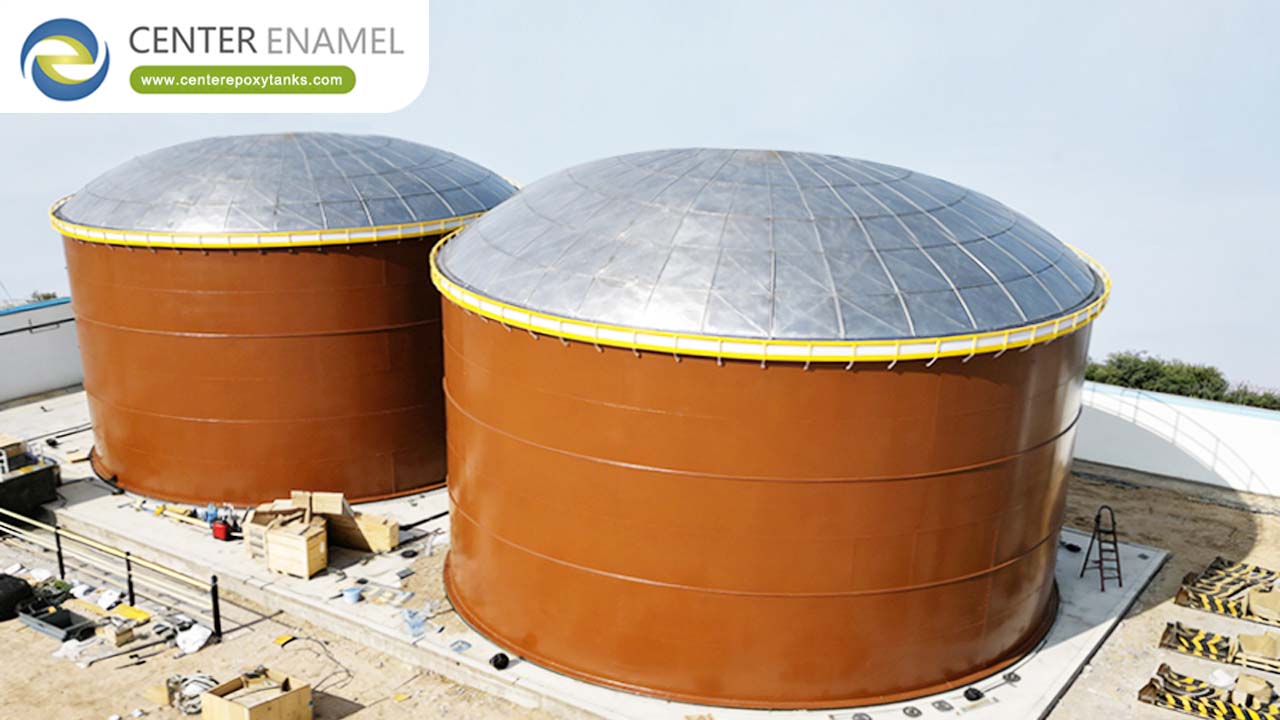
Geodesic Aluminum Dome Roofs: Fabricated from corrosion-resistant structural aluminum alloys, geodesic domes provide a curved, self-supporting geometry that completely eliminates internal support columns and internal painting requirements, making them ideal for modern chemical and water processing.
·
2. Operational Mechanics and Vapor Space Management
The operational behavior of a fixed-roof tank is defined by its permanent headspace (ullage):
·
Breathing Losses (Thermal Expansion): As ambient temperatures fluctuate between day and night, the vapor space inside the tank expands and contracts. This diurnal cycle forces hydrocarbon-laden air out of the tank vents, creating evaporative losses.
·
·
Working Losses (Filling and Emptying): When liquid is pumped into the tank, the rising fluid level compresses the headspace, expelling saturated vapors. Conversely, draining the tank draws in fresh ambient air that saturates with product vapors.
·
·
Fluid Suitability: Due to vapor space expansion, fixed-roof tanks are restricted to storing low-volatility liquids (such as water, diesel, heavy fuel oils, lubricants, and bitumen) where vapor pressure remains minimal.
·
Data Table: Fixed-Roof Tank Design Matrix
Roof Geometry Type | Internal Support Structure | Primary Rainwater Drainage | Typical Industrial Application |
Supported Cone Roof | Rafters, girders, and center columns | Natural gravity slope toward shell rim | Large crude oil settling tanks, heavy fuel oil storage |
Self-Supporting Cone Roof | Self-supporting edge shell connection | Natural gravity slope toward shell rim | Small-to-medium industrial water and chemical tanks |
Geodesic Dome Roof | Clear-span structural aluminum space frame | Sloped curvature sheds precipitation outward | Chemical processing, modern bulk liquid terminals |
Flat Roof | Heavy structural steel beam grid | Requires perimeter drainage or overflow | Low-pressure industrial silos and specific process vessels |
3. Safety Considerations and Compliance Protocols
Operating fixed-roof storage vessels requires rigorous adherence to industrial safety standards to prevent structural failure, overpressure, and fire hazards:
·
Pressure and Vacuum Relief Valves (PVRVs): Because fixed-roof tanks operate at near-atmospheric pressures, PVRVs must be installed on the roof to protect the shell-to-roof junction from over-pressurization during rapid filling or vacuum collapse during fast pump-outs.
·
·
Emergency Venting: In the event of an external pool fire adjacent to the tank, emergency vents (such as frangible roof-to-shell welds or secondary hatches) provide rapid pressure release to prevent catastrophic tank rupture.
·
·
Lightning Grounding Systems: Fixed-roof tanks storing flammable or combustible liquids must be equipped with certified electrical grounding systems to dissipate static electricity and lightning strikes safely.
·
Frequently Asked Questions (FAQ)
Q: What is the primary purpose of a fixed-roof tank?
A: The primary purpose of a fixed-roof tank is to provide a cost-effective, secure containment vessel for storing low-volatility liquids, water, heavy fuel oils, and industrial chemicals where floating roofs are unnecessary.
Q: How do fixed-roof tanks manage thermal expansion and breathing losses?
A: Fixed-roof tanks use pressure-vacuum relief valves (PVRVs) mounted on the roof. For products with higher environmental requirements, facilities pair fixed roofs with Vapor Recovery Units (VRUs) or convert them into internal floating roof tanks.
Q: What is the difference between a cone roof and a geodesic dome roof?
A: A cone roof features a sloped, conical shape that often requires internal support columns for larger diameters. A geodesic dome features a curved, self-supporting geometry made of structural aluminum that requires zero internal support columns and offers superior corrosion resistance.
Q: Can a fixed-roof tank be retrofitted into a floating-roof tank?
A: Yes. Many industrial facilities perform cost-effective retrofits by installing an internal floating deck inside an existing fixed-roof tank shell, creating an internal floating roof tank (IFRT) to improve VOC emission compliance without building a new vessel.


