FBE vs. Fiberglass (FRP) Tanks: Engineering & Selection Guide
For engineers and procurement managers, the choice between Fusion-Bonded Epoxy (FBE) Bolted Tanks and Fiberglass (FRP/GRP) Tanks is a choice between two distinct material philosophies: High-Strength Structural Steel and Composite Polymer Matrix. While fiberglass is known for its non-metallic corrosion resistance, FBE technology has become the global industrial standard for large-scale municipal, industrial, and wastewater applications where structural predictability and lifetime reliability are required.
1. Technical Mechanics: Comparing Structures
The fundamental difference lies in the material architecture. FBE tanks leverage the mechanical strength of steel, while fiberglass (FRP) relies on the chemical properties of a resin matrix.
Fusion-Bonded Epoxy (FBE) Bolted Tanks
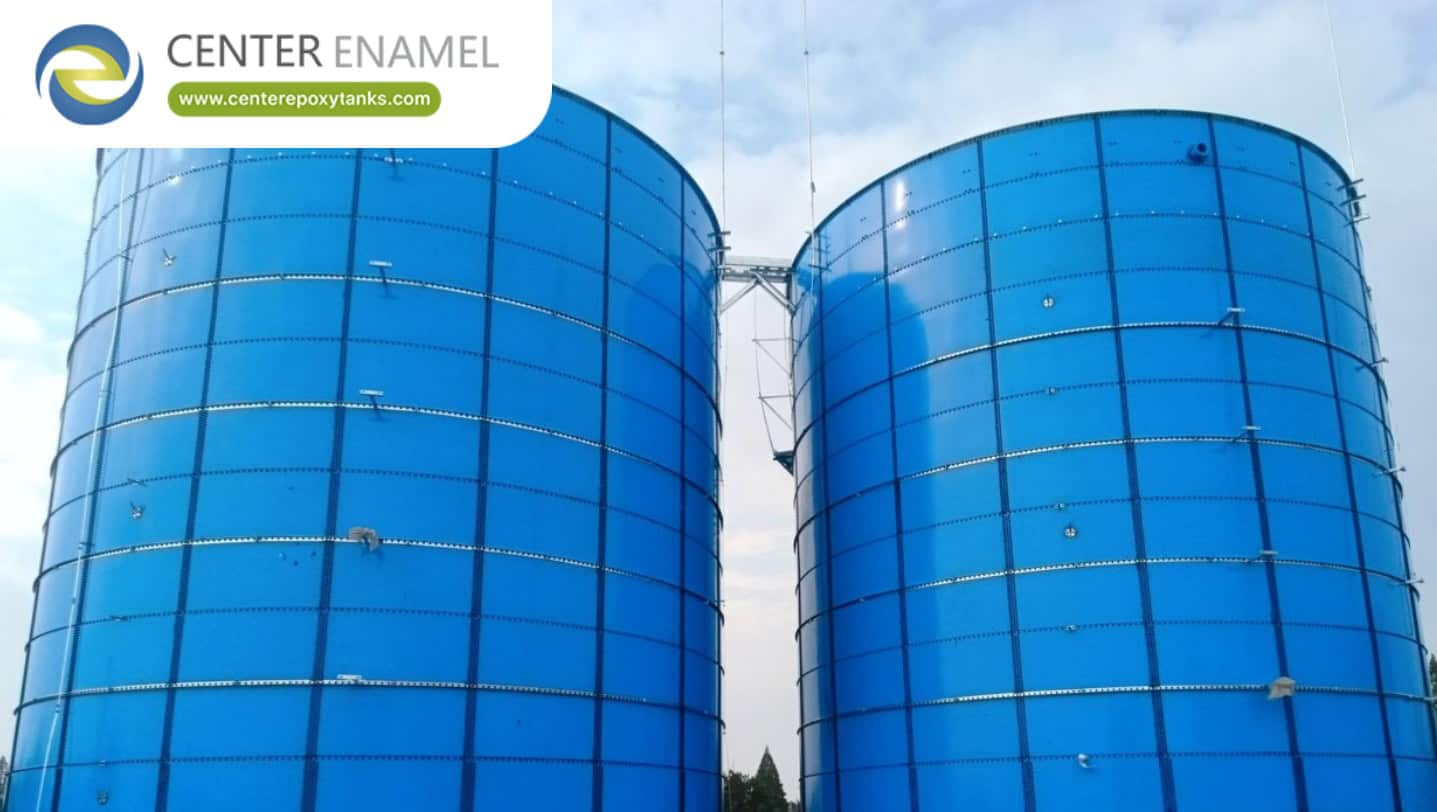
FBE tanks utilize high-strength structural carbon steel panels that are grit-blasted and coated with a factory-applied, thermoset polymer.
● Structural Integrity: The steel core provides the rigidity required to resist wind, seismic loads, and hydrostatic pressure, regardless of the tank's size.
● Scalability: Engineered for a wide range of volumes, from compact industrial vessels to massive municipal reservoirs (thousands of cubic meters).
Fiberglass (FRP) Tanks
FRP tanks are manufactured using a matrix of glass fibers embedded in a resin (plastic) binder.
● Structural Integrity: As a composite material, structural strength depends entirely on the thickness of the laminate and the quality of the resin-fiber bond.
● Scalability: Generally limited for large-scale applications; as size increases, fiberglass tanks often require significantly thicker walls or external reinforcement, which can lead to exponential cost increases and material handling challenges.
2. Comparison Matrix: At a Glance
Feature | FBE Bolted Tank | Fiberglass (FRP/GRP) Tank |
Primary Strength | Structural Rigidity (Steel Core) | Chemical Inertness (Composite) |
Max Capacity | Unlimited (Modular expansion) | Limited (Structural constraints) |
Chemical Range | Excellent (pH 3–13) | Very High (Customizable resin) |
Thermal Range | Excellent (Stable up to ~80°C) | Moderate (Risk of resin degradation) |
Structural Reliability | High (Predictable steel properties) | Variable (Risk of delamination) |
UV Resistance | High (Formulated for outdoors) | Moderate (Requires specialized gel-coat) |
3. Critical Engineering Considerations
Structural Certainty vs. Material Specificity
● The Fiberglass Case: Fiberglass is a valid solution for highly specific, corrosive environments (e.g., concentrated acids or alkalis) where epoxy might be compromised. However, this comes at the cost of structural predictability. Fiberglass can suffer from "creep" (deformation over time) or brittleness if not engineered perfectly.
● The FBE Case: FBE is the industry "workhorse." It provides the chemical resistance required for 90% of industrial and municipal applications (wastewater, biogas, water storage) while providing the structural certainty of steel. FBE tanks do not deform under load, and their modular bolted design makes them significantly easier to ship and install globally.
Total Cost of Ownership (TCO)
Procurement often favors fiberglass for its corrosion-proof nature, but this is often short-sighted. Fiberglass tanks are difficult to transport (often requiring wide-load shipping), sensitive to UV degradation without expensive coatings, and harder to repair if damaged. FBE tanks arrive as containerized panels, reducing logistics costs, and are backed by factory-verified, spark-tested quality assurance.
4. Frequently Asked Questions (FAQ)
Q: Which is better for large-capacity storage?
A: FBE bolted tanks are superior for large-capacity storage. Because they use a structural steel core, they do not face the same wall-thickness and mechanical stability limits that fiberglass composite tanks face as they scale in size.
Q: Are fiberglass tanks immune to all corrosion?
A: Not necessarily. Fiberglass is non-metallic, so it doesn't rust. However, it can suffer from "osmotic blistering" or resin degradation if exposed to sunlight, chemicals, or temperature cycles that the specific resin system wasn't designed for.
Q: Can FBE tanks handle the same chemicals as fiberglass?
A: Fiberglass can be formulated with exotic resins for extreme chemical resistance that FBE cannot match. However, for standard industrial effluent, water treatment, and agricultural storage, FBE provides equal performance at a significantly lower cost.
Engineering Certainty for Your Infrastructure
When comparing containment systems, you must balance chemical needs with structural requirements. For large-scale projects, storage systems must be able to withstand environmental and load stresses without deforming. FBE technology provides the structural certainty and factory-verified quality that composite fiberglass systems often struggle to maintain at scale.
Are you currently evaluating containment options for a specific chemical process, or would you like to review our structural data sheets for your required tank volume?


