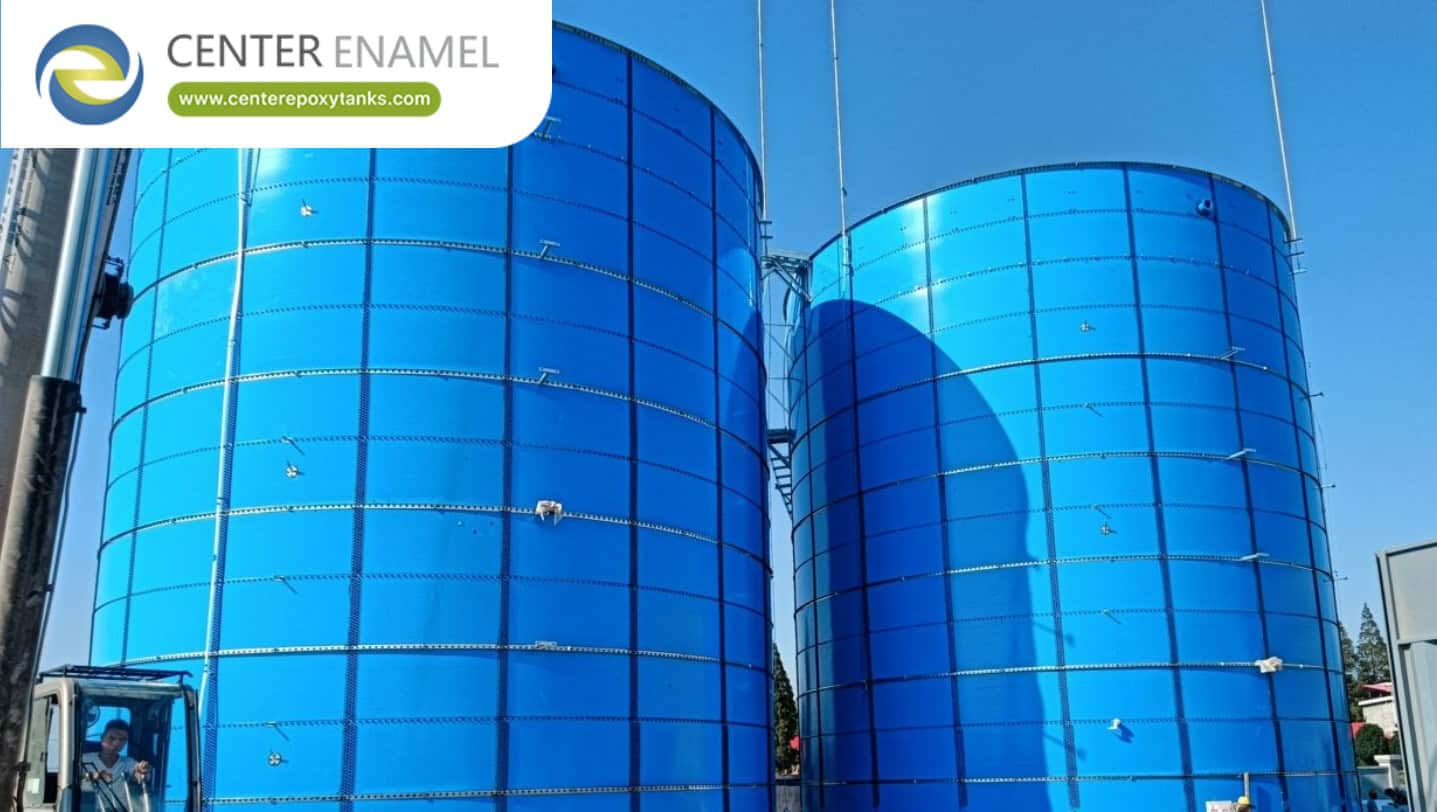
FBE vs. FRP Tanks: Engineering & Selection Guide
For project managers and structural engineers, the choice between Fusion-Bonded Epoxy (FBE) Bolted Tanks and Fiber-Reinforced Plastic (FRP) Tanks represents a decision between two distinct material philosophies: "High-Strength Steel Core" versus "Composite Polymer Matrix." While FRP is often selected for specific high-corrosion chemical environments, FBE technology has become the industry benchmark for general industrial, municipal, and wastewater applications due to its predictable structural performance, superior mechanical strength, and lifecycle value.
1. Technical Overview: Defining the Technologies
Fusion-Bonded Epoxy (FBE) Tanks
FBE tanks utilize a structural carbon steel substrate that is grit-blasted and coated with a factory-applied, thermoset polymer. This process creates a rigid, high-strength vessel. The steel core provides the necessary structural rigidity to resist environmental loads (wind, snow, seismic), while the FBE coating provides the chemically inert barrier against corrosion.
Fiber-Reinforced Plastic (FRP) Tanks
FRP tanks are manufactured using a matrix of glass fibers embedded in a resin (plastic) binder. These tanks are composite structures. They are inherently non-corrosive, meaning they do not "rust" in the traditional sense, but their structural integrity relies on the quality of the resin-fiber bond and the thickness of the composite wall.
2. Comparison Matrix: At a Glance
Feature | Fusion-Bonded Epoxy (FBE) | Fiber-Reinforced Plastic (FRP) |
Substrate | Structural Carbon Steel | Fiberglass & Resin Matrix |
Structural Integrity | Rigid (Steel-grade strength) | Composite (Varies by resin/layer) |
Chemical Resistance | Excellent (pH 3–13) | Varies by Resin (Customizable) |
UV Stability | High (Factory-cured coating) | Moderate (Requires Gel-coat) |
Quality Control | High (Factory Spark/Holiday test) | Moderate (Hand-layup/variability) |
Installation | Modular (Bolted assembly) | Often Monolithic or Sectional |
3. Engineering Trade-offs: Why FBE Often Wins
While FRP is a specialized solution for handling specific concentrated acids, FBE is the superior "generalist" industrial solution for the following reasons:
● Structural Reliability: FBE tanks offer the predictable engineering properties of steel. FRP is susceptible to "creep" (deformation under sustained load) and can be brittle if the resin matrix is compromised, especially in colder climates.
● Quality Assurance: FBE panels are manufactured in a climate-controlled factory where every square inch is spark-tested for electrical discontinuities (holidays). FRP production is often more variable, depending heavily on the skill of the laminator or the precision of the filament winding process.
● UV and Weathering: In outdoor applications, FRP surfaces can chalk and degrade under direct sunlight without expensive, maintenance-intensive gel-coat applications. FBE coatings are engineered specifically for outdoor industrial environments, maintaining their integrity for decades.
● Modularity & Cost: FBE tanks are designed to be containerized and shipped anywhere in the world. Their modular design allows for rapid assembly. Large FRP tanks, due to their size and sensitivity to transport damage, often face higher logistical and shipping costs.
4. Frequently Asked Questions (FAQ)
Q: Is FRP better for chemical storage?
A: FRP can be superior only if you are storing highly specialized, concentrated chemicals (e.g., concentrated sulfuric acid) that would compromise an epoxy coating. For standard municipal wastewater, fire protection, and industrial effluent, FBE provides equal or better performance at a much lower cost.
Q: Does FRP "rot" or degrade over time?
A: FRP does not rust like steel, but it can suffer from "osmotic blistering" or delamination of the resin-fiber layers if the manufacturing quality is poor or if the material is exposed to harsh UV for extended periods.
Q: Can FBE tanks handle the same pressures as FRP?
A: Because FBE tanks are built on a steel substrate, they typically offer higher mechanical stability and load-bearing capacity than standard FRP tanks, which may require significant wall-thickness increases to handle the same hydrostatic pressures.
Q: Which is more sustainable?
A: FBE tanks are built on a steel core, which is globally recognized as the most recycled material on earth. FRP is a composite material that is notoriously difficult to recycle at the end of its service life.
Engineering Certainty for Your Project
Your tank selection should be based on your process profile, not just material trends. If your storage requirement is for municipal water, industrial treatment, or general liquid storage, FBE technology provides the best balance of structural certainty, factory-verified quality, and long-term economic value.
Are you currently weighing the structural benefits of FBE versus the chemical-specific nature of FRP, or would you like to review the technical data sheets for a specific application?


