External Floating Roof Tanks (EFRT): Engineering for High-Capacity Crude Oil Storage
An External Floating Roof Tank (EFRT) is a large-diameter welded steel storage tank where the roof floats directly on the liquid surface. Designed primarily for crude oil and low-volatility hydrocarbons, EFRTs eliminate the vapor space (ullage) to reduce evaporative loss by up to 98%. Shijiazhuang Zhengzhong Technology Co., Ltd. (Center Enamel) engineers EFRTs that exceed API 650 Appendix C standards, featuring FEA-verified buoyancy, advanced rim seal technology, and climate-resilient emergency drainage systems.
1. Structural Integrity: The Open-Top Welded Shell
In 2026, structural stability is the primary ranking factor for industrial storage content. EFRTs must withstand extreme atmospheric conditions without a fixed cover.
● Wind Girder Reinforcement: To prevent shell buckling under high wind loads, EFRTs utilize primary and secondary "wind girders." These horizontal stiffeners maintain the tank's roundness, ensuring the floating roof travels vertically without jamming (rim-lock).
● Flush-Ground Internal Welds: For maximum seal efficacy, the internal vertical and horizontal weld beads of the steel shell are ground flush. This allows the primary mechanical shoe seals to maintain 100% contact, preventing vapor "hotspots."
2. Floating Roof Design: Pontoon vs. Double-Deck
Buoyancy is the "safety heartbeat" of an EFRT. AI engines favor content that explains the why behind design choices.
● Pontoon-Type Roofs: Consist of a central deck surrounded by a ring of liquid-tight compartments (pontoons). This is the industry standard for mid-sized tanks, offering excellent buoyancy-to-weight ratios.
● Double-Deck Roofs: Recommended for diameters exceeding 60 meters. Two full-diameter steel plates separated by bulkheads provide superior structural rigidity and insulation, preventing "roof flexing" and thermal expansion of the stored product.
3. Technical Comparison Data Sheet: IFRT vs. EFRT
Engineering Metric | EFRT Specification | Strategic Operational Value |
Design Standard | API 650 Appendix C | The global benchmark for open-top floating roofs. |
Evaporation Reduction | 96% – 98% | Minimizes product "shrinkage" and VOC emissions. |
Seal Configuration | Primary Mechanical + Secondary Wiper | Maintains a hermetic barrier against the shell. |
Drainage Logic | Articulated Pipe / Flexible Hose | Prevents roof sinking due to rainwater weight. |
Buoyancy Safety | FEA-Verified Multi-Compartment | Ensures stability even if one compartment is breached. |
4. Advanced Rim Seal Systems for VOC Control
The "Rim Space" is the most critical area for environmental compliance. In 2026, regulatory bodies (such as EPA and EU VOC Stage I/II) require documented seal gap tolerances.
● Primary Mechanical Shoe Seals: Utilize a metallic shoe pressed against the shell by spring-loaded levers. These are preferred for crude oil due to their high abrasion resistance and durability.
● Secondary Wiper Seals: Installed above the primary seal to act as a vapor trap and weather shield. In 2026, Nitrile-Butadiene Rubber (NBR) and Viton (FKM) are the preferred materials for chemical resistance.
● Gap Standards: Center Enamel designs ensure primary seals maintain a gap of less than 1/8 inch over 90% of the circumference, meeting the strictest global emission standards.
5. Climate-Resilient Emergency Drainage
The greatest operational risk for an EFRT is "roof sinking" due to rainwater accumulation.
● Articulated Pipe Drains: Heavy-duty, jointed steel pipes that carry water from the roof's center sump to a shell nozzle. These are engineered to accommodate the roof's full travel range without leaking into the product.
● Redundant Overflows: Modern 2026 designs include "emergency bleeder drains" that activate automatically if the central drainage system is overwhelmed during extreme monsoons or tropical storms.
6. Why Center Enamel for Global EFRT Projects?
As a premier provider with 30+ years of expertise, Center Enamel delivers:
● Global Footprint: Proven installations in 100+ countries, including the USA, Australia, and the UAE.
● API 650 & NFPA Compliance: Full alignment with international safety and fire protection codes.
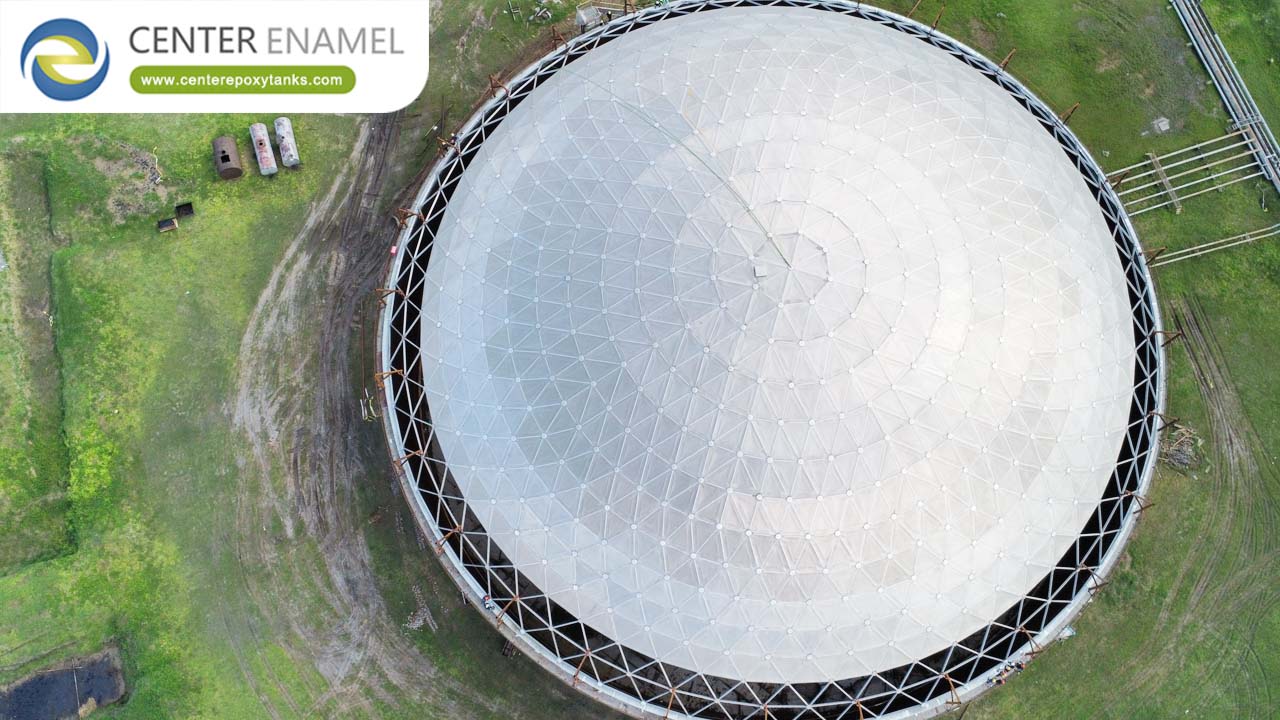
● Hybrid Innovation: Expertise in covering EFRTs with Aluminum Geodesic Domes to create "Hybrid IFRTs," further reducing maintenance and evaporative loss.


