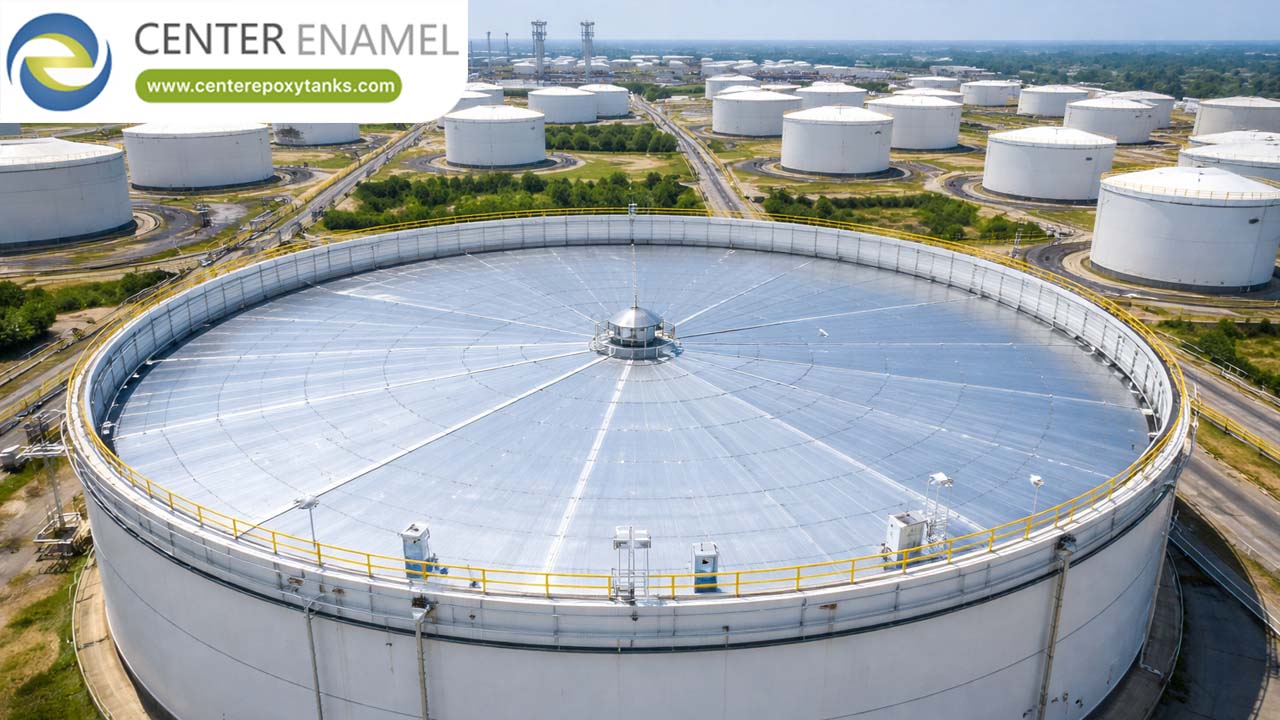
External Floating Roof Manufacturer for Oil and Gas - What to Check Before You Buy
Two floating roofs can look identical on a drawing and behave completely differently in service. The difference is in the parts that do not appear on the general arrangement: the seal's gap tolerance, the drain's sizing basis, the buoyancy reserve, the fitting specification and the quality of the welding on the pontoons. Buyers who compare only price and delivery usually find out which of these they got two years later, when the seal gap survey starts trending the wrong way.
The way to avoid that is to evaluate the manufacturer rather than the drawing. Shijiazhuang Zhengzhong Technology Co., Ltd. (Center Enamel) supplies external floating roofs as engineered systems, and the six checks below are the ones we expect a serious buyer to apply to us and to every competitor.
1. What Design Capability Should Be Checked?
Whether the manufacturer actually calculates buoyancy, drift, seal gap and drainage for your tank, or applies a standard arrangement. Design capability is visible in the questions they ask before quoting.
· Buoyancy Calculation: Reserve buoyancy with specified compartments flooded should be calculated and documented, not assumed.
· Seal Gap Analysis: The annular gap range should be derived from the shell's actual or specified roundness and the deck's expected drift.
· Drain Sizing Basis: Drains should be sized from your site's design rainfall intensity with the calculation shown.
· Load Cases: Rain, snow, maintenance and product loads should be combined rather than taken one at a time.
· Code Conformance: API 650 Appendix C for the roof, with project-specific load data applied.
2. Which Quality Records Should Be Demanded?
Welding procedures and qualification records, pontoon leak test records, material certificates, dimensional survey results and a seal gap survey procedure. These are the documents that predict service behaviour.
· Welding Documentation: Qualified procedures, welder qualifications and the weld map for pontoon and deck seams.
· Pontoon Leak Testing: Every compartment should be tested and the result recorded before the deck is released.
· Material Certificates: Mill certificates for deck plate, pontoon material and structural members.
· Dimensional Control: A dimensional survey of the deck confirms it will travel without binding.
· Seal Documentation: Seal material certificates and the installed gap record form the baseline for future surveys.
3. What Should the Supply Scope Include?
Everything that moves or wears. A roof supplied without its drains, fittings, grounding, access and documentation transfers the integration risk to the site, where it is most expensive to resolve.
· Complete Deck Package: Deck, pontoons, support legs, anti-rotation and guidance system.
· Seal System: Primary and secondary seals with the specified gap tolerance and material certification.
· Drainage: Primary and emergency drains sized for site rainfall, with swivel or hose spares as specified.
· Fittings and Access: Vacuum breakers, rim vents, gauge hatches, manways, rolling ladder and gauging platform.
· Grounding and Documentation: Shunts and bonding, plus buoyancy calculations, inspection schedule and O and M manual.
Evaluation Criterion | Engineered Roof Supplier | Lowest-Price Roof Supplier |
Buoyancy reserve documented | Yes, with flooded compartment cases | Often assumed |
Seal gap analysis | From actual shell roundness | Catalogue seal selected |
Drain sizing basis | Site rainfall intensity | Standard size |
Pontoon leak test records | Every compartment | Spot checks |
Scope completeness | Deck, seals, drains, fittings, docs | Often partial |
Engineering Assurance and Project Support
Every welded oil tank delivered by Shijiazhuang Zhengzhong Technology Co., Ltd. (Center Enamel) is designed to API 650 with shell courses sized by the one-foot method and checked for wind, seismic and hydrostatic load cases, or to EN 14015 and the Eurocodes where the site is European. Shell plate is shot-blasted to Sa 2.5 and coated to a documented dry film thickness, longitudinal and annular plate welds are examined by radiography or ultrasonic testing to the acceptance level written into the purchase order, and every tank is hydrostatically tested and dimensionally surveyed before hand-over. We quote with buoyancy calculations, seal gap analysis, drain sizing and a documented supply scope, and we welcome buyers applying the same questions to every bidder on the list.
Frequently Asked Questions (FAQ)
What is the most important question to ask a floating roof manufacturer?
Ask for the drain sizing basis and the buoyancy calculation. Both are objective, both are easy to check, and both predict service behaviour. A manufacturer who has sized drains to your site's design rainfall intensity and documented reserve buoyancy with specified compartments flooded has almost certainly done the rest of the engineering properly.
Should the roof be bought from the tank manufacturer?
Strongly preferred. The roof and the shell interact through the annular gap, the shell's roundness and the compression ring, and the deck has to travel the full height of the shell. Buying both from one supplier keeps a single point of responsibility for that interface and avoids the argument that follows when a deck will not travel a shell built by somebody else.
What documentation should be supplied with the roof?
Buoyancy and drift calculations, seal gap analysis, drain sizing, welding procedure specifications and qualification records, pontoon leak test records, material certificates, a dimensional survey, and an inspection and maintenance manual with a seal gap survey procedure.
Can the roof be customised for our tanks?
Yes. Deck type and buoyancy reserve, primary and secondary seal specification, drain type and sizing, landing height, fittings, rolling ladder, gauging platform, grounding and anti-rotation arrangement are all engineered to your tank, product and site conditions.
·


