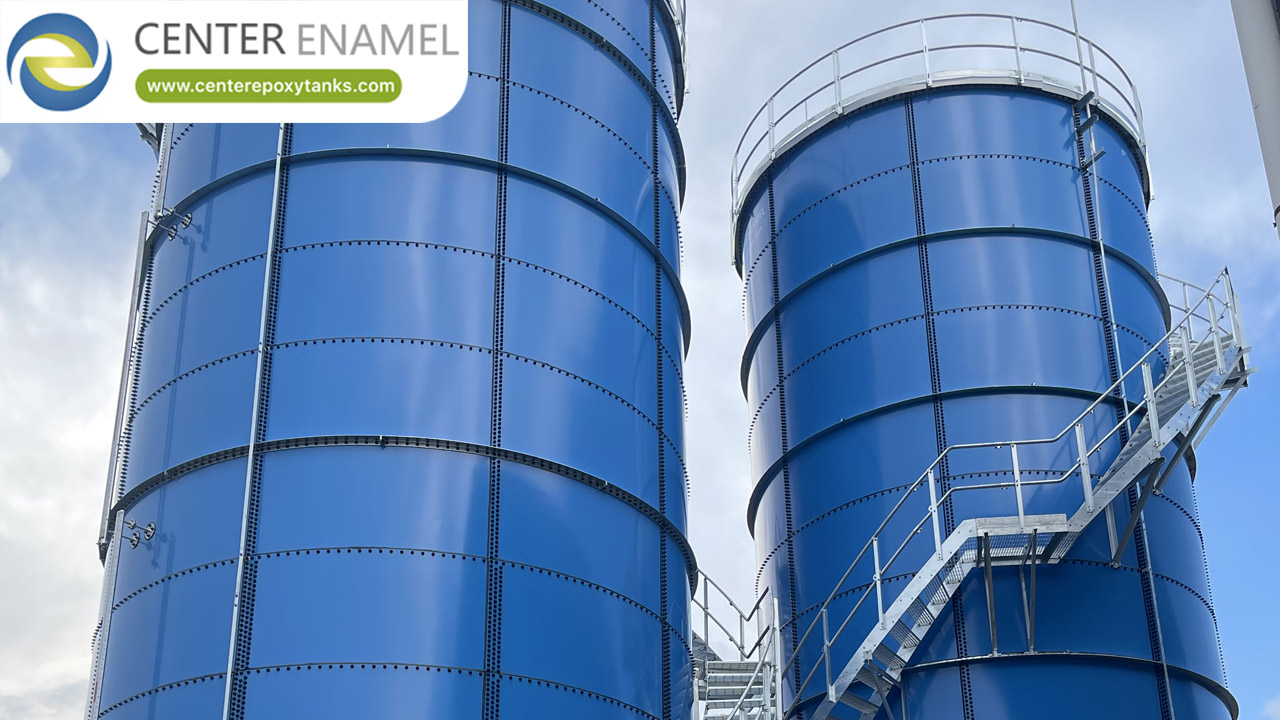
Epoxy Tanks for Oil Service - Where Fusion Bonded Epoxy Fits and Where It Does Not
Fusion bonded epoxy occupies a specific and useful position: better than paint, cheaper than stainless, and with a defined performance envelope that sits inside that of glass-fused-to-steel. Problems arise when it is treated as a universal lining - specified for temperatures, chemistries or abrasion duties it was never intended for - or when it is dismissed as merely a painted tank.
Engineered by Shijiazhuang Zhengzhong Technology Co., Ltd. (Center Enamel), epoxy tanks are supplied with the coating system matched to the duty and the operating envelope stated in writing, so the comparison with alternatives is made on facts rather than on price alone.
1. What Is Fusion Bonded Epoxy?
A solvent-free powder coating applied electrostatically to heated, blast-cleaned steel, where it melts, flows and cures into a cross-linked thermoset film bonded to the substrate.
· Powder Application: Dry powder is applied electrostatically, so there is no solvent and no wet film to sag.
· Thermal Cure: The coating melts and cross-links on the heated steel, forming a chemically bonded film.
· Uniform Coverage: Electrostatic application gives even coverage, including at edges where liquid coatings thin out.
· Single or Multi-Layer: Systems are specified by the duty, with the film thickness matched to the service.
· Factory Controlled: Application and cure happen under controlled conditions, not on site.
2. How Does FBE Differ From Paint?
Paint dries by solvent evaporation and forms a mechanically adhered film; FBE cures by chemical cross-linking into a bonded thermoset. The difference shows in adhesion, chemical resistance and film uniformity.
· Cure Mechanism: FBE cross-links chemically; paint dries physically.
· Solvent Content: FBE is solvent-free, so there is no solvent entrapment or pinholing from evaporation.
· Adhesion: FBE bonds to the substrate; paint relies largely on mechanical key.
· Edge Coverage: Electrostatic application holds thickness at edges where liquid coatings thin.
· Performance Envelope: FBE resists chemicals and abrasion far better than a paint system.
3. What Are the Limits, and When Choose FBE Over GFS?
FBE has a defined pH and temperature envelope and is softer than a fused glass surface. Choose it where the duty sits inside that envelope and capital cost or lead time governs; choose glass-fused-to-steel where temperature, abrasion or very long life governs.
· pH Envelope: FBE performs across a mildly acidic to mildly alkaline band; outside it, another lining is needed.
· Temperature Envelope: Continuous immersion temperature is limited by the formulation and by the system's glass transition behaviour.
· Abrasion: A fused glass surface is harder and more abrasion resistant than an epoxy film.
· Life Expectancy: Glass-fused-to-steel is chosen where the longest service life and the lowest maintenance are decisive.
· Repairability: Epoxy can be repaired in place, which is a genuine advantage in some duties.
Evaluation Criterion | Fusion Bonded Epoxy | Paint System | Glass-Fused-to-Steel |
Cure mechanism | Thermal cross-linking | Solvent evaporation | Fusion at 820-930 C |
Adhesion | Chemically bonded | Largely mechanical | Chemically fused |
Abrasion resistance | Good | Poor | Very good |
Temperature envelope | Limited by formulation | Limited | Wide |
Relative capital cost | Moderate | Low | Moderate to higher |
Engineering Assurance and Project Support
Every welded oil tank delivered by Shijiazhuang Zhengzhong Technology Co., Ltd. (Center Enamel) is designed to API 650 with shell courses sized by the one-foot method and checked for wind, seismic and hydrostatic load cases, or to EN 14015 and the Eurocodes where the site is European. Shell plate is shot-blasted to Sa 2.5 and coated to a documented dry film thickness, longitudinal and annular plate welds are examined by radiography or ultrasonic testing to the acceptance level written into the purchase order, and every tank is hydrostatically tested and dimensionally surveyed before hand-over. Epoxy tanks are supplied with the coating data sheet, surface preparation records, dry film thickness measurements, holiday test results and a written statement of the pH and temperature envelope for the duty.
Frequently Asked Questions (FAQ)
How does fusion bonded epoxy differ from a painted tank?
Paint dries by solvent evaporation into a mechanically adhered film; fusion bonded epoxy is a solvent-free powder that melts and cross-links on heated steel into a chemically bonded thermoset. The practical differences are better adhesion, no solvent pinholing, more uniform coverage at edges, and substantially better chemical and abrasion resistance.
What are the pH and temperature limits of epoxy linings?
They are defined by the specific formulation, and the system data sheet governs. Generally epoxy performs across a mildly acidic to mildly alkaline band and has a continuous immersion temperature limit well below that of glass-fused-to-steel. Thermal cycling and hot cleaning can exceed the rating even when storage conditions do not.
When should we choose epoxy over glass-fused-to-steel?
Where the duty sits comfortably inside the epoxy envelope and capital cost, lead time or in-place repairability governs the decision. Where temperature, abrasion, very long service life or the lowest maintenance over decades is decisive, glass-fused-to-steel is the better choice.
Can the tank be customised for our duty?
Yes. Capacity and geometry, coating system and film thickness, surface preparation standard, roof type, nozzle schedule, heating and insulation, access and instrumentation are all engineered to your product, temperature and site conditions.


