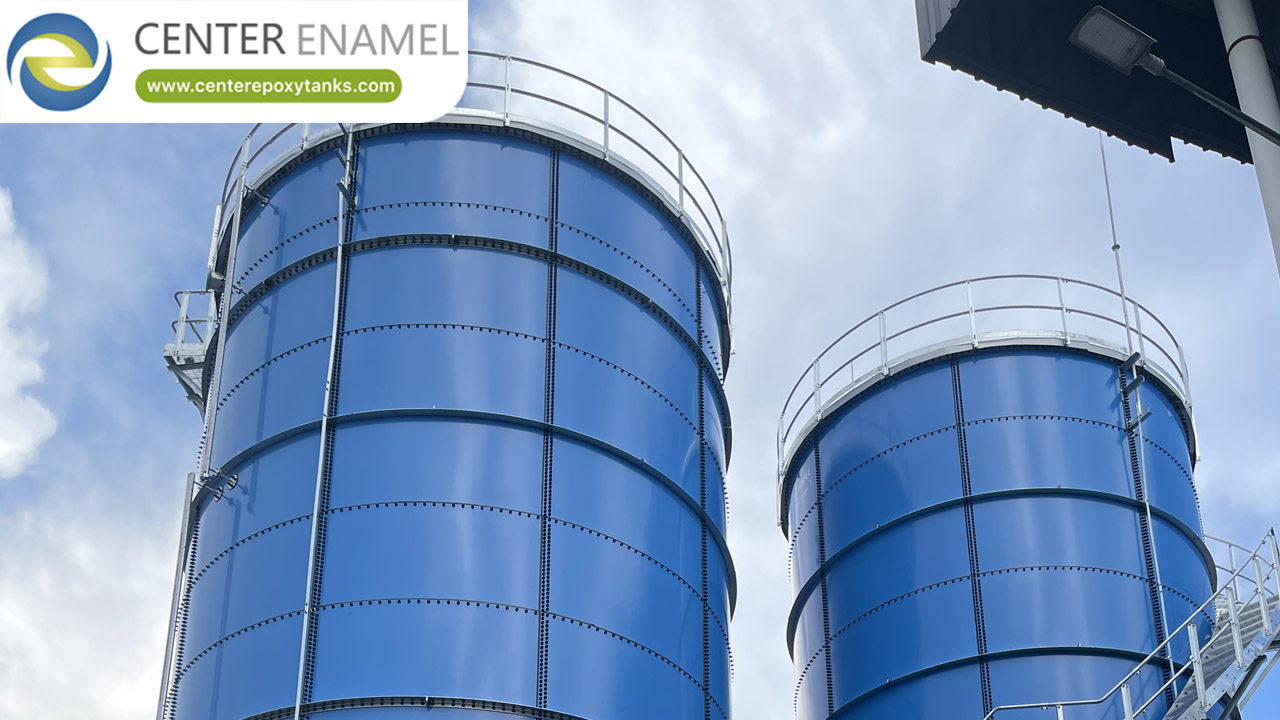
Epoxy Coated Tanks for Vegetable Oil - Linings, Limits and When They Work
Epoxy linings are widely used for vegetable oil storage, and used well they work. The failures come from three things: a lining specified without reference to the oil's temperature, application over inadequately prepared steel, and an assumption that a lining rated for water or wastewater will behave the same way in warm edible oil. Get those right and an epoxy-lined tank is an economical, serviceable asset.
Engineered by Shijiazhuang Zhengzhong Technology Co., Ltd. (Center Enamel), epoxy coated vegetable oil tanks are specified with a food-contact-appropriate lining, verified surface preparation and holiday testing, and clear operating limits stated in writing.
1. Is Epoxy Lining Suitable for Vegetable Oil?
Yes, where the lining has a documented food-contact position for the oil and temperature in question and is applied correctly. It is not a universal substitute for stainless, but it is a sound, economical choice for large volumes.
· Food-Contact Position: The specific lining system should have documented suitability for the oil and temperature.
· Temperature Rating: The lining must be rated for the actual storage and cleaning temperature, not for ambient.
· Compatibility with Fatty Material: The formulation should be selected for fatty product contact.
· Cleaning Agent Compatibility: The lining must tolerate the cleaning regime, not just the oil.
· Honest Limits: Where a duty exceeds the lining's envelope, stainless is the correct recommendation.
2. What Temperature and pH Limits Apply?
Epoxy linings have defined envelopes - typically a pH range in the mildly acidic to mildly alkaline band, and a continuous immersion temperature limit well below that of glass-fused-to-steel. The manufacturer's data for the specific system governs.
· Temperature Limit: Continuous immersion rating depends on the formulation; exceeding it shortens lining life sharply.
· pH Range: Epoxy performs across a mildly acidic to mildly alkaline band; strong acid or strong alkali is outside it.
· Thermal Cycling: Cycling stresses the film and the bond more than steady temperature at the same peak.
· Cleaning Temperature: Hot cleaning can exceed the immersion rating even when storage temperature does not.
· Manufacturer Data: The system data sheet, not a generic statement, defines the envelope.
3. How Is the Lining Applied and Tested?
The outcome is dominated by surface preparation. Blasting to a defined cleanliness and profile, controlled application conditions, a measured dry film thickness and holiday testing are what determine service life.
· Surface Preparation: Blast-cleaned to a specified standard with a defined anchor profile; this dominates performance.
· Application Conditions: Temperature, humidity and dew point are controlled and recorded during application.
· Dry Film Thickness: Measured and recorded across the surface, not spot-checked.
· Holiday Testing: The finished lining is holiday tested at a voltage appropriate to the film thickness.
· Cure and Records: Cure is confirmed before service and the full record set is issued.
Evaluation Criterion | Correctly Specified Epoxy Lining | Generic Epoxy Lining |
Food-contact documentation | Provided for the specific system | Assumed |
Temperature rating | Matched to storage and cleaning | Generic |
Surface preparation | Specified, verified, recorded | Unspecified |
Holiday testing | Across the full surface | Spot checks or none |
Operating limits in writing | Yes | No |
Engineering Assurance and Project Support
Every welded oil tank delivered by Shijiazhuang Zhengzhong Technology Co., Ltd. (Center Enamel) is designed to API 650 with shell courses sized by the one-foot method and checked for wind, seismic and hydrostatic load cases, or to EN 14015 and the Eurocodes where the site is European. Shell plate is shot-blasted to Sa 2.5 and coated to a documented dry film thickness, longitudinal and annular plate welds are examined by radiography or ultrasonic testing to the acceptance level written into the purchase order, and every tank is hydrostatically tested and dimensionally surveyed before hand-over. Epoxy lined tanks are delivered with the lining data sheet and food-contact documentation, surface preparation records, dry film thickness measurements, holiday test results and written operating limits.
Frequently Asked Questions (FAQ)
Is an epoxy lining food safe for vegetable oil?
It can be, where the specific lining system has a documented food-contact position for the oil and temperature in question. That documentation should be requested for the exact system being supplied, along with compatibility with the cleaning agents used, rather than assumed from a general statement that the lining is food grade.
What temperature can an epoxy lined oil tank handle?
It depends on the specific formulation, and the system data sheet governs. Many epoxy linings are rated for continuous immersion well below the temperatures that glass-fused-to-steel or stainless tolerate, and hot cleaning can exceed the rating even when storage temperature does not. Exceeding the limit shortens lining life sharply.
How long does an epoxy lining last in edible oil service?
It depends on the system, the preparation quality and whether the temperature and cleaning regime stay inside the lining's envelope. Where all three are right, epoxy gives many years of service; where preparation was poor or the temperature is over the limit, failure can be early and localised at the defect.
Can the tank be customised for our oil?
Yes. Capacity and geometry, lining system and thickness, surface preparation standard, cone or flat bottom, heating and insulation, nozzle schedule, blanketing provision, access and instrumentation are all engineered to your oil, temperature and process.
·


