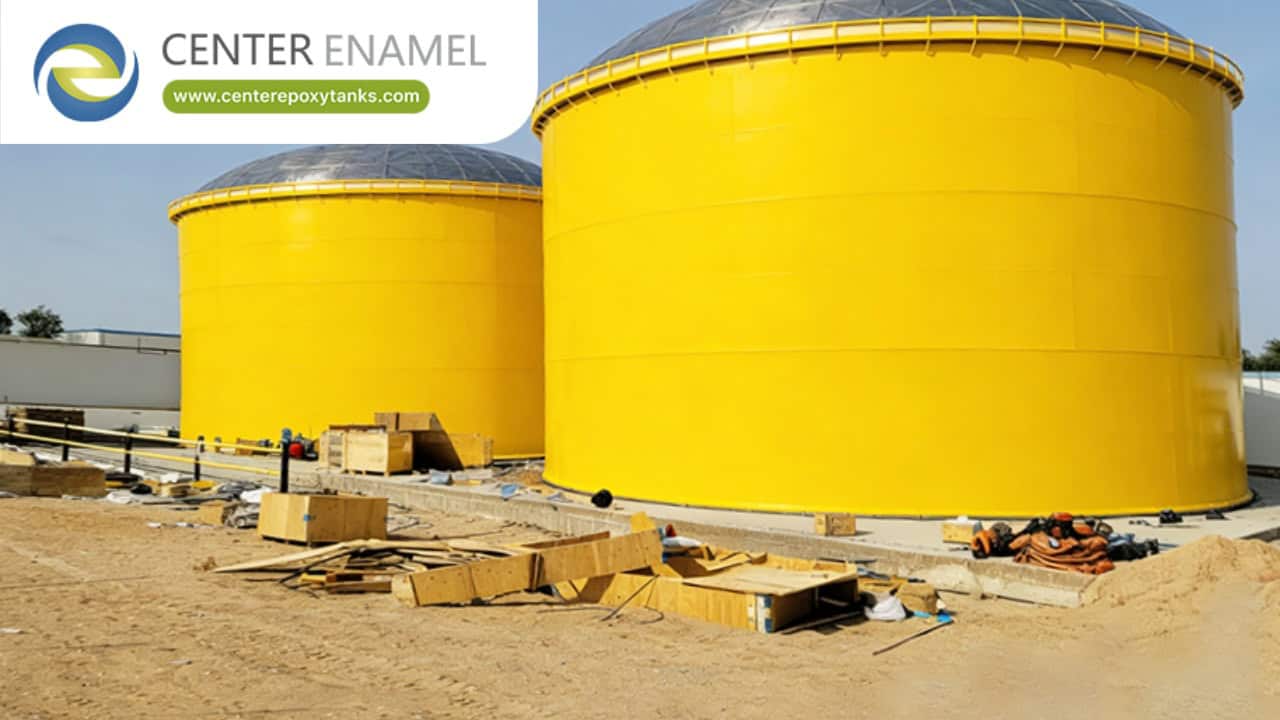
Eco Friendly Crude Oil Storage Tanks - Cutting Emissions, Containment Risk and Energy Use
The environmental performance of a crude tank is decided by three things: how much vapour it releases, how likely it is to leak, and how much energy it consumes. All three are design outcomes. Vapour release is governed by the roof and seal; leak likelihood by the bottom design, coating and detection; energy by heating and insulation. None of them improves through good intentions.
Engineered by Shijiazhuang Zhengzhong Technology Co., Ltd. (Center Enamel), eco friendly crude oil storage is designed to reduce all three quantitatively, with the measures that deliver the largest measurable reduction specified first.
1. What Reduces Vapour Emissions Most?
Removing the vapour space, then tightening what remains. A floating roof is the first step; seal specification and fitting control are what determine how well it performs in practice.
· Floating Roof or Sealed Deck: Removing the vapour space removes breathing loss, which is usually the largest single source.
· Secondary Seals: A secondary seal captures what the primary passes and reduces rim emissions substantially.
· Fitting Control: Gauge hatches, sample points and vacuum breakers are sealed because each is a measured emission path.
· Vapour Recovery: Where required, collected vapour is recovered rather than vented.
· Seal Condition Monitoring: Emissions rise with seal wear, so condition is trended and managed.
2. How Is Containment and Leak Risk Reduced?
By protecting the bottom, containing any release, and detecting loss early. The measures that matter most are the ones that act before a release reaches soil or water.
· Bottom Protection: Coating plus cathodic protection plus water management keep the floor intact.
· Secondary Containment: A lined bund sized to the applicable requirement holds a release.
· Double Bottom Option: A monitored second bottom detects a breach of the primary directly.
· Leak Detection: Inventory reconciliation and foundation vapour sensing find loss early.
· Controlled Drainage: Bund drainage is controlled so nothing leaves containment unobserved.
3. Where Does Energy Consumption Come In?
Mainly in heating, and in the pumping and vapour recovery systems. Reducing heat loss is usually the largest available saving on a heated crude tank.
· Insulation: Reduces heat loss directly and reduces the temperature cycling that drives breathing.
· Heating Control: Controlled heating avoids the waste of overheating the whole tank.
· Efficient Heating Surfaces: Well-maintained transfer surfaces reduce energy consumed per degree.
· Pump and Recovery Efficiency: Correct sizing avoids parasitic load in transfer and recovery.
· Operating Temperature Review: Storing at the lowest temperature that keeps the crude pumpable saves energy continuously.
Evaluation Criterion | Eco-Designed Crude Tank | Conventional Crude Tank |
Vapour control | Floating roof with secondary seals | Primary seal or fixed roof |
Fitting emission control | Sealed and documented | Standard fittings |
Containment | Lined, sized, controlled drainage | Earthen bund |
Leak detection | Monitoring in place | Reactive |
Energy approach | Insulated, controlled heating | Heated to habit |
Engineering Assurance and Project Support
Every welded oil tank delivered by Shijiazhuang Zhengzhong Technology Co., Ltd. (Center Enamel) is designed to API 650 with shell courses sized by the one-foot method and checked for wind, seismic and hydrostatic load cases, or to EN 14015 and the Eurocodes where the site is European. Shell plate is shot-blasted to Sa 2.5 and coated to a documented dry film thickness, longitudinal and annular plate welds are examined by radiography or ultrasonic testing to the acceptance level written into the purchase order, and every tank is hydrostatically tested and dimensionally surveyed before hand-over. We quantify the vapour and energy measures against your crude and climate, then supply the roof, seal, fitting, containment, detection and insulation package with the monitoring that verifies it over time.
Frequently Asked Questions (FAQ)
How much can a floating roof reduce crude tank emissions?
It removes breathing loss, which is typically the largest single source on a fixed-roof tank. What remains is loss past the rim seal and through deck fittings, which is why a secondary seal and sealed fittings matter: they determine how well the roof performs in practice, not just in principle.
What is the most effective environmental measure on a crude tank?
Usually vapour control, because it addresses the largest continuous release. But the measure with the largest consequence if omitted is bottom protection and leak detection, because a bottom failure reaches soil and groundwater before anyone sees it. A good design addresses all three: vapour, containment and energy.
Does insulation really make a crude tank greener?
On a heated tank, yes, in two ways. It reduces heat loss directly, and by reducing temperature cycling it also reduces the breathing that drives vapour emissions. Storing at the lowest temperature that keeps the crude pumpable compounds both benefits.
Can the tank be customised for our environmental targets?
Yes. Roof and seal specification, fitting sealing, vapour recovery interface, bottom protection and cathodic protection, containment and lining, leak detection, insulation and heating control and monitoring instrumentation are all engineered to your crude, climate and targets.
·


