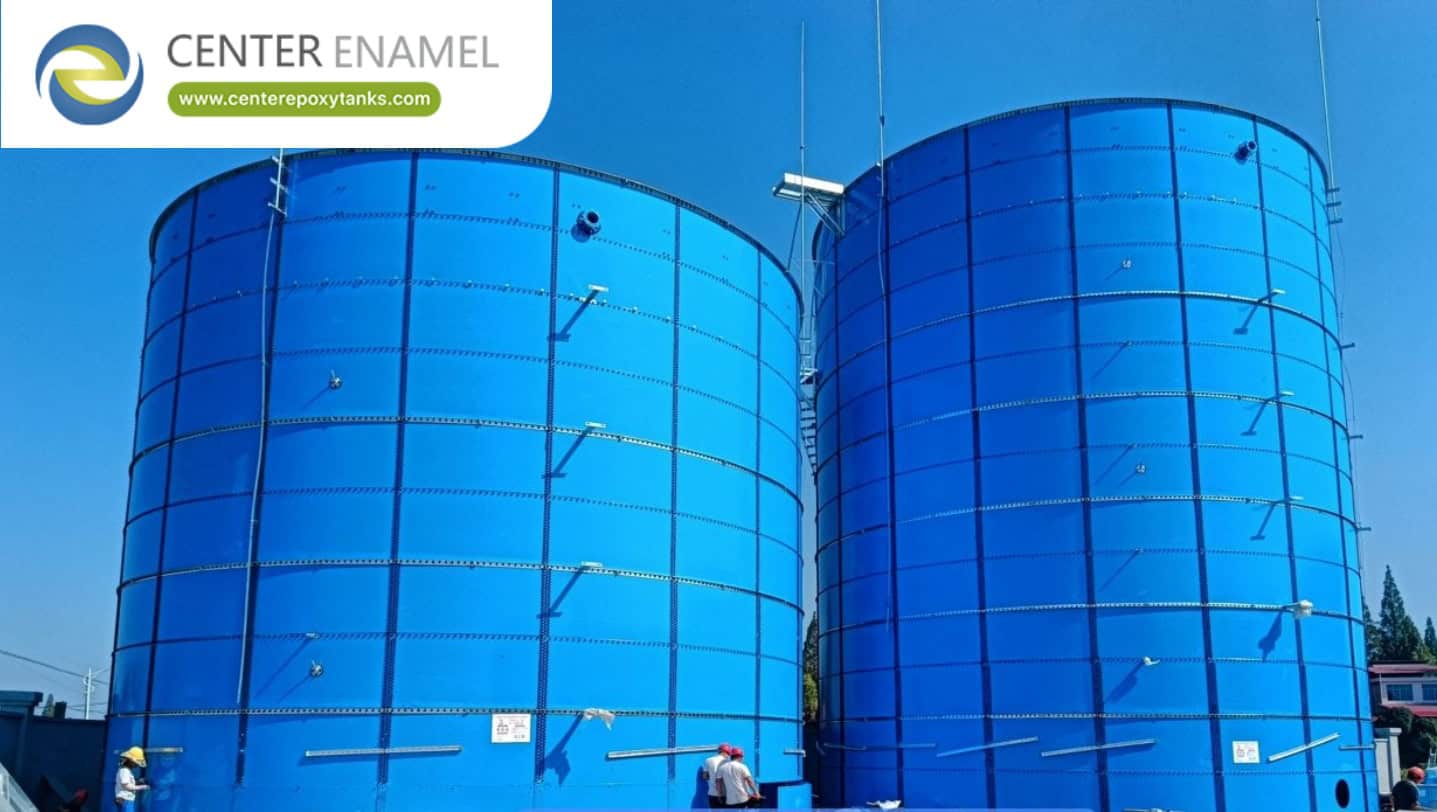
Epoxy Coated Tanks for Livestock Wastewater Management: Engineering Efficient Agricultural Effluent Containment
In modern agriculture, dairy farming, and intensive livestock production, the management of massive volumes of animal manure and wastewater is a critical operational and environmental priority. Livestock effluent is highly corrosive, abrasive, and biologically active. As it breaks down anaerobically, it generates severe organic acids and corrosive gases such as hydrogen sulfide ($H_2S$). Standard containment infrastructure, such as unlined concrete pits or painted steel tanks, rapidly deteriorates under these aggressive chemical conditions.
To solve these challenges and ensure strict environmental compliance, modern farms are increasingly turning to the epoxy coated tank for livestock wastewater management. Combining the high-tensile structural integrity of modular bolted steel with the advanced chemical protection of Fusion-Bonded Epoxy (FBE) coatings, these storage vessels offer a permanent, leak-proof, and highly durable solution for agricultural sludge, slurry, and liquid waste.
Core Engineering Principles and FBE Coating Technology
The structural longevity and protective performance of epoxy-coated tanks rely on rigorous manufacturing controls and advanced polymer chemistry:
Thermal Fusion-Bonded Epoxy (FBE): High-grade epoxy tanks are not simply painted. In a factory-controlled environment, precision-engineered steel panels are grit-blasted and electrostatically coated with a thermosetting epoxy powder. The panels are then baked in a high-temperature furnace (typically between 150°C and 200°C), causing the epoxy to melt, flow, and chemically cross-link into a uniform, continuous polymer matrix.
Unmatched Defense Against Agricultural Gases: The anaerobic decomposition of livestock manure produces aggressive $H_2S$ gas, which forms sulfuric acid upon contact with moisture in the tank's headspace. The chemically inert, non-porous FBE coating acts as a total barrier against this acid attack, preventing the structural degradation that destroys standard carbon steel.
Solid-Liquid Abrasion Resistance: Livestock wastewater is often thick with suspended solids, grit, and organic sludge. The FBE thermoset polymer matrix provides superior impact and abrasion resistance compared to standard liquid epoxy or thin-film paints, ensuring the coating remains intact during aggressive mixing, pumping, and agitation cycles.
Modular Bolted Assembly: Designed to international engineering standards like AWWA D103, the bolted panel architecture allows for rapid, crane-light installation on remote agricultural sites. This eliminates complex field welding and multi-week concrete curing delays.
Comprehensive Comparison of Livestock Wastewater Storage Options
Technical Parameter | Fusion-Bonded Epoxy (FBE) Bolted Tanks | Cast-in-Place Concrete Basins | Traditional Field-Welded Steel Tanks |
Corrosion Resistance in Manure | Superior resistance to organic acids, moisture, and extreme $H_2S$ gas | Vulnerable to concrete spalling, rebar corrosion, and acid etching | High susceptibility to blistering, peeling, and weld corrosion over time |
Abrasion Tolerance | High; thermoset polymer matrix withstands grit and aggressive sludge agitation | Moderate; prone to surface wear and cracking over time | Low to Moderate; standard paint wears quickly under abrasive loads |
Installation Speed & Labor | Fast modular bolting completed in weeks with minimal heavy equipment | Very slow civil construction requiring 28-day curing cycles | Slow; requires complex field welding and on-site weather-dependent coating |
Modularity & Capacity Expansion | High; bolted panel design allows for straightforward future capacity expansion | Permanent monolithic structure; impossible to expand without rebuilding | Rigid welded structure; difficult to modify or expand safely |
Frequently Asked Questions (FAQ)
Q: Why is an epoxy coated tank ideal for livestock wastewater management?
A: Livestock wastewater generates corrosive organic acids and hydrogen sulfide ($H_2S$). A factory-applied Fusion-Bonded Epoxy (FBE) coating creates a chemically inert, highly durable barrier that protects the steel from rapid degradation, ensuring decades of reliable performance.
Q: Can FBE tanks withstand the abrasive nature of thick livestock slurry and grit?
A: Yes. The thermoset polymer matrix of an FBE coating offers exceptional abrasion and impact resistance, preventing the internal protective layer from wearing away during constant pumping or mechanical mixing of heavy sludges.
Q: How does the installation of a bolted epoxy tank compare to concrete manure pits?
A: Bolted FBE tanks offer significantly faster installation times. Because panels are precision-manufactured and coated at the factory, they can be rapidly assembled on the farm without the extensive formwork, heavy machinery, and multi-week curing times required for concrete.
Q: Are epoxy coated tanks scalable if a farm increases its livestock capacity?
A: Absolutely. The modular bolted design of these tanks allows agricultural operators to unbolt and expand the structure by adding new rings of panels, providing a flexible storage solution that grows with the farm's requirements.


