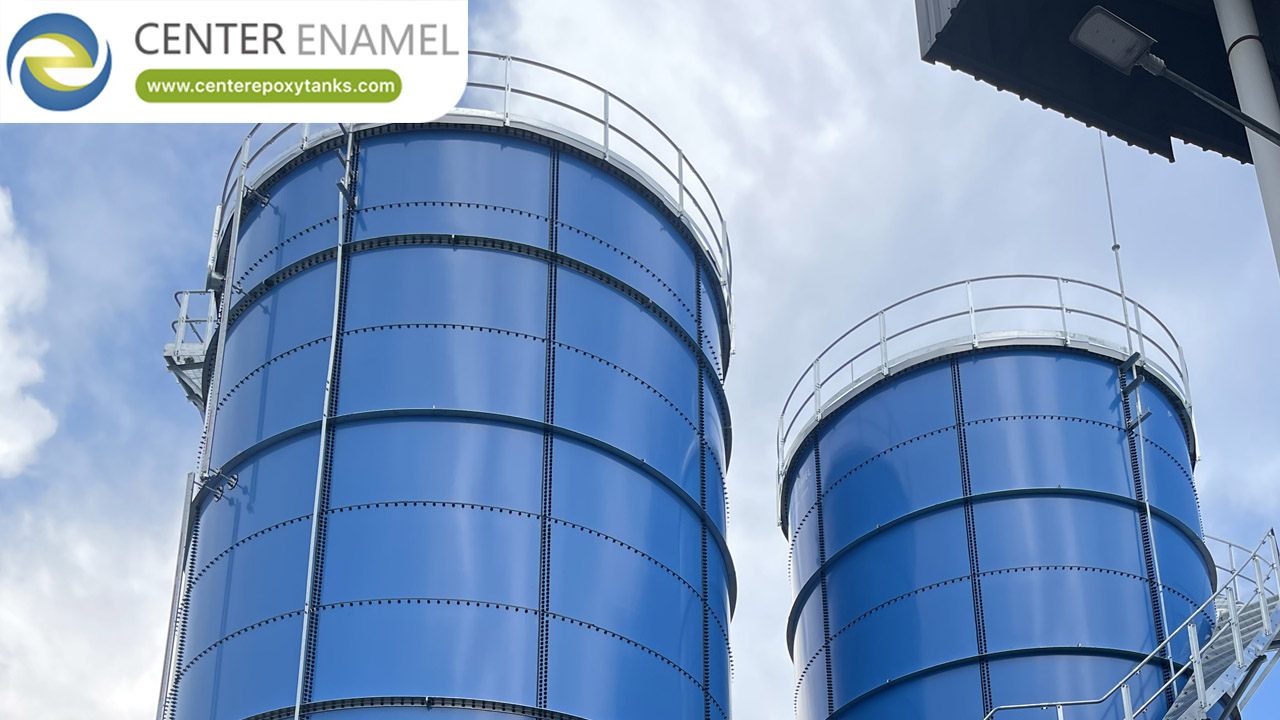
Why Epoxy Coated Tanks Are the Industrial Standard for Wastewater Treatment
In industrial operations, wastewater is rarely just "water." It is a complex, often aggressive cocktail of chemicals, varying pH levels, suspended solids, and biological matter. Choosing the right storage vessel is not just a logistical decision—it is a critical investment in compliance, safety, and operational longevity.
Fusion Bonded Epoxy (FBE) bolted steel tanks have emerged as the industry-preferred solution, outperforming traditional concrete and field-welded steel structures in nearly every critical performance metric.
The Technological Advantage: Why FBE?
Traditional industrial storage often relies on concrete, which is naturally porous and prone to cracking, or field-welded steel, which requires "field-applied" coatings that are highly vulnerable to environmental factors like humidity and dust.
In contrast, an FBE tank is a precision-engineered system. The epoxy powder is electrostatically applied to steel panels in a factory-controlled environment and then thermally cured. This process creates a thermoset polymer barrier that is chemically bonded to the steel substrate.
Comparison: Wastewater Storage Solutions
Feature | Epoxy Coated Steel (FBE) | Reinforced Concrete | Field-Welded Steel |
Coating Type | Factory-applied FBE | Often requires liners | Field-applied paint |
Installation Speed | Fast (Bolted/Modular) | Slow (Pour & Cure) | Moderate |
Chemical Tolerance | High (pH 2–13) | Variable | Low (Corrosion prone) |
Repairability | High (Field touch-up) | Low (Structural damage) | Moderate |
Maintenance | Low (Non-stick surface) | High (Structural sealing) | High (Rust prevention) |
Key Benefits for Industrial Wastewater Operations
1. Superior Chemical & pH Resistance
Industrial effluent often fluctuates between highly acidic and highly alkaline states. FBE coatings are specifically engineered to withstand aggressive chemical environments, typically rated for a pH range of 2–13. This prevents the chemical degradation that frequently causes catastrophic leaks in concrete or inferior steel tanks.
2. Asset Agility & Modular Design
Industrial needs change. Unlike poured-in-place concrete, which is a permanent fixture, bolted FBE tanks are modular. They can be expanded in volume as your facility grows or even dismantled and relocated if your operations shift. This "asset agility" provides a level of future-proofing that other storage methods cannot match.
3. Reduced Maintenance & Sludge Buildup
The smooth, non-porous surface of a thermally cured epoxy barrier prevents the buildup of biofilms, scaling, and sludge. This not only makes the tank interior easier to clean but also improves the overall efficiency of your treatment process by ensuring consistent flow and material properties.
4. Rapid, "Hot-Work-Free" Installation
Field-welded tanks pose safety risks due to "hot work" (welding and grinding) in industrial environments. FBE tanks are assembled using bolted connections, which eliminates these risks and drastically reduces installation time. You can often have your containment system operational in a fraction of the time required for traditional construction.
Sustainability and Long-Term Value
For industrial facilities, "Total Cost of Ownership" (TCO) is the ultimate metric. While concrete may have a lower material cost initially, the long-term expenses associated with structural repair, lining replacement, and potential environmental fines often exceed the investment. Epoxy coated steel tanks provide a proven 20–30+ year service life with minimal maintenance, making them the most cost-effective and environmentally responsible choice for modern wastewater infrastructure.
Frequently Asked Questions (FAQ)
Q: Can epoxy-coated tanks handle acidic wastewater?
A: Yes. Fusion Bonded Epoxy (FBE) coatings are highly robust and are typically rated for a wide pH range (often 2–13), making them suitable for most industrial effluent environments.
Q: Is "Epoxy Coated" the same as "Painted" steel?
A: No. Standard paint is a liquid-applied, air-dried coating prone to peeling. FBE is a thermally cured powder that is fused to the steel at high temperatures, creating a chemically bonded, thermoset plastic layer that is exponentially more durable.
Q: How do you handle repairs if the tank is damaged?
A: Because the coating is a factory-applied thermoset polymer, field-repair kits are available. Small nicks or scratches can be easily patched on-site without requiring factory-level equipment.
Q: Are these tanks suitable for municipal wastewater treatment?
A: Yes. They are widely used in both municipal and industrial sectors. Their ability to handle high-volume, continuous flow and their resistance to microbial activity make them ideal for wastewater equalization, aerobic/anaerobic zones, and sludge holding.
Q: How do I ensure the coating is perfect upon installation?
A: Professional-grade installations should always include "holiday testing." This uses high-voltage equipment to scan the interior surfaces for microscopic pinholes or voids in the coating, ensuring the tank is 100% leak-proof before it is put into service.


