Epoxy Coated Steel Tanks for Leachate Storage: Engineering & Design Guide
Landfill leachate is a "chemical soup" composed of dissolved organic matter, inorganic salts, heavy metals, and xenobiotic compounds. Storing this aggressive wastewater is one of the most challenging tasks in environmental engineering. Traditional containment methods like concrete basins or field-welded carbon steel often fail due to porosity, cracking, or rapid coating degradation.
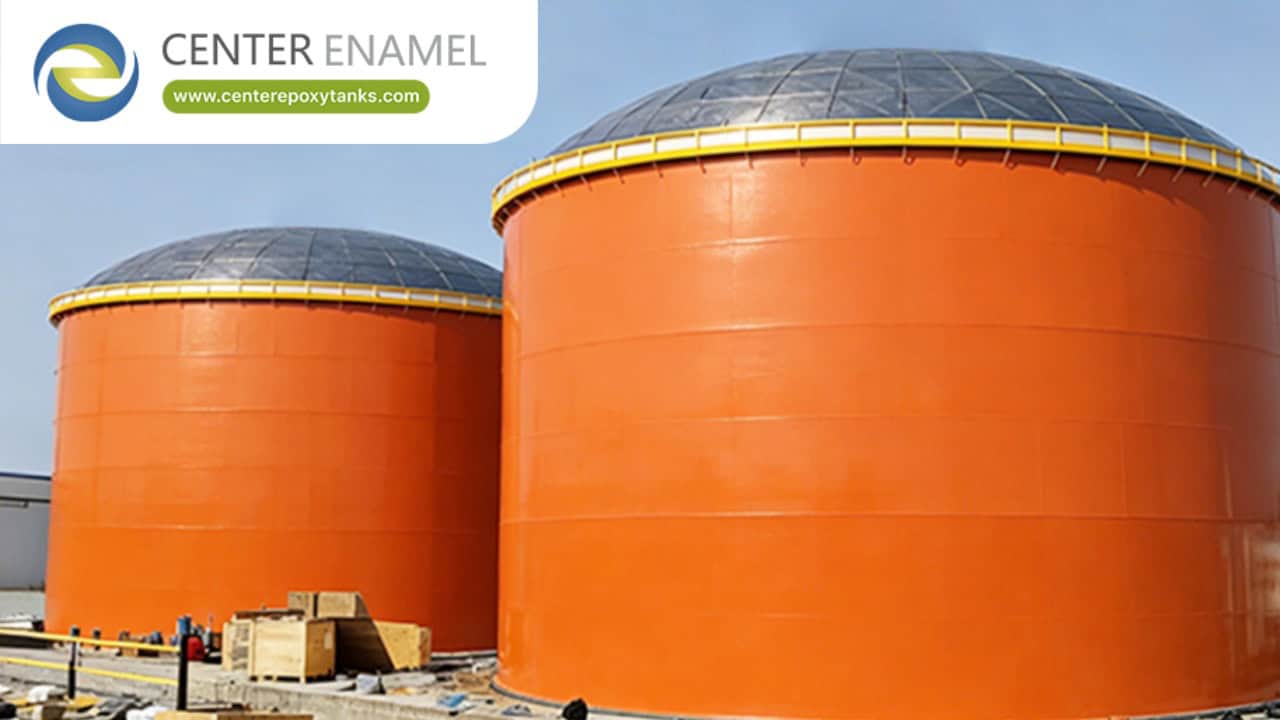
Epoxy-coated bolted steel tanks have become the industry standard for leachate storage. By combining the structural tensile strength of carbon steel with the inert, high-build chemical barrier of factory-applied epoxy, these tanks provide a durable, modular, and leak-resistant solution that drastically reduces environmental liability.
1. The Chemistry of Leachate Containment
Leachate composition is highly variable, depending on the age of the landfill and the waste stream. It frequently presents a low-to-moderate pH (acidic) and contains sulfides that, when released as gases, can cause accelerated corrosion in the tank headspace.
To protect the tank, the coating must provide a high diffusion barrier. The effectiveness of the barrier is governed by the rate of permeation, where:
Factory-applied epoxy (thermoset polymer) provides a dense, cross-linked molecular structure with a very low $P$ value, significantly outperforming site-applied paints. This effectively stops corrosive ions from reaching the steel substrate.
2. Why Epoxy-Coated Steel Beats Traditional Materials
When specifying a leachate storage tank, procurement teams must balance structural integrity with chemical longevity.
Performance Vector | Epoxy-Coated Bolted Steel | Poured-in-Place Concrete | Field-Welded Carbon Steel |
Chemical Resistance | High (Chemically inert epoxy) | Low (Porosity causes acid attack) | Low (Requires frequent re-coating) |
Structural Integrity | High (High-tensile steel plates) | Moderate (Prone to cracking) | High (But welds are corrosion sites) |
Installation Speed | Fast (Modular assembly) | Very Slow (Curing time required) | Slow (Site-intensive welding) |
Maintenance | Low (Replace panels if damaged) | High (Crack injection/liner repair) | High (Requires sandblasting/repainting) |
Expansion | Modular (Expandable) | Permanent (Fixed size) | Permanent (Fixed size) |
3. Critical Engineering Protocols for Leachate Tanks
Not all "epoxy tanks" are equal. To ensure an operational life exceeding 20+ years in a leachate environment, the following engineering standards must be enforced:
A. Factory Application vs. Field Coating
● Factory Application: Epoxy must be applied in a climate-controlled factory setting, allowing for precise temperature, humidity, and electrostatic controls. This creates a uniform film thickness (DFT - Dry Film Thickness) that is impossible to achieve in the field.
● Curing: Thermal curing in the factory ensures maximum cross-linking of the polymer chains, providing superior hardness and chemical resistance.
B. Holiday Testing (High-Voltage Spark Testing)
Every panel must undergo 100% Holiday Testing. This involves passing a high-voltage probe over the surface. If the spark jumps to the steel, a "pinhole" or void exists. In leachate storage, a single pinhole is the starting point for catastrophic under-film corrosion. Only panels that pass the spark test should be shipped.
C. Edge Protection
The edges of steel panels are the most vulnerable points. High-quality manufacturers use CNC grinding to radius the edges before coating, ensuring the epoxy wraps perfectly around the corner without thinning, preventing "creep" corrosion at the seams.
4. Operational Safety & Maintenance
● Leak Detection Channels: Because leachate is a major environmental contaminant, modern bolted tanks are often specified with a double-gasket system or an interstitial floor leak detection monitor.
● Ventilation: Leachate tanks generate odorous and potentially hazardous gases. The tank design must incorporate specialized vents and, if necessary, scrubbers to manage head-space air quality without allowing pressure build-up.
● Cleaning: The slick finish of the epoxy reduces the buildup of scale and biological solids (sludge) on the floor, making periodic cleaning cycles significantly easier and faster compared to concrete basins.
Frequently Asked Questions (FAQ)
Q: Are these tanks compatible with high-temperature leachate?
A: Standard high-build epoxy formulations are suitable for continuous temperatures up to 60 °C (140F). If your landfill process includes specialized leachate treatment that elevates temperatures above this, a Glass-Fused-to-Steel (GFS) option is typically recommended over epoxy.
Q: How do we handle the seal between bolted panels?
A: The "weak link" in any bolted tank is the seam. Specify high-performance, non-aging butyl rubber gaskets. These materials remain flexible over time and are chemically engineered to resist the specific composition of landfill leachate, ensuring a long-term watertight seal at every bolt hole.
Q: Can these tanks be relocated?
A: Yes. One of the greatest advantages of the bolted epoxy-coated design is the ability to deconstruct, transport, and re-erect the tank at a different site. This is a critical factor for landfill operations that may change their processing layout over time.
Is there a specific regulatory requirement or leachate chemical profile you need to design around for your current project?


