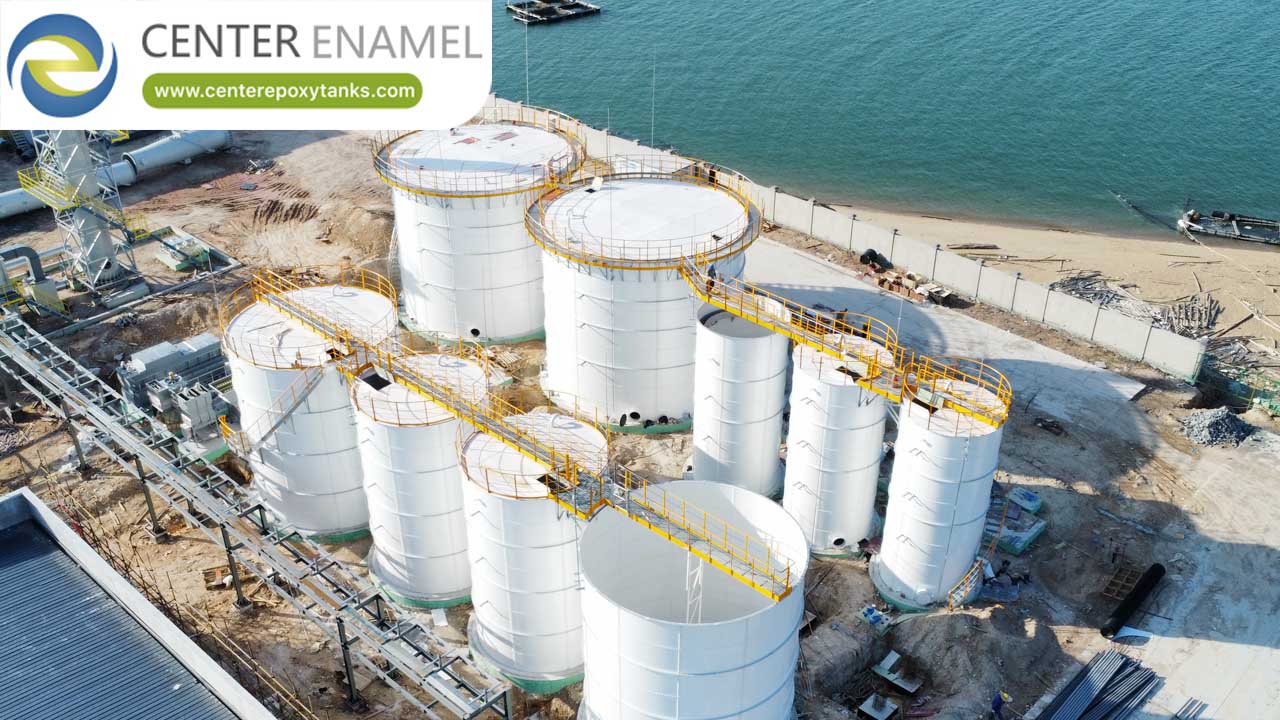
China Slurry Storage Tanks: Engineering & Procurement Guide
Slurry—whether agricultural manure, mining tailings, or industrial wastewater—is a "hostile" medium. It combines the chemical corrosivity of liquids with the mechanical abrasion of solids. Storing it requires more than just a container; it demands an engineered vessel capable of resisting "liquid sandpaper" effects while maintaining structural integrity under dynamic agitation loads. Sourcing slurry storage tanks from a top-tier Chinese manufacturer requires a focus on material science, such as Glass-Fused-to-Steel (GFS), Fusion-Bonded Epoxy (FBE), and 316L Stainless Steel, engineered to rigorous international standards like AWWA D103-09 and ISO 28765.
1. Technical Decision Matrix: Slurry Containment
Not all tanks are created equal when it comes to slurry. Selecting the right material is the first "quality gate" in your procurement process.
Feature | Glass-Fused-to-Steel (GFS) | Fusion-Bonded Epoxy (FBE) | 316L Stainless Steel |
Primary Use | Highly Corrosive/Abrasive Slurry | General Industrial/Biogas | High-Purity/Extreme Acid |
Abrasion Resistance | Superior (Mohs Hardness 6.0) | High | Moderate |
Corrosion Protection | Molecular bond (Inert) | Polymer barrier | Intrinsic Alloy |
Maintenance | Minimal (Non-porous) | Low | Low |
Installation | Rapid (Bolted/Modular) | Rapid (Bolted/Modular) | Rapid (Bolted/Modular) |
2. Engineering the "Hostile" Environment
A slurry tank is not a static vessel; it is a dynamic processing component. A professional manufacturer engineers for three specific failure points:
● Abrasion Resilience: The inner walls of the tank are subject to constant scouring. GFS technology, where glass enamel is fused to steel at 930°C, creates a glass-hard, non-porous surface that minimizes friction and resists the abrasive impact of grit and minerals.
● Dynamic Load Management (Agitation): Stagnant slurry leads to sediment buildup ("sanding in"). Our tanks are engineered with reinforced bridge mounts and heavy-duty connection points to support high-torque mixers and aeration systems. We utilize Finite Element Analysis (FEA) to ensure the tank shell can withstand the constant vibration and shear forces of heavy slurry agitation.
● Structural Integrity: Slurry density often ranges from $1,050–1,200 text{ kg/m}^3$, significantly heavier than water. Manufacturers must provide verified structural calculations for the increased hoop stress, ensuring the bolted seams and steel panels maintain a 30+ year service life.
3. Procurement Vetting: Vetting Chinese Manufacturers
When sourcing from China, EPC managers should look for manufacturers that operate as "Engineering Partners" rather than "Steel Sellers." Use this checklist to vet your supplier:
1. Manufacturing "Quality Gates": Does the manufacturer use CNC laser cutting and automated high-frequency welding? Look for facilities with 100,000+ sqm manufacturing bases that provide Non-Destructive Testing (NDT) records (RT/UT/Vacuum testing).
2. Standards Compliance: Does the manufacturer hold and actively use certifications like AWWA D103-09 (Standard for Factory-Coated Bolted Steel Tanks), ISO 28765, and NSF/ANSI 61?
3. Modular Logistics: Can the manufacturer provide flat-packed, container-ready panels? Professional exporters ship these panels in standard 40ft containers to reduce freight costs and protect the internal coating during ocean transit.
4. Reference Projects: Request site references in your specific sector (e.g., biogas digestion, mining tailings, or municipal wastewater). A proven track record in extreme climates and high-abrasion environments is the best indicator of reliability.
4. Frequently Asked Questions (FAQ)
Q: Why bolted tanks instead of welded for slurry?
A: Bolted steel tanks allow for factory-controlled quality. In a factory, coating consistency, weld integrity, and steel thickness are verified under laboratory conditions. Field-welded tanks are prone to weather-related coating failures and rust-prone weld seams. Furthermore, bolted tanks are modular, allowing for future expansion or relocation.
Q: How do you prevent "dead zones" in the tank?
A: We use CAD-optimized tank geometry combined with internal baffles and mixer placement analysis. This ensures that the slurry is kept in constant suspension, preventing sedimentation and microbial-induced corrosion (MIC) that can compromise the tank structure.
Q: Can these tanks be retrofitted with insulation?
A: Yes. For biogas and agricultural applications, we provide optional external insulation panels and integrated heat-tracing systems, maintaining the slurry at optimal temperatures for biological or chemical processing.
Selecting a slurry storage tank manufacturer is an investment in the long-term uptime of your facility. By prioritizing manufacturers that utilize high-performance materials like Glass-Fused-to-Steel, adhere to international engineering standards, and employ advanced modular fabrication techniques, you can ensure that your storage infrastructure is a high-performing asset rather than a recurring maintenance liability.
Are you currently tendering a slurry storage project, and would you like to review the structural FEA calculations for your specific tank volume or receive a technical datasheet for our high-abrasion GFS coating?


