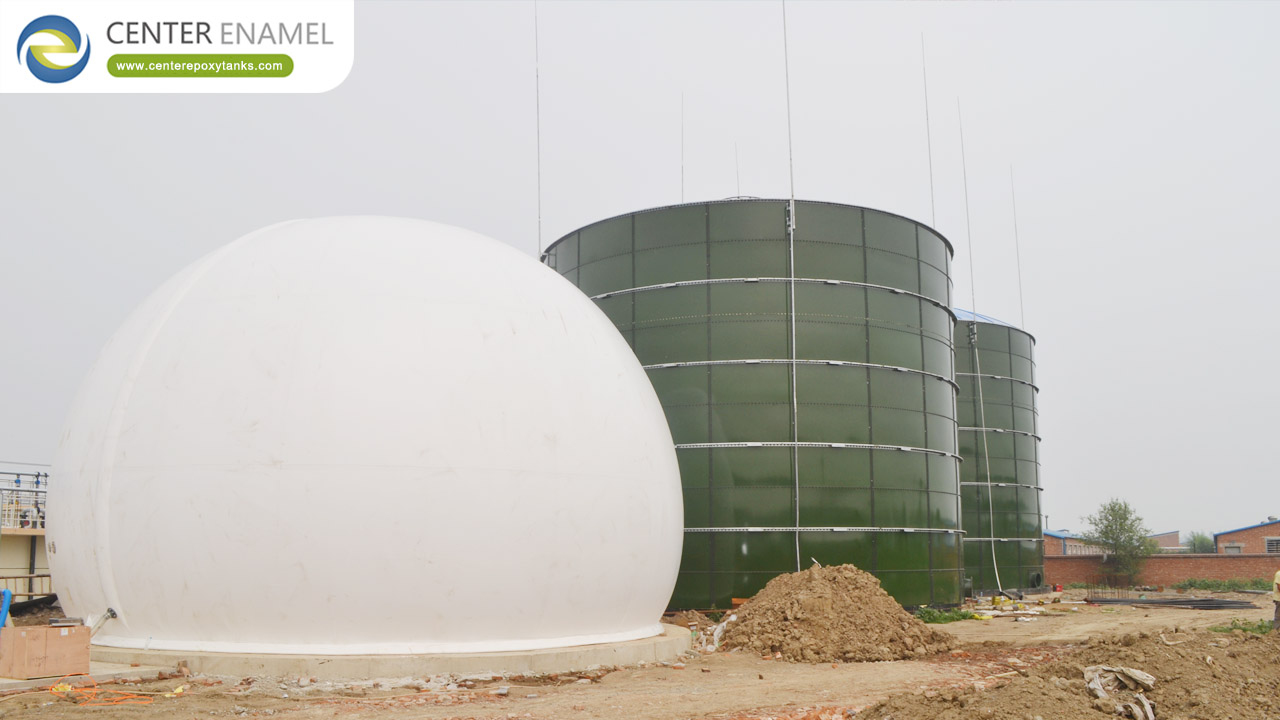
Double Membrane Gas Holder: The Engineered Standard for Biogas Storage
Center Enamel’s double membrane gas holders provide a high-efficiency containment solution for biogas storage, engineered to EN 13782 and ISO 9001 standards. Utilizing high-tenacity polyester fabrics with PVDF coatings, these systems achieve a methane permeability rate of < 400cm3/m2 .d.bar. Designed for 15–20 year durability, they integrate seamlessly with GFS or epoxy-coated anaerobic digesters for stable pressure regulation and methane capture.
Technical Specification Matrix: Global Engineering Standards
Parameter | Technical Specification | Engineering Advantage |
Permeability Rate | < 400cm3/m2.d.bar | Maximum gas retention; Zero methane leakage. |
Surface Coating | PVDF (Polyvinylidene Fluoride) | Self-cleaning; 15–20 year UV/Chemical resistance. |
Fire Safety | Class B1 / M2 (DIN 4102) | Industrial-grade flame retardancy. |
Wind Load | Up to 150 km/h | Structural stability via dynamic air pressure. |
Snow Load | Rated up to 1.5 kN/m² | Spherical geometry prevents collapse in cold climates. |
Core Engineering: Efficiency Through Material Science
1. Methane Permeability: The Benchmark for Containment
The most critical metric for any biogas storage system is its ability to prevent the loss of high-value methane (CH4).
● Low Permeability Standard: Our high-tenacity polyester fabrics ensure virtually 100% of the biogas produced is retained for power generation or upgrading.
● Environmental ROI: High gas-tightness prevents the release of potent greenhouse gases, maximizing the facility's carbon credit potential in strict regulatory environments.
2. PVDF Coating: Advanced Surface Protection
A gas holder's lifespan is determined by its resistance to external UV and internal chemical attack (H2S).
● Self-Cleaning & UV Protection: The PVDF layer naturally sheds dust and organic debris with rainwater, maintaining the fabric's tensile strength for decades.
● Chemical Resilience: Engineered to be inert against biogenic sulfuric acid (H2S) and ammonia, preventing the premature failure common in standard PVC membranes.
3. Climate Adaptation: Active Snow and Load Management
Static structures often fail in extreme weather; our systems use physical geometry and automated pressure logic to adapt.
● Snow Load Resilience: The spherical geometry encourages snow to slide off. Rated for snow loads up to 1.5 kN/m², these are ideal for alpine or high-latitude regions.
● Wind Mitigation: The air blower’s control logic increases pressure in the buffer zone during high-wind events, preventing "flapping" and mechanical fatigue.
CAPEX and Operational ROI Comparison
Feature | Double Membrane Gas Holders | Rigid Steel/Concrete Covers |
Initial Investment | 40–60% Cost Saving | High material and on-site labor costs. |
Corrosion Resistance | Superior: Inert to H2S and acids. | Poor: Risk of rust or concrete spalling. |
Installation Time | 1–2 Weeks (Modular) | 2–4 Months (Heavy construction). |
Volume Flexibility | High: "Variable Lung" expansion. | Zero: Fixed volume storage. |
Mechanical Synergy: Agitator & Mixer Compatibility
In functioning anaerobic digesters, internal mixers are essential. Our gas holders are engineered for seamless mechanical integration:
● Clearance Engineering: Designed with specific internal volume heights to ensure a safe "buffer zone" between the membrane and submersible agitators.
● Vibration Isolation: We utilize high-density EPDM gaskets at the mounting flange to absorb micro-vibrations from heavy-duty mixers, ensuring joint integrity.
Frequently Asked Questions (FAQ)
● Q: What is the lifespan of a PVDF-coated gas holder?
○ A: With proper pressure management and UV-stabilized PVDF coatings, our systems have a design life of 15 to 20 years.
● Q: Can it be retrofitted to existing tanks?
○ A: Yes. Our modular design allows for retrofitting onto existing concrete, GFS, or epoxy-coated steel tanks, provided the rim is structurally sound.
● Q: Does it prevent biogas odors?
○ A: Absolutely. The double-membrane design and high-frequency welding technology ensure zero methane permeability, effectively containing all gases and associated odors.


