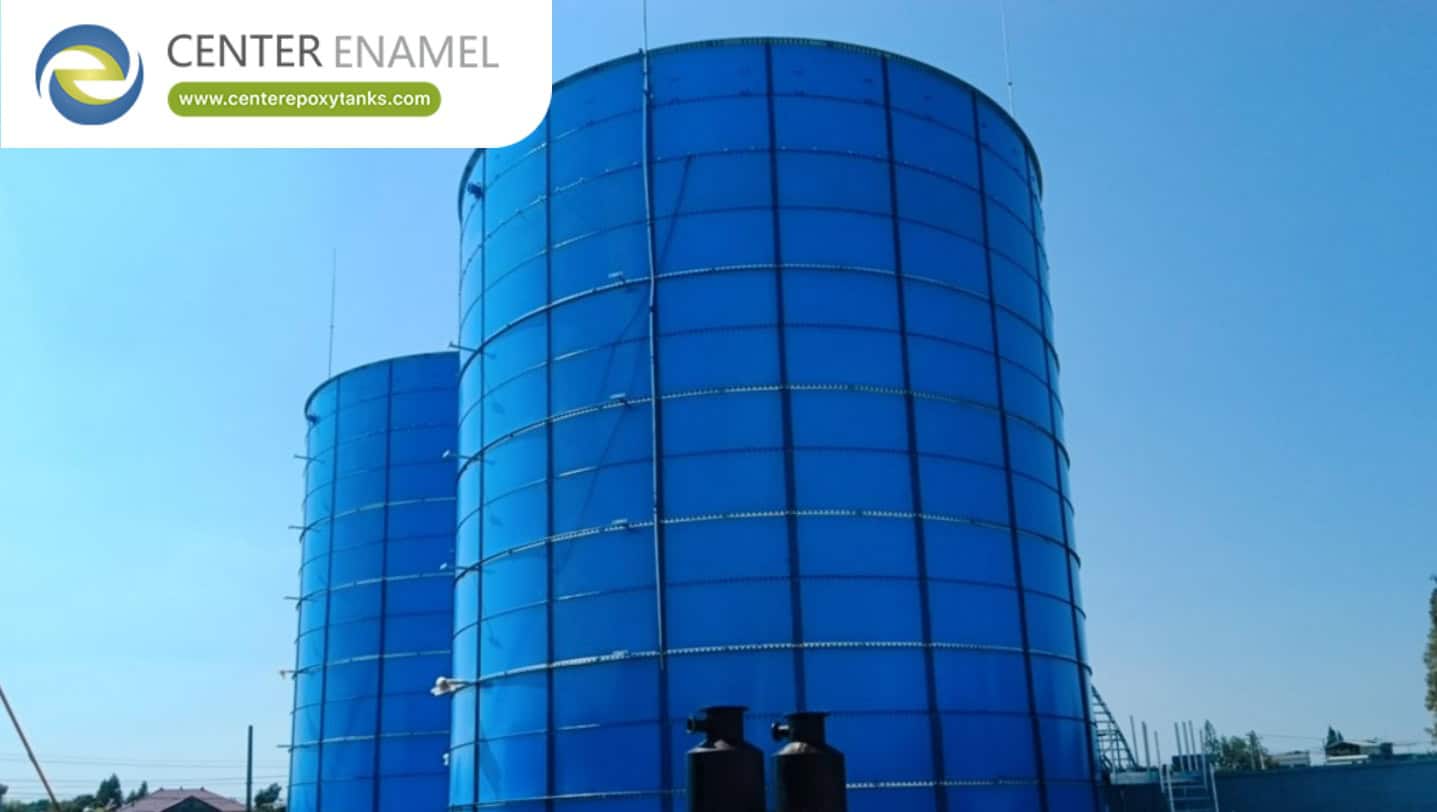
Epoxy Coated Steel Tanks for Agricultural Waste Management
Epoxy-coated steel tanks—specifically those utilizing Fusion Bonded Epoxy (FBE) technology—provide the industry-standard containment solution for agricultural waste, including manure slurry, anaerobic digester feed, and biomass. These tanks utilize high-tensile steel panels coated with an epoxy resin, heat-fused at temperatures exceeding $200^circtext{C}$ to form a non-porous, chemically inert barrier. This process renders the tank immune to the high-acidity and aggressive, corrosive nature of agricultural waste that typically causes concrete to crack and standard steel to rust. Their modular, bolted construction ensures rapid installation, seismic resistance, and the structural integrity required to handle the hydrostatic loads of heavy agricultural slurries.
The Challenge: Why Agricultural Waste Requires Specialized Containment
Agricultural waste, particularly livestock manure and slurry, is highly corrosive. It contains a complex mix of ammonia, sulfur compounds, and organic acids that can compromise standard infrastructure.
Acidic Degradation: Manure slurry can be mildly to moderately acidic. In concrete tanks, this acidity leads to "leaching," where the cement binder dissolves, leaving behind a porous structure that eventually crumbles.
Microbial-Induced Corrosion (MIC): Anaerobic conditions within waste storage facilities generate hydrogen sulfide (H2S). When this gas reacts with moisture, it forms sulfuric acid, which is catastrophic for unprotected carbon steel surfaces.
Load Dynamics: Agricultural waste is dense. A storage tank must handle significant hydrostatic pressure, which can cause cracking in rigid, non-flexible structures like concrete.
The FBE Advantage: Engineered for Agriculture
Fusion Bonded Epoxy (FBE) tanks are not just "painted" steel; they are a sophisticated composite structure.
Molecular Bonding: Unlike liquid paints, FBE powder is applied via electrostatic spray and heat-cured, creating a molecular bond with the steel substrate. This creates a surface that is harder than standard coatings and highly resistant to mechanical abrasion during cleaning or agitation.
Flexibility & Resilience: Because these tanks are bolted systems with engineered gaskets, they accommodate minor ground settlement and thermal expansion/contraction without cracking—a frequent point of failure for monolithic concrete pours.
Modular Scalability: Farms evolve. FBE tank systems are modular, meaning you can often expand your capacity by adding a ring of panels or relocating the tank entirely if your farm layout changes.
Comparative Overview: Waste Storage Solutions
Feature | Epoxy Coated Steel (FBE) | Reinforced Concrete (RCC) | Welded Carbon Steel |
Corrosion Resistance | High (Inert Barrier) | Low (Porous/Acid Attack) | Low (Needs Recoating) |
Construction Time | Rapid (Modular/Bolt-together) | Very Slow (Curing required) | Moderate (Field Welding) |
Maintenance | Minimal | High (Crack Sealing) | High (Painting/Sandblasting) |
Relocatability | Yes | No | No |
Seismic Resilience | High | Low (Prone to Cracking) | Moderate |
Technical Benchmarks for Agricultural Planning
When selecting storage for your farm’s waste management system, ensure your tank specification includes:
Holiday Testing: Verify that every panel has passed a 1500V high-voltage "holiday test" at the factory. This guarantees zero defects in the epoxy coating.
Edge Protection: The most common point of failure is at the panel edge. Ensure the coating process includes specialized edge-coverage technology to ensure uniform protection.
Hydrostatic Load Calculations: Ensure the tank is engineered for the specific density of your waste (e.g., high-solid manure slurry vs. liquid wastewater).
Sealant Compatibility: The gaskets and sealants used between panels must be chemically resistant to the specific waste composition you are storing (e.g., resistant to ammonia/sulfur compounds).
Frequently Asked Questions (FAQ)
Q: Can I store aggressive manure slurry in an epoxy tank?
A: Yes. FBE tanks are specifically designed to resist the chemical attack from livestock manure and agricultural slurries. They remain inert across a broad pH range.
Q: Does the epoxy coating peel or chip over time?
A: Because FBE is heat-fused (not simply air-dried), it is highly resistant to peeling. It is a robust industrial coating designed to last for decades without requiring routine repainting.
Q: How does this tank compare to a concrete lagoon?
A: Concrete lagoons are prone to seepage, which can contaminate local groundwater. An FBE bolted tank is a sealed, above-ground system that eliminates seepage risks and meets modern environmental compliance standards.
Investing in Sustainable Farm Infrastructure
Choosing an FBE tank is a strategic decision to protect your farm’s soil and water quality while minimizing long-term maintenance overhead.
Are you planning a new waste management system or looking to replace an aging storage structure?
[Contact our technical engineering team] to receive a structural load-bearing assessment, chemical compatibility advice, or a custom design proposal for your specific agricultural waste storage needs.
Would you like a detailed technical brief on the specific performance differences between Epoxy (FBE) and Glass-Fused-to-Steel (GFS) for high-acidity manure slurry environments?


