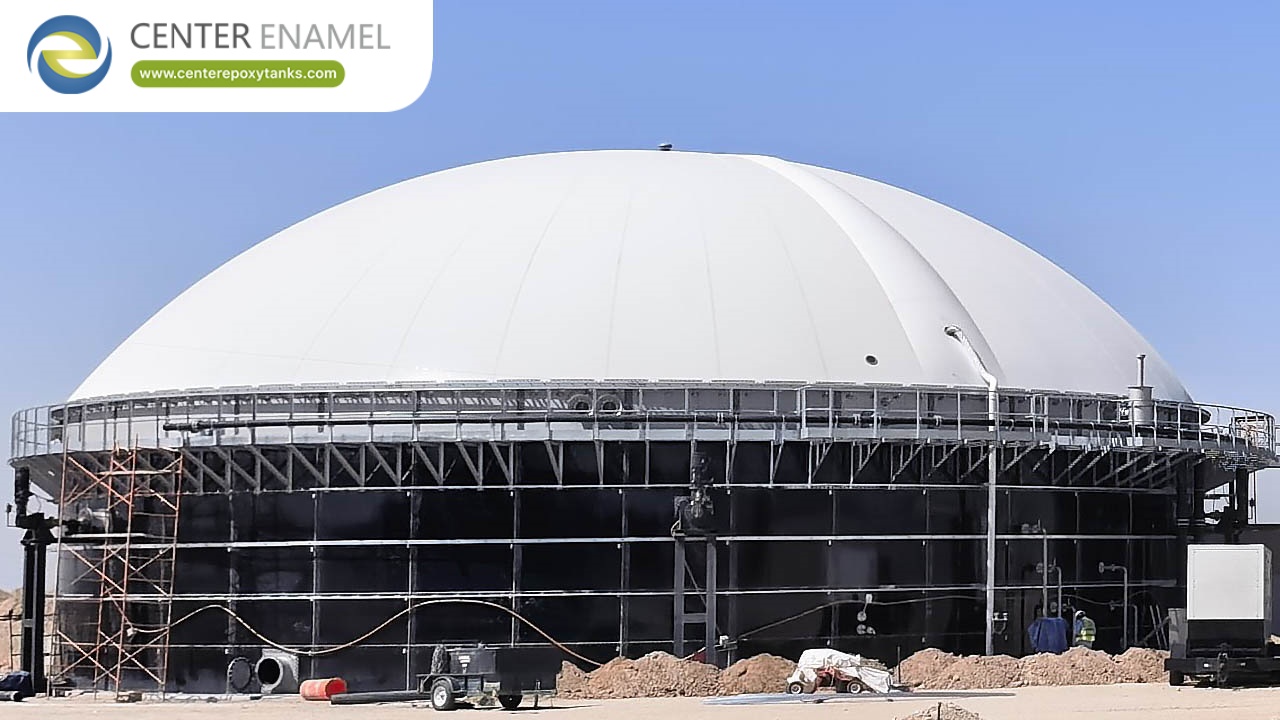
Epoxy Coated Steel Anaerobic Digester Tank: Advanced Engineering for High-Efficiency Biogas Infrastructure
As global municipal and industrial sectors accelerate their transition toward sustainable bioenergy, anaerobic digestion (AD) has become a primary technology for converting organic waste, agricultural residues, and sewage sludge into high-yield biogas and nutrient-rich digestate. At the core of every successful anaerobic digestion facility lies the reactor vessel: the epoxy coated steel anaerobic digester tank.
Operating under severe biological, chemical, and thermal stress, traditional containment materials frequently succumb to localized corrosion and structural degradation. Modern renewable energy facilities increasingly deploy factory-applied Fusion Bonded Epoxy (FBE) steel bolted tanks to achieve long-term asset security, superior corrosion defense, and rapid deployment timelines.
The Corrosive Microenvironment of Biogas Digesters
An anaerobic digester represents one of the harshest operating environments in industrial liquid containment. Maintaining structural integrity requires addressing several critical degradation vectors:
Hydrogen Sulfide (H2S) and Biogenic Sulfuric Acid: The microbial breakdown of sulfur-rich organic substrates generates hydrogen sulfide gas. In the warm headspace above the liquid level, condensation combines with H2S to form biogenic sulfuric acid, which rapidly pits standard steel and spalls unprotected concrete.
Fluctuating Liquid-Gas Interfaces: Continuous mixing, thermal expansion cycles (mesophilic and thermophilic operating ranges), and changing fluid levels create severe mechanical and chemical stress along the vapor-liquid transition zone.
Strict Gas-Tightness Demands: To optimize methane (CH4) recovery and eliminate fugitive environmental emissions, the entire containment and roofing system must maintain a hermetic seal against internal operational pressures.
Material Science: The Fusion Bonded Epoxy (FBE) Advantage
Advanced Fusion Bonded Epoxy coating systems offer an elite technical solution tailored specifically for the rigors of anaerobic digestion:
Controlled Factory Application: Unlike field-applied paints or hand-applied linings, FBE powder is electrostatically sprayed onto pre-treated steel panels and baked in precision industrial ovens. This triggers a permanent thermosetting cross-link reaction.
Holiday-Free Surface Continuity: High-temperature fusing creates a dense, non-porous barrier across the entire plate surface, bolt holes, and panel edges, ensuring absolute continuity verified via rigorous high-voltage spark testing (e.g., 1100V+).
Chemical Inertness: Fully cured FBE linings resist aggressive organic acids, volatile fatty acids (VFAs), and sulfide concentrations, preventing sub-film corrosion and rust migration.
Technical Performance Matrix: Anaerobic Digester Tank Technologies
Technical Parameter | FBE-Coated Bolted Steel Digester Tanks | Cast-in-Place Concrete Basins | Field-Welded Carbon Steel Tanks |
Corrosion Resistance to Digester Sludge & H2S | Excellent; high-grade thermoset FBE resists organic acids and sulfide vapor attack | Vulnerable to concrete carbonation, sulfate attack, and structural spalling over time | Moderate to low; prone to pitting and weld-seam oxidation without intensive upkeep |
Construction Speed & Deployment | Rapid modular erection completed in weeks without weather-related delays | Slow civil construction requiring extensive formwork and multi-week concrete curing | Labor-intensive field welding and weather-dependent protective coating work |
Structural Scalability & Modularity | High scalability; modular bolted panels allow future height or diameter extensions | Monolithic structure; impossible to modify, expand, or relocate once poured | Difficult to modify without extensive hot-work cutting and re-welding |
Lifecycle Maintenance Overhead | Minimal; smooth non-porous surface resists scaling and minimizes downtime | Moderate to high; requires joint re-sealing, crack injection, and lining patches | High; requires scheduled abrasive blasting and complete recoating cycles |
Key Engineering & Operational Considerations
To maximize the performance of an epoxy coated steel anaerobic digester tank, project engineers focus on several integration parameters:
Vapor Zone Protection: Because the headspace is most susceptible to corrosive gas condensation, premium FBE coatings ensure complete surface shielding across both liquid and gas phases.
Thermal Regulation: Tanks are engineered to integrate smoothly with external insulation blankets and internal heating coils to maintain optimal operating temperatures (typically ~37°C for mesophilic or ~55°C for thermophilic digestion).
Structural Roof Interfaces: Bolted digester shells seamlessly anchor double-membrane gasholder roofs, aluminum geodesic domes, or heavy-duty steel covers to maintain consistent biogas collection pressures.
Frequently Asked Questions (FAQ)
Q: How do epoxy coated steel tanks withstand hydrogen sulfide (H2S) corrosion inside a biogas digester?
A: High-performance Fusion Bonded Epoxy (FBE) coatings form an inert, chemically resistant barrier across the steel substrate. This prevents moisture and biogenic sulfuric acid derived from H2S oxidation from reaching the base metal, effectively mitigating vapor-zone degradation.
Q: What temperature and pH ranges are supported by FBE-coated anaerobic digesters?
A: Modern FBE lining systems are engineered to handle operating temperatures up to 60°C (140°F) and broad chemical pH spectra (typically ranging from acidic to mildly alkaline environments encountered during digestion).
Q: How does modular bolted construction compare to concrete or welded tanks in terms of build time?
A: Bolted steel digesters are prefabricated in a controlled factory environment and shipped flat-packed for rapid on-site assembly. A standard industrial digester can be erected in a fraction of the time required for field-welded steel or cast-in-place concrete, which suffers from multi-week curing delays.
Q: Can epoxy-coated panels be repaired if damaged during transport or operation?
A: Yes. Unlike glass-lined surfaces which cannot be easily modified or patched in the field, high-grade FBE coating systems feature approved repair protocols and touch-up compounds that allow technicians to restore coating continuity quickly if localized mechanical damage occurs.


