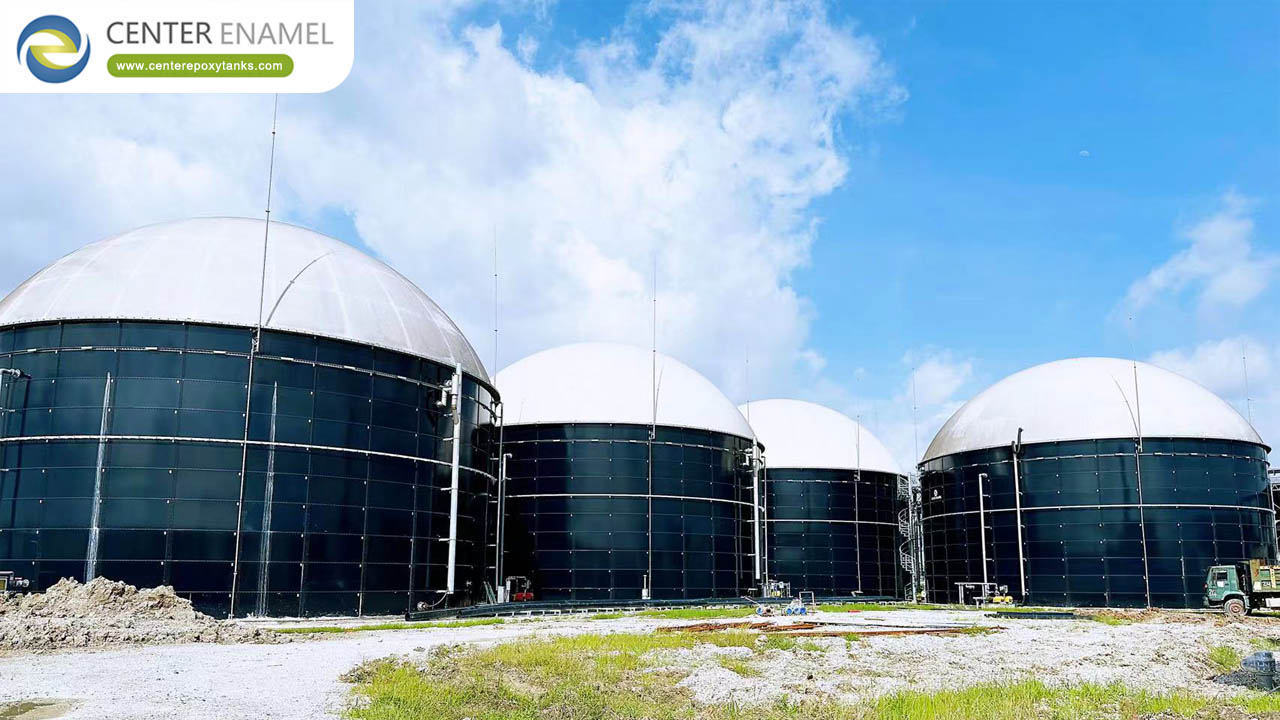
Leading Biogas Storage Tank Manufacturer: Engineering Excellence for Renewable Energy
A leading biogas storage tank manufacturer provides specialized, high-durability containment solutions, primarily utilizing Glass-Fused-to-Steel (GFS) and advanced bolted steel technology. These manufacturers are distinguished by their ability to engineer tanks that are chemically inert and impervious to the highly corrosive, sulfur-rich environments (H₂S) characteristic of anaerobic digestion. Top-tier providers offer end-to-end EPC support, including factory-controlled production, seismic-compliant engineering, and modular, rapid-deployment installation, ensuring maximum lifecycle value and operational safety for waste-to-energy projects.
The Engineering Standard: Why GFS is the Industry Gold Standard
In the renewable energy sector, the "leading" manufacturer is defined by the material science applied to the tank structure. Biogas digesters create a harsh environment—a combination of methane, carbon dioxide, and hydrogen sulfide ($H_2S$) that leads to microbial-induced corrosion (MIC) in traditional concrete or field-painted steel tanks.
Molecular Fusion Technology: Leading manufacturers use a glass-fused-to-steel process where glass frit is fused to carbon steel at temperatures between 820°C and 930°C. This creates a non-porous, chemically inert barrier.
H₂S Resistance: This glass-hard finish provides a full pH tolerance of 1–14, effectively neutralizing the acid-attack caused by sulfur compounds in the biogas headspace.
Modular Scalability: Unlike monolithic concrete tanks, bolted steel designs allow for rapid assembly, future expansion, or even disassembly and relocation, providing critical flexibility as your biogas plant’s throughput grows.
Comparative Overview: Biogas Storage Technologies
Feature | Glass-Fused-to-Steel (GFS) | Welded Carbon Steel | Reinforced Concrete |
Corrosion Resistance | Excellent (Inert Glass) | Low (Needs Coating) | Moderate (Needs Liner) |
Installation Time | Rapid (Modular) | Moderate (Field Welding) | Slow (Curing Required) |
Maintenance | Minimal (No Recoating) | High (Frequent Painting) | Moderate (Sealing/Patching) |
Quality Control | Factory-Verified | Site-Dependent | Site-Dependent |
Flexibility | High (Expandable) | Low (Static) | Low (Static) |
Technical Benchmarks for Elite Biogas Manufacturers
To ensure your facility meets modern reliability standards, vetting a manufacturer should focus on these technical competencies:
100% Quality Verification: The best manufacturers utilize automated factory processes, such as 1500V holiday testing, to ensure zero defects in the coating before the panels ever leave the factory.
Integrated Gas Management: A leading manufacturer doesn't just provide the tank; they provide the integrated system. This includes specialized synthetic elastomeric gaskets (EPDM/Viton) for gas-tight sealing and integration with double-membrane gas holders.
Regulatory Compliance: Ensure the supplier adheres to international standards like API, AWWA, or local equivalents for seismic, wind, and liquid load-bearing capacity.
Global Track Record: Look for manufacturers with a proven history of exporting to various climatic regions, proving their ability to handle different environmental stressors (from high-humidity tropical zones to arid, high-wind regions).
Frequently Asked Questions (FAQ)
Q: Why choose GFS over concrete for an anaerobic digester?
A: Concrete is naturally porous and prone to cracking under the chemical stress of H₂S. Over time, this leads to structural compromise and gas leaks. GFS tanks are glass-lined, offering total immunity to acid-induced corrosion and a significantly lower Total Cost of Ownership (TCO).
Q: Can your biogas tanks handle high-pressure fluctuations?
A: Yes. Leading manufacturers engineer their tanks with specialized pressure/vacuum relief valves (PVRV) and, when required, integrate double-membrane roofs that act as dynamic gas holders to absorb pressure fluctuations safely.
Q: How does the "modular" design help my project timeline?
A: Modular bolted tanks are manufactured entirely off-site. On-site work is reduced to assembly, cutting construction time by up to 50% compared to traditional concrete pouring, which is highly sensitive to weather and curing cycles.
Partnering for Long-Term Biogas Reliability
Choosing a biogas storage tank is a 20-to-30-year infrastructure commitment. Prioritizing manufacturers that combine material durability (like GFS), rigorous quality control, and technical engineering support ensures your plant remains a stable, profitable renewable energy asset.
Are you currently designing or retrofitting a biogas facility and need a technical feasibility study?
[Contact our technical engineering team] for a detailed assessment of your project’s storage requirements, a comparative material analysis, or a custom structural proposal.
Would you like a detailed technical brief on the specific performance differences between double-membrane gas holders and rigid-roof gas storage options for your plant’s design?


