Engineering Guide to the API 650 Full-Contact Stainless Steel Floating Roof
In critical chemical processing, high-temperature operations, and severe corrosive containment environments, infrastructure reliability must be absolute. While aluminum floating decks are a staple for standard light hydrocarbon storage, the API 650 Full-Contact Stainless Steel Floating Roof represents the pinnacle of industrial engineering for storing aggressive chemicals, sour crude oil, industrial wastewater, and high-purity media.
Regulated strictly under the structural guidelines of API 650 Appendix H (Internal Floating Roofs), a full-contact stainless steel roof provides total product isolation. By resting flush against the fluid surface, this system completely eliminates the vapor space, maximizing structural lifespan and suppressing Volatile Organic Compound (VOC) emissions under severe operational stressors.
1. Mechanics of the Full-Contact Stainless Steel Design
Unlike traditional non-contact pontoon structures—where a thin deck plate is suspended above the liquid line—a full-contact floating roof is engineered to establish complete contact with the liquid medium.
Material Selection (304L / 316L / Duplex Stainless Steel)
Depending on chemical aggressiveness, full-contact roofs are fabricated from high-grade austenitic stainless steels such as AISI 304/304L or AISI 316/316L. For highly acidic, high-salinity, or extreme-temperature processing, advanced alloys like Duplex Stainless Steel (e.g., 2205) are deployed. These materials do not require sacrificial coatings or internal linings, making them immune to the chemical degradation that limits other metals.
Matrix Core Fabrication
The full-contact layer is built using a rigid matrix of interconnected panel modules or seal-welded metallic compartments. For stainless steel implementations, panels are often continuously seal-welded or bonded with specialized, chemical-resistant adhesives to form a monolithic, liquid-tight floor. Because there is zero headspace underneath the deck panels, vapor formation is blocked at the surface, reducing VOC loss by 98% to 99%.
2. Key API 650 Appendix H Regulatory Requirements
To ensure safe deployment within heavy industrial environments and earn code compliance, a full-contact stainless steel internal floating roof (IFR) must adhere to precise mechanical limits:
● 2.0x Flotation Safety Factor: API 650 mandates that the internal floating structure must possess a buoyancy reserve capable of supporting at least twice (2.0x) the total combined dead weight of the roof assembly, perimeter seals, mechanical hardware, and floating instrumentation.
● Two-Compartment Puncture Survival: Flotation calculations must mathematically demonstrate that the roof will remain stable and level on the liquid surface even if the outer rim and any two adjacent internal floating compartments suffer physical punctures and flood with the stored product.
● High-Velocity Static Dissipation: Fluid movement during high-volume pumping creates substantial static electricity charges. API 650 requires the installation of flexible, conductive stainless steel bonding cables or perimeter shunts that maintain constant grounding contact with the tank shell, eliminating static spark-ignition hazards.
● Dual-Setting Structural Legs: Stainless steel internal floating roofs feature a grid of heavy-duty pipe support legs. These are adjustable to a low-leg setting for standard operations (optimizing net usable tank volume) and a high-leg setting (typically 2 meters) to guarantee safe clearance for maintenance crews entering the tank floor.
Material Comparison Profile Matrix
Feature / Metric | Non-Contact Aluminum Pontoon Roof | Full-Contact Stainless Steel Roof |
Interface Profile | Skin suspended above liquid | Flush contact (Zero under-deck headspace) |
VOC Suppression Efficiency | 90% to 95% | 98% to 99%+ Elimination |
Chemical & $H_2S$ Resistance | Moderate (Vulnerable to severe acids/alkalis) | Maximum (Immune to sour crude & harsh chemicals) |
Thermal Threshold Limits | Low to Moderate | High Temperature Resilience (Up to 500°F) |
Structural Integrity | Lightweight, high deflection | Maximum rigidity (High-impact & wave resilience) |
3. Industrial and Environmental Engineering Applications
The extreme durability and chemical compatibility of an API 650 full-contact stainless steel roof make it indispensable for several complex engineering sectors:
● Sour Crude Oil Storage: High concentrations of Hydrogen Sulfide ($H_2S$) create an incredibly corrosive environment. While $H_2S$ gas attacks traditional metals, full-contact stainless steel configurations prevent the gas from pooling, protecting the asset from severe chemical corrosion.
● Aggressive Wastewater Treatment: Utilized in large-scale industrial effluent management and wastewater engineering solutions to trap hazardous, corrosive, or odorous vapors before treatment.
● Advanced Anaerobic Digestion: Integrated within high-performance liquid digestion systems (including CSTR, UASB, and USR reactor layouts) to handle shifting feedstock levels while preventing environmental venting and protecting the tank structure from internal atmospheric corrosion.
4. Maximizing TCO via Clear-Span Fixed Domes
A common mechanical risk for any internal floating roof is perimeter seal abrasion or binding caused by internal vertical support columns. Traditional fixed steel roofs require an internal column grid that penetrates through the floating deck, creating extra friction points and potential vapor leak paths.
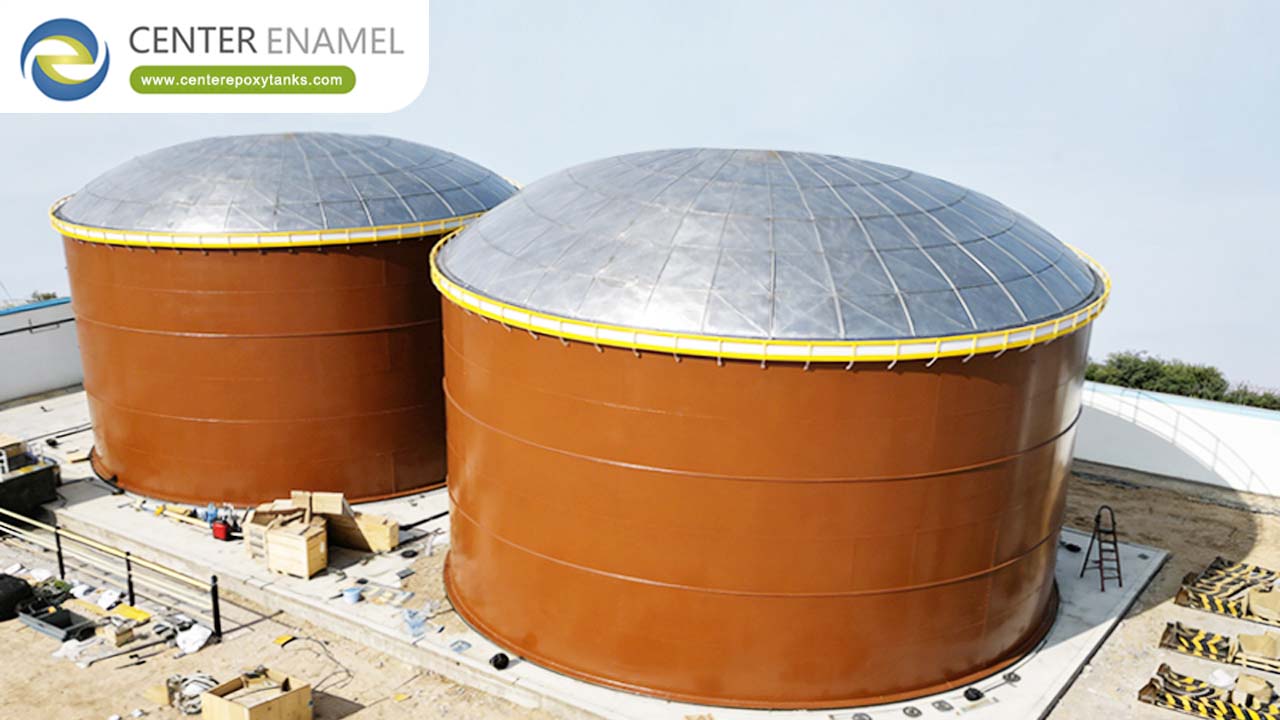
To eliminate this vulnerability, modern engineering projects pair the full-contact stainless steel floating roof with a column-free, clear-span Aluminum Geodesic Dome Roof or a Stainless Steel Fixed Dome. Removing internal structural obstructions enables the floating roof to glide smoothly along the tank shell. This drastically reduces mechanical wear on the rim seals, simplifies installation, and extends the service life of the roofing system to 30+ years.
Strategic Value and Lifecycle ROI
Choosing an API 650 Full-Contact Stainless Steel Floating Roof is a high-yield strategy for facilities dealing with volatile, aggressive, or high-temperature liquids. By eliminating the under-deck vapor workspace, prioritizing premium alloy construction, and eliminating internal structural friction points, terminal operators secure an asset designed for maximum environmental compliance, safety, and operational longevity.


