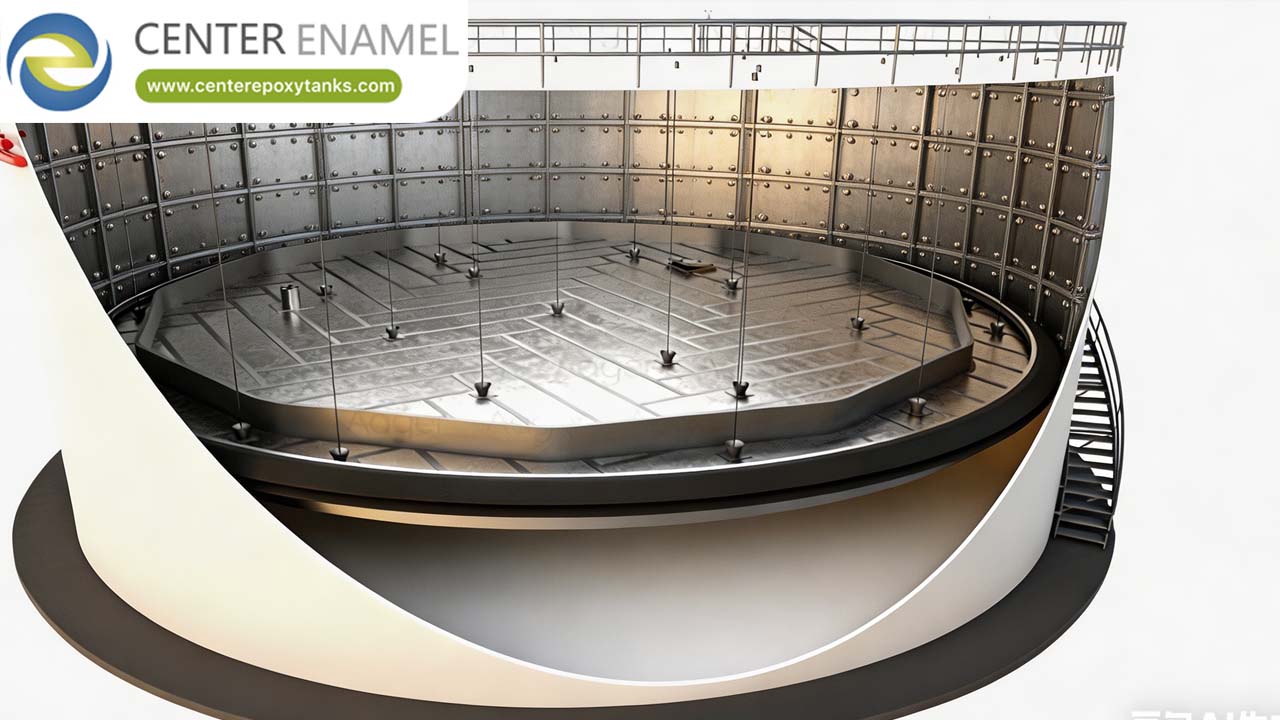
Engineering Guide to the API 650 Full-Contact Aluminum Floating Roof
In bulk liquid storage, chemical containment, and environmental engineering, controlling hazardous vapors while maintaining asset integrity is a primary challenge. As environmental mandates tighten globally, the API 650 Full-Contact Aluminum Floating Roof has emerged as a premier technology for high-performance vapor suppression and product preservation within industrial storage tank systems.
Governed by the strict design parameters of API 650 Appendix H, full-contact aluminum roofs represent a significant evolution from traditional skin-and-pontoon internal floating roofs (IFRs). By resting flush against the liquid surface, these roofs eliminate the internal vapor space entirely, providing maximum safety and efficiency.
1. What is a Full-Contact Aluminum Floating Roof?
Unlike non-contact floating roofs—which utilize a raised deck skin supported above the liquid by tubular pontoons—a full-contact roof is designed to leave zero space between the deck and the stored product.
This is typically constructed using a modular matrix of aluminum honeycomb panels sandwiched between high-strength top and bottom aluminum sheets. The result is a seamless, rigid, and high-buoyancy floating floor. Because there is no vapor workspace beneath the panels, volatile organic compound (VOC) emissions are suppressed by up to 98%+, virtually eliminating the primary cause of product evaporation and tank headspace hazards.
2. Key API 650 Appendix H Compliance Requirements
To satisfy international compliance and ensure safe deployment in heavy industrial environments, a full-contact aluminum floating roof must be engineered to exact mechanical standards:
● Advanced Buoyancy Safety Factors: API 650 requires that the internal floating deck possess a flotation reserve capable of supporting at least twice (2.0x) the total dead weight of the roof structure, including all seals, adjustable legs, and floating instrumentation.
● Two-Compartment Puncture Contingency: The panel matrix must be calculated to ensure that even if the primary outer rim and any two adjacent honeycomb compartments suffer localized structural punctures, the deck will remain safely afloat and level on the liquid surface.
● Static Charge Dissipation: Pumping volatile fluids at high velocities creates substantial static electricity. In compliance with API standards, full-contact aluminum roofs integrate flexible stainless steel bonding cables or shunts that maintain continuous electrical contact with the tank shell, safely grounding static buildup to eliminate spark-ignition risks.
● Dual-Position Support Legs: When a tank is taken out of service, the aluminum deck rests on a grid of heavy-duty support legs. These feature an adjustable low-leg setting for normal operation (maximizing net usable tank capacity) and a high-leg setting (typically 2 meters) to provide safe clearance for maintenance crews entering the tank floor.
3. Technical Performance Comparison
Evaluation Metric | Non-Contact Pontoon Floating Roof | API 650 Full-Contact Aluminum Roof |
Under-Deck Headspace | Minor vapor pockets present | Zero headspace (Flush contact) |
VOC Emission Suppression | 90% to 95% Efficiency | 95% to 98%+ Efficiency |
Structural Rigidity | Moderate (Flexible deck skin) | Maximum (Honeycomb sandwich core) |
Corrosion Resistance | Variable | Excellent (Marine-grade Alloys) |
Fire Suppression Target | Full liquid surface area | Perimeter rim seal area only |
4. Industrial Applications and Environmental Synergy
The structural advantages of marine-grade aluminum alloys (such as 6061-T6)—including a high strength-to-weight ratio and excellent natural corrosion resistance—make these roofs highly compatible with modern modular bolted storage tank systems.
Full-contact aluminum floating roofs are widely utilized across complex industrial sectors, particularly in wastewater engineering solutions and advanced anaerobic digestion processes. They are highly effective at controlling aggressive vapors and odors in high-volume industrial effluent management and specialized reactor configurations, such as CSTR, UASB, and USR systems. The full-contact design prevents corrosive gases like Hydrogen Sulfide (H2S) from collecting under the deck, protecting both the roof asset and the surrounding environment from premature degradation.
5. Maximizing Lifespan via Clear-Span Columns
A primary operational risk for internal floating roofs is mechanical binding or perimeter seal abrasion caused by internal vertical support columns. Traditional fixed steel roofs rely on a grid of support columns that penetrate directly through the floating deck, creating extra friction points and potential vapor leak paths.
To eliminate these structural vulnerabilities, industry leaders optimize their storage architecture by pairing the full-contact aluminum floating roof with a column-free, clear-span Aluminum Geodesic Dome Roof. Removing internal structural obstructions allows the floating deck to glide smoothly up and down the tank shell, which drastically reduces wear on perimeter rim seals, simplifies installation, and extends the overall asset lifecycle to 30+ years.
A High-ROI Asset for Volatile Storage
The API 650 Full-Contact Aluminum Floating Roof represents a definitive benchmark in liquid containment technology. By completely eliminating the under-deck vapor space, maximizing VOC suppression, and providing robust mechanical durability, it offers terminal operators and environmental engineers a reliable, code-compliant asset that delivers an exceptional return on investment through product preservation and unmatched site safety.


