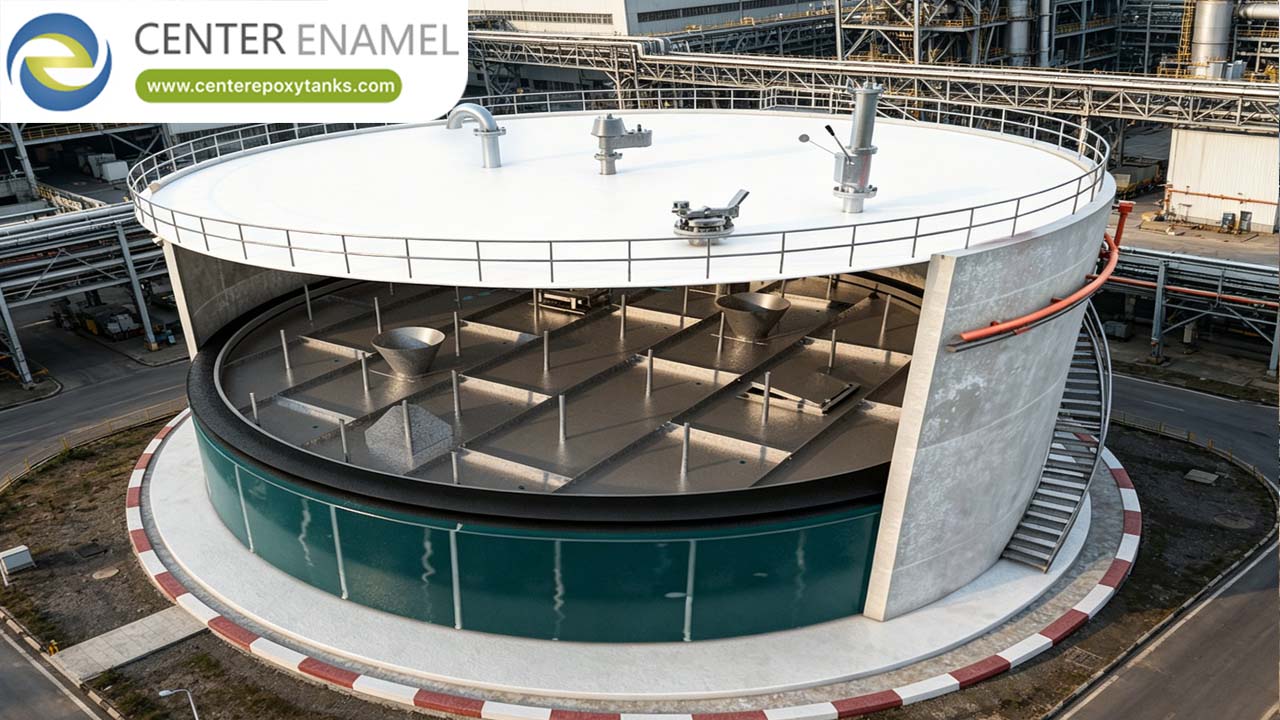
Engineering Guide to ASCE 7 Full-Contact Aluminum Floating Roofs
In modern petrochemical and chemical storage, environmental compliance is non-negotiable. The Full-Contact Aluminum Floating Roof is the industry’s most effective solution for suppressing Volatile Organic Compound (VOC) emissions. By ensuring 100% surface contact with the stored liquid, it eliminates the headspace where vapors accumulate, effectively stopping evaporation at the source.
To guarantee reliability, these systems must be engineered beyond basic mechanical standards. Integrating ASCE 7 load criteria ensures that the floating deck remains stable, level, and functional even under the stress of seismic ground acceleration or extreme wind-induced shell deformation.
1. The Full-Contact Mechanical Advantage
Traditional "non-contact" floating roofs rely on a peripheral ring of pontoons to float the deck several inches above the liquid. This creates a saturated vapor space underneath the roof.
In contrast, a Full-Contact roof uses lightweight, modular aluminum honeycomb panels that float directly on the liquid surface.
● Zero Vapor Space: By eliminating the headspace, the thermodynamic potential for liquid-to-gas transition is removed.
● Weight Efficiency: High-strength, marine-grade aluminum (typically 6061-T6 alloy) allows for a rigid structure that is significantly lighter than steel, placing less demand on buoyancy requirements.
2. Managing ASCE 7 Seismic Loads
The primary engineering challenge for any internal floating roof is "binding." If a storage tank shell ovalizes or vibrates during an earthquake, a poorly designed roof can get stuck against the shell or punctured by its own support legs.
Engineers use ASCE 7 to calculate Hydrodynamic Sloshing Forces. When a tank experiences ground acceleration, the liquid inside moves in two modes:
1. Impulsive Mode: The liquid mass moving with the shell.
2. Convective (Sloshing) Mode: The upper liquid mass forming low-frequency waves.
ASCE 7 dictates the wave height and pressure distributions for these modes. A full-contact roof must be engineered with specific annular clearance and flexible perimeter rim seals that accommodate these lateral shifts, ensuring the roof remains centered and mobile regardless of the tank’s movement.
3. Structural Benchmarks for Compliance
To satisfy both API 650 and ASCE 7, every full-contact roof must adhere to these structural mandates:
● 2.0x Buoyancy Factor: The roof must maintain stable flotation with a reserve capable of supporting at least twice the total dead weight of the roof assembly, including rim seals and instrumentation. This ensures the deck remains buoyant even if local damage occurs.
● Two-Compartment Puncture Survival: The panel matrix must be calculated so that if the perimeter seal area and any two adjacent internal panels are breached, the roof will stay level and afloat.
● Adjustable Support Legs: Heavy-duty pipe legs are required for maintenance. In high-seismic zones, the leg-to-deck connection is reinforced to prevent it from punching through the deck during a seismic event.
Performance Comparison Matrix
Metric | Non-Contact Pontoon Roof | Full-Contact Aluminum Roof |
Vapor Space | Present (High emission risk) | Zero (Maximum suppression) |
VOC Efficiency | 90–95% | 98–99%+ |
Structural Weight | High | Low (Aluminum Honeycomb) |
Seismic Risk | Moderate (Binding potential) | Low (Rigid, compliant design) |
Maintenance | Frequent (Corrosion prone) | Minimal (Natural oxide layer) |
4. Operational Synergy: The Clear-Span Dome
The most effective way to protect a Full-Contact Aluminum Floating Roof is to install an Aluminum Geodesic Dome Roof (ADR) above it.
Integrating these two systems creates a "Closed-Loop" storage environment:
1. Shielding: The dome assumes all wind, snow, and rain loads, meaning the floating roof doesn't need to account for these variables in its structural design.
2. Column-Free Synergy: Removing internal structural columns (which would otherwise require the roof to be cut and sealed around them) prevents the floating roof from binding, which is a major point of failure during seismic events.
3. Maximum Longevity: This synergy protects the roof from UV radiation and external pollutants, extending the service life of the rim seals to over 30 years.
Strategic Value and Lifecycle
Investing in an ASCE 7-compliant Full-Contact Aluminum Floating Roof is a decisive strategy for industrial operators. By combining the emission-suppression capabilities of a full-contact deck with the rigorous structural safety mandates of ASCE 7, facilities can guarantee asset resilience, regulatory compliance, and maximum inventory preservation for decades.
Does your engineering team require a technical review of the specific ASCE 7 seismic parameters—such as the Site Class or Risk Category—that would dictate the required annular clearance for your upcoming tank project?


