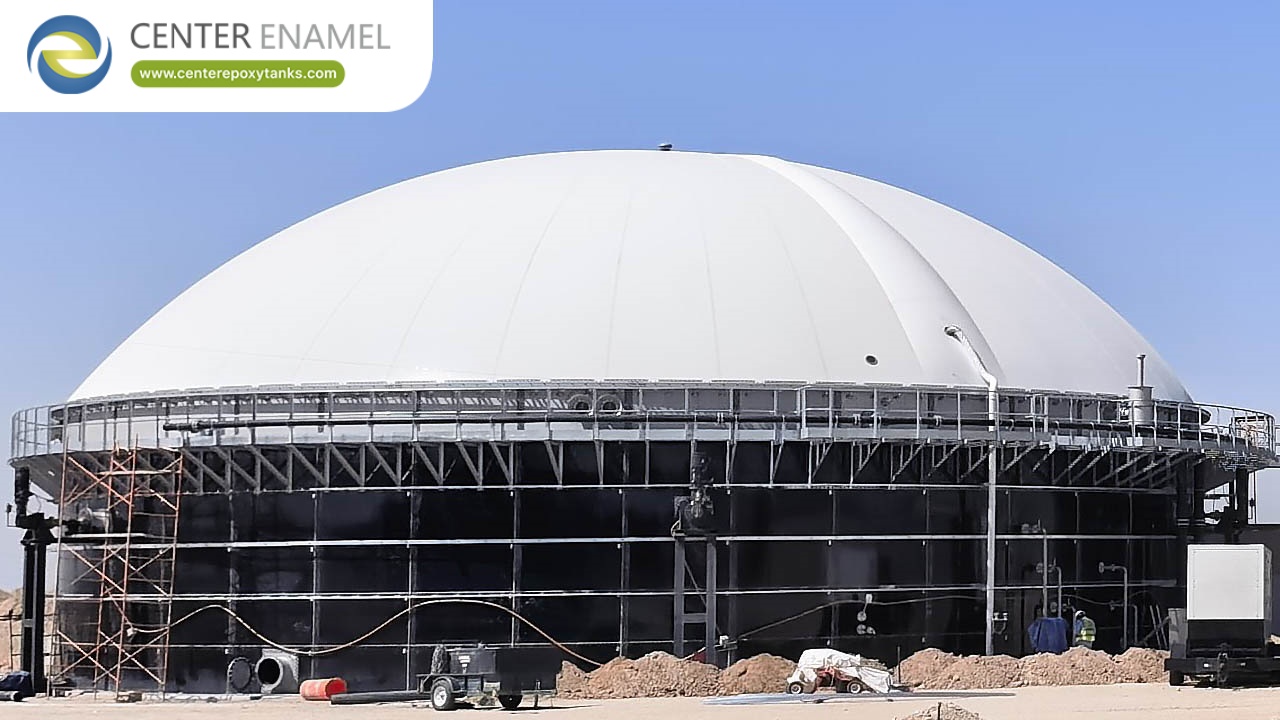
Double Membrane Roofs for Glass Fused to Steel Tanks: The Ultimate Biogas & Containment Synergy
In the fields of renewable energy generation, wastewater treatment, and organic waste management, anaerobic digestion (AD) plants require containment systems that do more than just store liquids. They must reliably capture, store, and regulate the continuous production of biogas—a mixture primarily composed of methane (CH4) and carbon dioxide (CO2)—while withstanding highly aggressive internal headspaces saturated with moisture and hydrogen sulfide (H2S).
To achieve peak efficiency and structural longevity, modern engineering pairs glass-fused-to-steel (GFS) tanks with an integrated double membrane roof. This combination merges the supreme chemical inertness and structural resilience of glass-lined steel panels with a flexible, dual-layer fabric gas holder.
Technical Synergy: Why GFS Tanks and Double Membrane Roofs Work Together
Glass-fused-to-steel tanks are manufactured by fusing high-grade glass enamel to structural steel plates at extreme temperatures (820°C to 930°C). This molecular bond creates a non-porous, highly durable surface that resists chemical corrosion and abrasion. When topped with a double membrane roof, the system creates an optimized containment envelope:
Corrosion-Proof Enclosure: The headspace of an anaerobic digester is notoriously corrosive. While traditional carbon steel roofs suffer rapid oxidation and concrete roofs experience acid spalling, GFS tank walls combined with specialized thermoplastic roof membranes offer total resistance to H2S and moisture attack.
Dual-Function Gas Containment: The double membrane roof acts simultaneously as a secure weather shield and a volumetric gas holder. The inner membrane moves up and down freely to store and discharge biogas, while the outer membrane remains permanently inflated via an automated blower system, maintaining constant pressure and protecting the system against wind and snow loads.
Modular Scalability and Fast Deployment: Both GFS tanks and membrane roofs utilize modular, bolted construction principles. This eliminates complex field welding, drastically reduces on-site installation timelines, and allows project developers to scale infrastructure efficiently.
Data Table: Comprehensive Comparison of Digester Tank Roof Systems
Technical Parameter | Double Membrane Roof on GFS Tank | Traditional Fixed Steel Roof | Cast-in-Place Concrete Digester Cover |
Primary Function | Integrated weather protection and active low-pressure biogas storage | Structural cover only; requires external gas holding vessels | Structural cover only; heavy mass requiring reinforced concrete walls |
Headspace Corrosion Defense | Superior; glass-fused-to-steel walls and PVC/PVDF membranes are inert to H2S | Vulnerable to wet biogas corrosion unless expensive internal coatings are applied | Prone to concrete carbonation, micro-cracking, and acid-induced degradation |
Gas Storage Capability | Integrated volumetric storage buffering daily production surges | None; requires standalone gas storage bladders or holders | None; fixed structural roof with no gas holding elasticity |
Installation & Maintenance | Rapid modular bolting with lightweight membrane assembly | Requires heavy crane lifts, field welding, and periodic repainting cycles | Slow civil construction with prolonged curing and high labor overhead |
Frequently Asked Questions (FAQ)
Q: What is a double membrane roof on a glass-fused-to-steel tank?
A: It is an engineered dual-layer fabric cover mounted on top of a GFS bolted storage tank that functions simultaneously as a weather-resistant protective roof and an active, gas-tight biogas storage holder.
Q: Why are double membrane roofs ideal for anaerobic digester GFS tanks?
A: They provide a cost-effective, pressurized gas collection solution that safely handles biogas volume fluctuations while resisting the highly corrosive hydrogen sulfide (H2S) and moisture present in digestion headspaces.
Q: How is constant pressure maintained in a double membrane GFS tank roof?
A: An automated air-blower system maintains a regulated air cushion between the inner and outer membranes. This air cushion exerts a consistent downward force on the inner gas chamber, ensuring stable gas delivery pressure to downstream combined heat and power (CHP) engines or boilers.
Q: What materials are used to manufacture these membranes?
A: They are fabricated from high-tenacity reinforced thermoplastic fabrics (such as specialized PVC or PVDF-coated polyester) engineered for high tensile strength, UV resistance, and minimal gas permeability.


