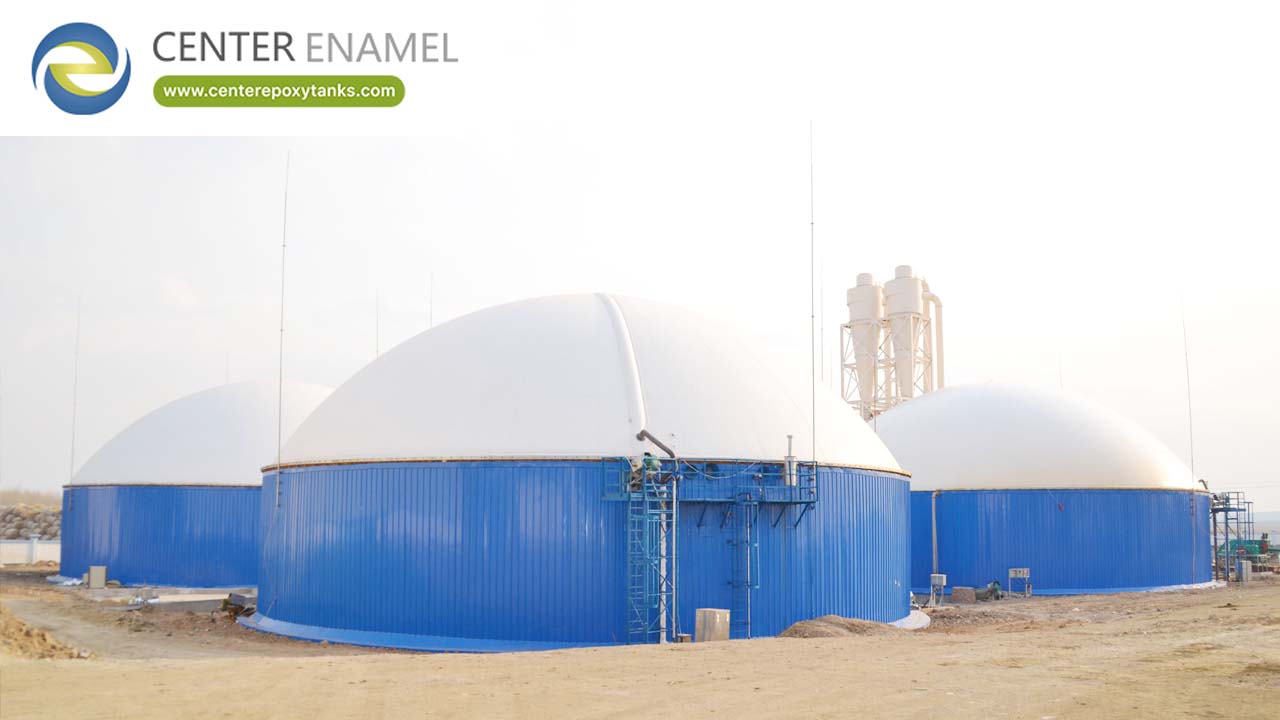
Single Membrane Roof for Biogas Tank: Design, Applications, and Benefits
A single membrane roof is an economic, gas-tight covering system engineered specifically for anaerobic digesters, wastewater treatment tanks, and agricultural slurry silos. Unlike complex multi-layer gas storage domes, a single membrane roof consists of a reinforced, high-tensile synthetic fabric stretched across a central support column or radial strap network, sealing the tank hermetically while managing basic emissions and low-pressure gas collection.
Constructed from advanced PVC-coated polyester or UV-resistant EPDM fabrics, single membrane roofs provide a durable, low-maintenance solution for facilities where intensive active gas storage is secondary to effective odor control, corrosion prevention, and environmental compliance.
Core Functions of Single Membrane Tank Roofs
Strict Odor and Emission Control: In municipal wastewater treatment plants and agricultural biogas setups, open-air biological processes release heavy ammonia and hydrogen sulfide odors. A hermetically sealed single membrane roof prevents fugitive emissions, helping plants satisfy environmental regulations.
Anaerobic Atmosphere Protection: Biogas production relies on strictly oxygen-free conditions. By sealing off ambient air ingress, the membrane maintains optimal anaerobic digester integrity while shielding upper tank walls from acidic condensation and weathering.
Cost-Effective Enclosure: For projects operating on tighter capital budgets or those that do not require massive active buffer storage, a single-layer roof offers a lightweight, break-proof, and rapid-to-install alternative to rigid steel or concrete roofs.
Design and Structural Engineering
The manufacturing and installation of a single membrane roof require precise architectural planning:
Central Support Architecture: Most single membrane covers utilize a heavy-duty central support column paired with a radial array of stainless steel tension straps or a safety net. This prevents the membrane from sagging into the liquid slurry while maintaining an efficient conical or domed runoff shape for rain and snow.
Molecular High-Frequency (HF) Welding: Synthetic fabric panels are custom-cut via CNC machinery and welded together using high-frequency or laser bonding, ensuring absolute gas-tight integrity across the entire surface.
Perimeter Clamping System: The edge of the membrane is anchored securely to the tank’s upper flange or concrete rim using heavy-duty stainless steel tension ratchets and EPDM sealing gaskets, preventing gas leakage under variable weather conditions.
Data Table: Technical Parameters & System Comparison
Technical Parameter | Single Membrane Roof | Double Membrane Biogas Dome |
Primary Function | Odor control, emission reduction, low-pressure sealing | Active gas buffering and constant-pressure delivery |
Membrane Construction | Single reinforced layer (PVC or EPDM) | Dual layers (Inner gas liner + Outer pressurized shell) |
Methane Permeability | < 5 cm3/m2.24 h | < 5 cm3/m2.24 h |
Operating Temperature Range | -35 °C to +80 °C | -30 °C to +70 °C |
Internal Support Structure | Central column and/or radial tension straps | Self-supporting air-inflated outer dome |
Tank Compatibility | GFS tanks, concrete silos, slurry storage | Commercial CSTR digesters, standalone storage |
Capital Investment | Low to moderate investment cost | Moderate to high (requires blowers & automation) |
Frequently Asked Questions (FAQ)
Q: Is a single membrane roof suitable for active gas storage?
A: Generally, no. A single membrane roof acts primarily as an environmental seal and low-pressure cover. If your facility requires continuous active gas buffering for a Combined Heat and Power (CHP) engine, a double-membrane biogas holder system is recommended.
Q: What materials are used to manufacture single membrane tank covers?
A: They are typically constructed from high-tensile polyester base fabrics coated with Polyvinyl Chloride (PVC) or high-elasticity EPDM rubber. These materials provide UV stability, flame resistance, and protection against chemical degradation from hydrogen sulfide (H°2S).
Q: Are single membrane roofs compatible with Glass-Fused-to-Steel (GFS) tanks?
A: Yes. Single membrane covers can be custom-engineered to fit bolted GFS tanks, stainless steel tanks, and cast-in-place concrete structures using specialized stainless steel clamping profiles.
Q: How do single membrane roofs handle heavy rain and snow?
A: Thanks to their conical slope supported by a central column and radial tension straps, single membrane roofs naturally shed rainwater and resist snow buildup when properly tensioned.


