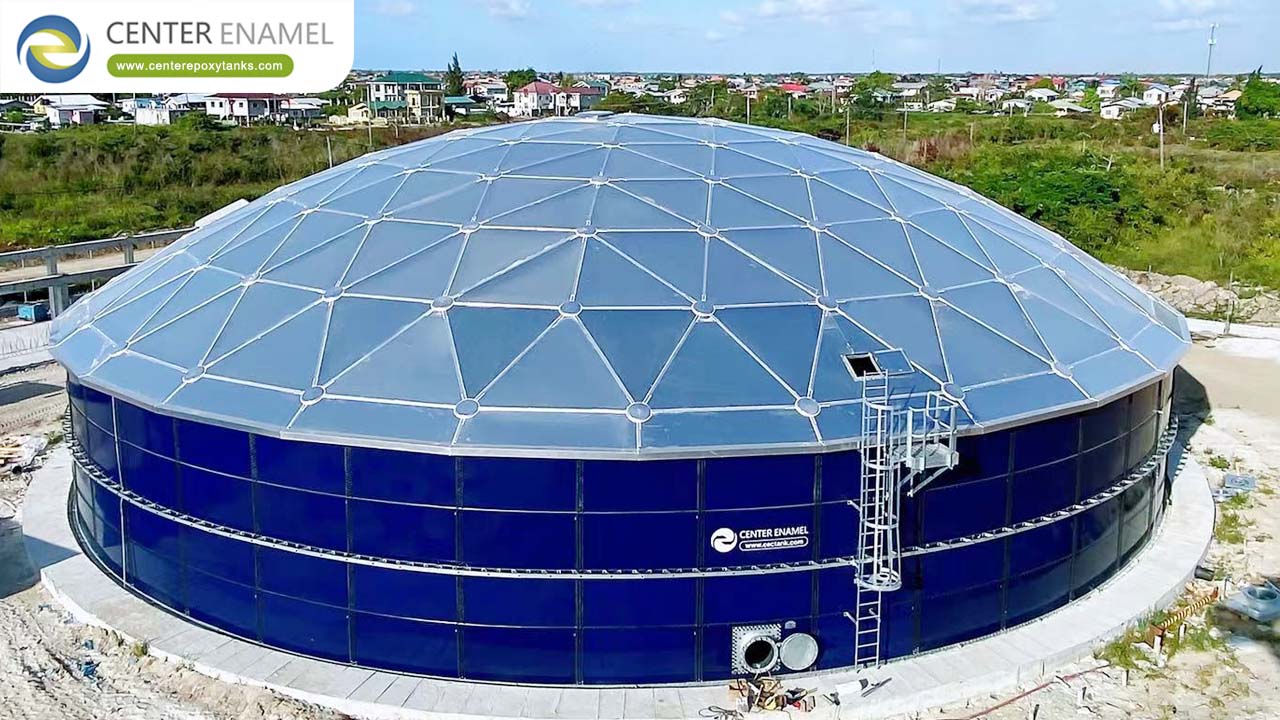
Aluminum Dome Roofs for GFS Tanks: The Ultimate Engineering Synergy by Center Enamel
In municipal water supply, industrial wastewater treatment, and bulk chemical containment, storage assets must survive decades of continuous exposure to harsh internal environments and fluctuating external weather. While Glass-Fused-to-Steel (GFS) tanks offer premium, low-maintenance corrosion resistance for the tank shell, pairing them with the correct roof system is critical to overall asset longevity.
Center Enamel, a global leader in custom liquid containment and cover systems, engineers premier Aluminum Geodesic Dome Roofs (AGDR) explicitly optimized for seamless mechanical integration with modular bolted GFS tanks.
Why Pair Aluminum Geodesic Domes with GFS Tanks?
Traditional carbon steel or glass-reinforced plastic (GRP) roofs often introduce structural vulnerabilities when managing volatile or highly humid headspaces. Aluminum geodesic domes resolve these issues via an efficient architectural shape:
1. Column-Free, Clear-Span Design
An aluminum geodesic dome utilizes a unique triangulated space-frame geometry that requires no internal vertical columns or structural rafters for support.
Process Efficiency: The entire internal tank volume remains unobstructed. This is ideal for wastewater clarifiers, sequencing batch reactors (SBRs), and anaerobic digesters where top-entering mixers, aeration grids, and scraper bridges must spin or move freely.
Foundation Relief: Because the dome is self-supporting, it transfers loads evenly around the perimeter of the GFS tank shell. It eliminates centralized dead loads, allowing for lighter, more cost-effective concrete foundation designs.
2. Microscopic Corrosion Protection
Wastewater and municipal sludge generation release volatile gases like hydrogen sulfide (H₂S). When mixed with internal humidity, H₂S forms highly acidic condensation that aggressively attacks painted or unlined carbon steel roofs.
Material Advantage: Structural aluminum naturally forms a tough, self-healing oxide layer when exposed to oxygen. It remains completely inert to H₂S and VOC vapors, ensuring the roof will last the lifetime of the GFS tank without needing costly sandblasting or protective re-coatings.
3. Thermal Efficiency and Reduced Product Loss
Aluminum possesses high solar reflectivity (reflecting up to 95% of solar radiation) and low emissivity. By turning away solar heat, the dome regulates temperature swings in the vapor headspace. This cuts down on evaporation losses in volatile liquid storage and prevents warm-temperature bacterial blooms in municipal potable water supplies.
Technical Specifications & Compliance
Center Enamel designs, manufactures, and supplies aluminum cover frameworks built to withstand extreme environmental configurations.
Performance Vector | Specification Detail | Industry Standard Compliance |
Primary Structural Alloy | High-strength extruded 6000-series aluminum | ASTM B221 / EN 755 |
Roof Panel Material | Marine-grade 3000 or 5000-series aluminum sheets | ASTM B209 / EN 485 |
Design Structural Load | Custom engineered for high snow/wind loads | AWWA D103/D108, API 650 App. G |
Sealing Gaskets | High-performance EPDM or Silicone matrices | FDA Food-Grade Compliant |
Fastener Hardware | Grade 304 or 316 Stainless Steel components | ISO / EN Standards |
Advanced Modular Installation Mechanics
A major benefit of specifying Center Enamel’s aluminum domes is the ease and speed of field installation, especially when paired with modular, bolted GFS tanks.
1.Ground-Level Frame Pre-Assembly:Minimizes Hot Work Risk。
Struts and node hubs are assembled on the ground adjacent to the tank footprint or directly on the tank floor. This eliminates dangerous high-elevation tasks and removes the need for field welding or specialized hot-work permits.
2.Panel Cladding and Sealing:Batten-Skin Clamping。
Marine-grade aluminum panels are laid over the frame structure. Center Enamel utilizes an interlocking batten-clamping or lapped configuration embedded with UV-resistant EPDM gaskets to form a weather-tight, leak-proof barrier.
3.Perimeter Shoe Alignment:Compensates for Thermal Movement。
Specialized sliding or pivoting support shoes are attached at the base perimeter. Because aluminum expands and contracts at a different rate than steel, these sliding shoes prevent structural stress from feeding into the top of the GFS tank shell.
4.Full Crane Lift and Final Anchoring:Rapid Deployment。
The entire completed dome is lifted by a crane and positioned directly onto the top angle rim of the GFS tank. The perimeter connection points are securely bolted, ensuring rapid tank completion with minimal downtime.
Frequently Asked Questions (FAQ)
Can an aluminum geodesic dome be retrofitted onto an existing GFS tank?
Yes. Because structural aluminum is incredibly lightweight compared to carbon steel, it is the premier choice for retrofitting aging or leaking roofs on older tanks. It rarely requires costly reinforcements to the existing tank shell or underlying foundation assets.
How do aluminum dome roofs handle extreme wind and heavy snow loads?
The physical shape of a geodesic dome distributes environmental forces (such as snow piles or wind shear) evenly across the entire frame grid. Its rounded profile also reduces wind uplift forces far better than flat or cone designs, making it resilient against hurricane-force winds. Center Enamel custom-engineers each roof configuration to comply with local wind and snow load parameters specified by AWWA D103/D108 or ASCE 7.
Are there risks of galvanic corrosion between the steel tank shell and the aluminum roof?
Center Enamel prevents galvanic corrosion by completely isolating dissimilar metals. Every connection point between the GFS steel top ring and the aluminum dome support shoe is lined with heavy-duty, non-conductive synthetic isolation gaskets (typically EPDM) and sleeved washer assemblies, stopping any direct metal-to-metal electrical pathways.
What maintenance is required over the lifespan of an aluminum dome cover?
Practically none. Unlike traditional steel alternatives that demand routine pressure washing, rust remediation, and expensive painting cycles every few years, an aluminum dome roof operates with near-zero required upkeep over its 30 to 50-year service span. Periodic visual checkups of the perimeter seals and vent cleanlines are usually all that is recommended.
For further visual insight into the construction flow, technical architecture, and real-world deployment of these space-frame containment enclosures, watch this Storage Tank Aluminum Geodesic Dome Roof Assembly, Installation & Benefits Video. This resource highlights the real-world advantages of modular, crane-assisted clear-span dome positioning on heavy-duty storage tanks.


