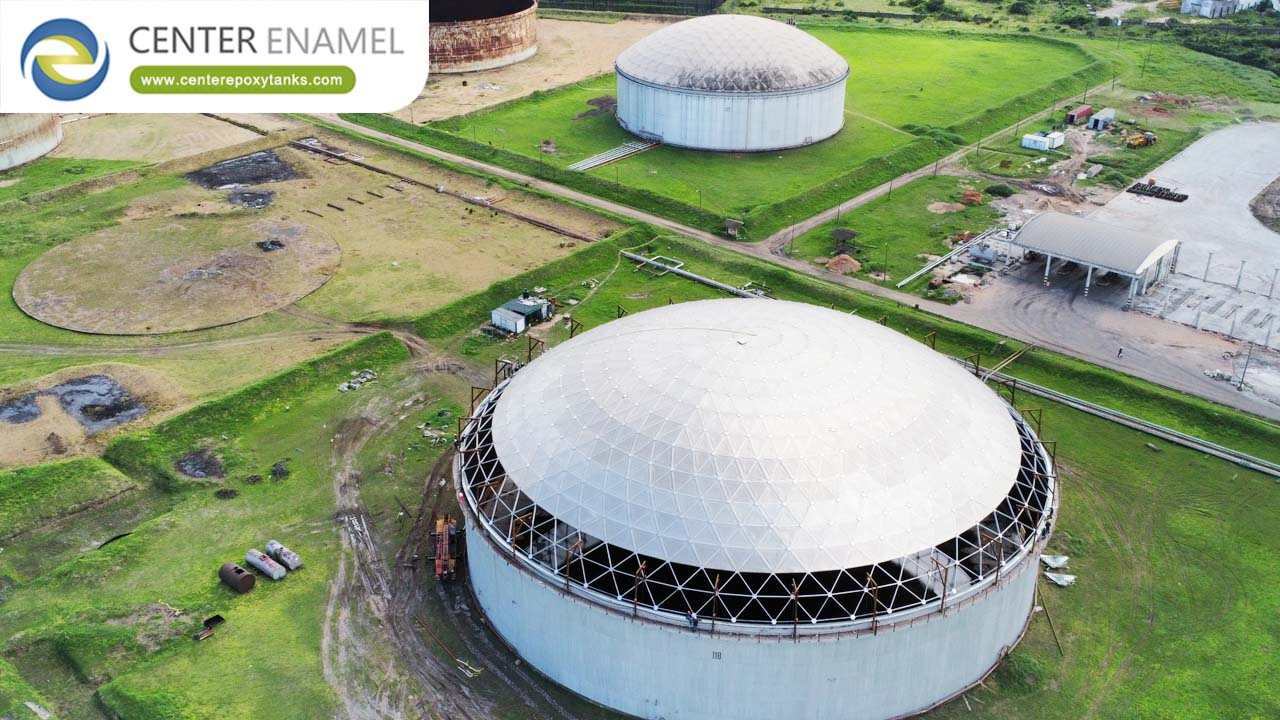
Aluminum Domes for Large Diameter Tanks: Innovative Clear-Span Storage Solutions
Aluminum geodesic domes are the premier roofing solution for large diameter tanks (exceeding 100m), engineered to meet API 650 Appendix G and AWWA D108 standards. These clear-span, self-supporting structures eliminate internal columns, significantly increasing storage volume while reducing Volatile Organic Compound (VOC) emissions. As a global leading manufacturer, Center Enamel utilizes high-strength 6000-series aluminum alloys to provide a maintenance-free, non-sparking barrier that withstands extreme wind, snow, and seismic loads in the energy, water, and agricultural sectors.
1. Technical Specification & Performance Matrix
Feature | Technical Specification (2026 Standard) | Strategic Utility Value |
Design Standard | API 650 Appendix G / ADM 2020 | Mandatory for structural and vapor safety. |
Span Capability | Up to 120m+ (Clear-Span) | Eliminates columns; maximizes internal volume. |
Alloy Grade | 6061-T6 / 6063-T6 Aluminum | Superior strength-to-weight; C5-M corrosion rating. |
Seal Integrity | UV-Resistant Silicone / EPDM | Ensures gas-tightness and zero rainwater ingress. |
Weight Advantage | ~1/3 of Steel Roof Weight | Reduces load on tank shells and foundations. |
Sustainability | 100% Recyclable Material | Supports ESG goals and LEED certification. |
2. Structural Engineering: The Geodesic Space-Frame Advantage
Clear-Span Geometry and Load Distribution
Unlike traditional cone roofs that require a forest of internal pillars, the geodesic dome is a space-frame lattice.
● Triangular Lattice Dynamics: The structure consists of interconnected triangular facets that distribute environmental loads (wind, snow, seismic) uniformly across the tank’s perimeter. This allows for diameters exceeding 120 meters with a completely unobstructed interior.
● Seismic and Wind Resilience: Engineered to ASCE 7-22 standards, these domes are aerodynamically superior, significantly reducing "wind uplift" forces during hurricane-strength events.
Passive Fire Safety and Non-Sparking Properties
For large-diameter petroleum and biogas storage, material choice is a safety critical factor.
● Passive Protection: Aluminum is inherently non-sparking and non-combustible. This makes it the preferred choice for Class 1, Div 1 environments where flammable vapors are present.
● Reflectivity and Temperature Regulation: Aluminum’s high thermal reflectivity keeps the stored product cooler, reducing internal pressure and secondary evaporation losses.
3. High-Stakes Applications for Large Diameter Storage
● Petrochemical Terminals: Covering massive external floating roof tanks (EFRTs) to eliminate rainwater accumulation and curb VOC emissions.
● Municipal Water Treatment: Protecting large-scale reservoirs and clarifiers from UV-induced algae growth and external contaminants.
● Bioenergy Infrastructure: Capping large-scale anaerobic digesters to contain methane and stabilize internal process temperatures.
4. Why Center Enamel? The EPC Engineering Edge
As a Global Leading Storage Solutions Provider, Shijiazhuang Zhengzhong Technology Co., Ltd offers a unique technological advantage:
● 30-Year Global Track Record: We are the first manufacturer in China to integrate Glass-Fused-to-Steel (GFS) tanks with advanced Aluminum Dome technology, providing a single point of accountability.
● Precision CNC Fabrication: Our 150,000 m2 facility ensures sub-millimeter tolerances for every strut and hub, facilitating rapid, "No-Hot-Work" assembly on-site.
● Compliance Mastery: Our engineering team rigorously adheres to ISO 9001, EN 1090, and FM Global benchmarks, ensuring insurance-grade reliability for critical infrastructure.
● Custom Integration: We provide tailored accessory packages, including explosion-proof vents, specialized hatches, and integrated peripheral seals for floating roof applications.
5. Technical FAQ: Large Diameter Dome Solutions
Q: How does the dome handle extreme snow accumulation?
A: Every dome is custom-modeled using Finite Element Analysis (FEA) software. We adjust the strut thickness and lattice density to meet specific local snow load requirements, ensuring structural safety even in arctic climates.
Q: What is the maintenance requirement for a 100m diameter dome?
A: Virtually zero. Aluminum naturally forms a protective oxide layer that resists atmospheric corrosion. Unlike steel, it never requires sandblasting or repainting, leading to significant lifecycle cost savings (TCO).
Q: Can these be installed while the tank is in service?
A: In many cases, yes. Because our modular design requires no welding ("Hot Work"), installation can often proceed with minimal disruption to terminal operations, provided safety protocols are followed.


