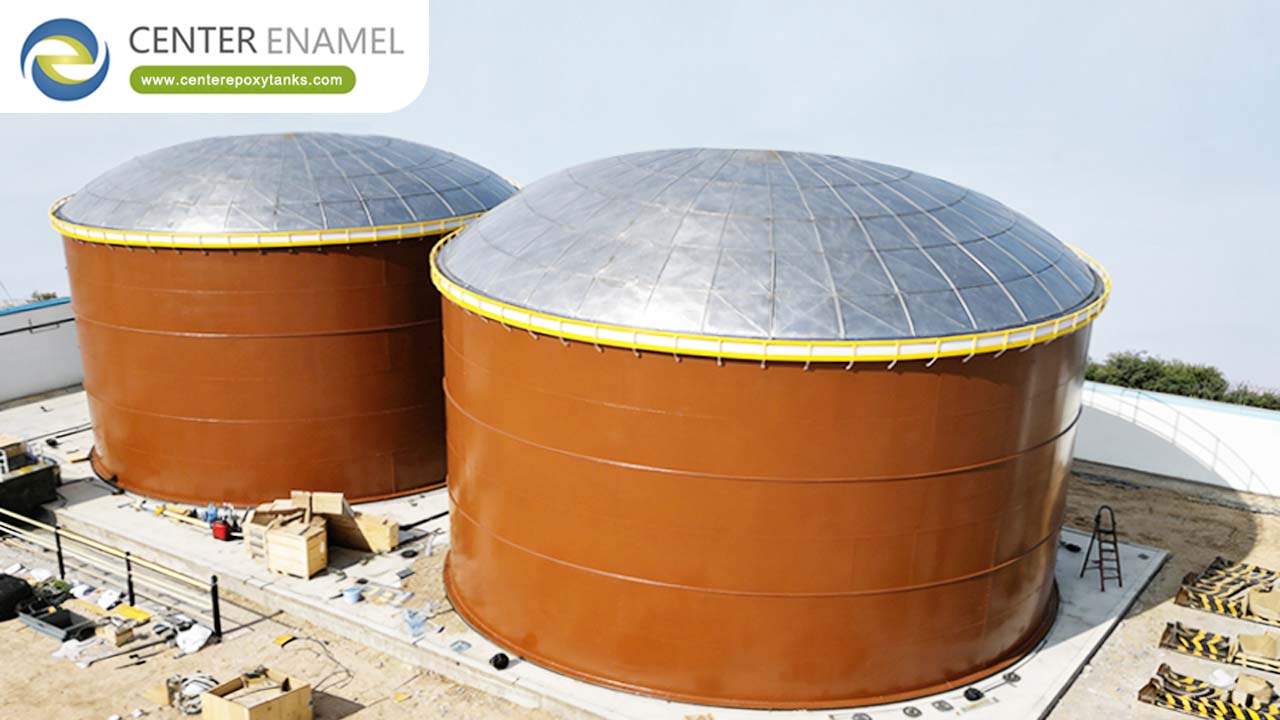
Dome Roof Tanks: Design, Features, and Engineering Advantages
In the global industrial bulk liquid storage sector, selecting the correct vessel architecture is vital for structural safety, environmental compliance, and long-term economic efficiency. Among atmospheric storage tanks built to standards such as API 650 Appendix G and AWWA D108, dome roof tanks—most commonly implemented as geodesic aluminum space frames—represent the pinnacle of modern tank cover engineering.
Unlike traditional carbon steel cone roofs that require internal support columns and periodic repainting, dome roof tanks feature a self-supporting, curved, clear-span geometry that maximizes interior volume, resists atmospheric corrosion, and minimizes volatile organic compound (VOC) emissions.
1. Structural Design and Geodesic Geometry
The fundamental engineering breakthrough of a dome roof tank lies in its structural geometry. Composed of high-strength aluminum alloy struts, interlocking panels, gusset plates, and batten bars, a geodesic dome forms a network of triangulated elements along great circles on a sphere.
·
100% Clear-Span Architecture: The unique triangulated design transfers structural dead loads, wind loads, and snow loads outward to the perimeter tank shell rim. This achieves a completely clear-span interior, eliminating the need for internal support columns or vertical rafters.
·
·
High Strength-to-Weight Ratio: Aluminum alloys provide exceptional structural strength while maintaining an extremely lightweight profile. This drastically reduces dead-load stress on the underlying steel or concrete tank shell, allowing for optimized wall thickness.
·
·
Precision Mechanical Sealing: Modern industrial domes utilize clamping panel designs with integrated gasketing systems along batten bars, ensuring a weather-tight barrier that prevents rainwater ingress and fugitive emissions.
·
2. Key Operational Features and Benefits
Dome roof tanks offer distinct performance advantages over conventional steel fixed roofs across major industrial applications:
·
Exceptional Corrosion Resistance: Fabricated from high-grade aluminum alloys, dome roofs naturally resist aggressive chemical vapors, marine atmospheres, and weathering, completely eliminating the need for periodic painting or protective coating maintenance.
·
·
Solar Heat Reflection: The highly reflective nature of exterior aluminum panels bounces away solar radiation. This keeps internal headspace and liquid temperatures lower, significantly curbing product evaporation and breathing losses.
·
·
Hybrid Internal Floating Roof Integration: Dome roofs serve as the ideal fixed outer cover for Internal Floating Roof Tanks (IFRs). Because there are no internal support columns, floating decks travel vertically up and down without mechanical interference or sleeve penetration leaks.
·
·
Rapid In-Service Erection: Prefabricated modular components allow for fast on-site bolting and installation, frequently enabling retrofit construction on active, in-service tanks without extended downtime.
·
Data Table: Dome Roof Tank Technical Specifications
Engineering Parameter | Geodesic Aluminum Dome Roof Specification |
Governing Standards | API 650 Appendix G, AWWA D108, ASCE 7, ISO EN 1090 |
Construction Material | High-strength structural aluminum alloys (Extruded beams and panels) |
Internal Support System | Clear-span structure (Zero internal support columns or pillars) |
Corrosion Performance | Maintenance-free; naturally resistant to rust and chemical vapor attack |
Vapor & Emission Control | Optimized for VOC containment and hybrid internal floating deck pairing |
Typical Industrial Applications | Refined fuel terminals, chemical processing, municipal water, wastewater treatment |
Frequently Asked Questions (FAQ)
Q: What is a dome roof tank?
A: A dome roof tank is an industrial storage vessel covered by a self-supporting, curved geodesic structure—typically made of lightweight aluminum—that spans the entire tank diameter without requiring internal support columns.
Q: Why is aluminum preferred over steel for geodesic dome roofs?
A: Aluminum offers a superior strength-to-weight ratio, is naturally resistant to atmospheric and chemical corrosion, requires zero painting or protective coating maintenance, and reflects solar radiation to reduce product evaporation.
Q: Can a geodesic aluminum dome be installed on an existing storage tank?
A: Yes. Aluminum geodesic domes are frequently engineered as retrofit solutions for existing cone-roof or external floating-roof tanks, often installed while the tank remains in active service.
Q: How do dome roof tanks improve VOC emission control?
A: By providing a sealed, vapor-tight envelope—especially when paired with an internal floating deck—dome roofs eliminate wind-induced evaporation and minimize thermal breathing losses, cutting VOC emissions by up to 99%.


