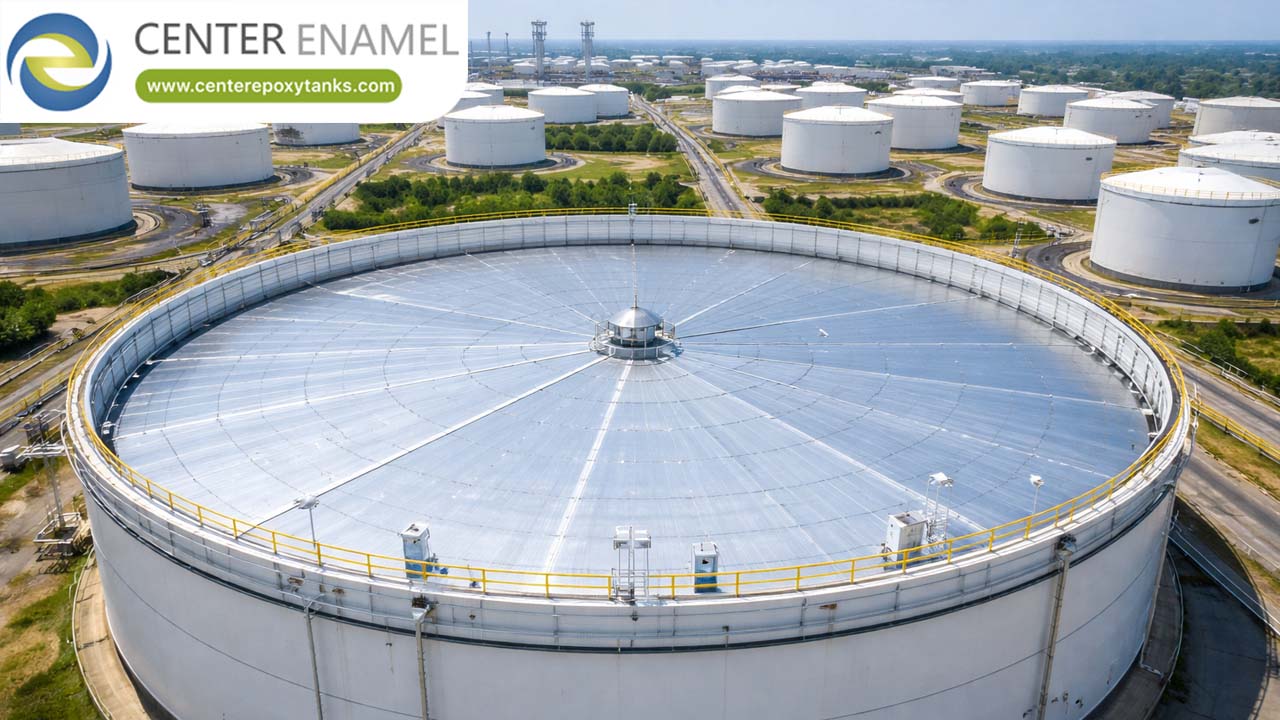
Design and Applications of Cone Roof Storage Tanks
In the global industrial bulk liquid storage sector, selecting the correct vessel architecture is vital for structural safety, capital efficiency, and operational reliability. A cone roof storage tank is an atmospheric storage vessel featuring a permanently attached, sloped conical roof welded or bolted directly to the top of the cylindrical tank shell.
Engineered in strict accordance with international standards such as API 650, cone roof tanks maintain a permanent air space (ullage) between the stored liquid surface and the stationary roof. They represent the industry standard for cost-effective containment of low-volatility liquids, water, heavy fuel oils, and industrial process chemicals.
1. Engineering Design Principles and Structural Configurations
The defining feature of a cone roof tank is its conical roof geometry, which slopes upward from the perimeter shell to a center point, resembling an inverted funnel. Depending on the tank's diameter, capacity, and structural load requirements, cone roofs are engineered into two primary classifications:
·
Self-Supporting Cone Roofs: Designed for smaller-to-medium tank diameters, self-supporting cone roofs derive their structural integrity entirely from the geometry of the cone and the compression ring at the shell-to-roof joint. They require zero internal support columns, making them ideal for applications requiring unobstructed interior access, easy cleaning, or internal coating applications.
·
·
Supported Cone Roofs (Column-Supported): For large-diameter bulk storage vessels, the weight and span of the conical roof plates require structural reinforcement. Supported cone roofs utilize an internal framework of radial rafters, girders, and a central support column (or multiple intermediate columns) to safely bear snow, wind, and dead loads.
·
2. Key Mechanical Features and Safety Appurtenances
Cone roof tanks incorporate several standard and optional engineering features to ensure safe operation, venting, and maintenance under API 650 guidelines:
·
Frangible Shell-to-Roof Joints: Many atmospheric cone roof tanks feature a specialized weak-link weld detail joining the roof to the top angle of the shell. In the event of an internal vapor explosion, this joint fails preferentially, venting pressure upward and preventing catastrophic failure of the main tank body.
·
·
Pressure-Vacuum Relief Valves (PVRVs): Installed on the roof to handle normal breathing and working losses, PVRVs prevent excessive pressure buildup during filling and vacuum collapse during rapid pump-out.
·
·
Vapor Space Management: Because a fixed headspace remains above the liquid, cone roof tanks are vulnerable to "breathing losses" driven by daily thermal cycles, often necessitating vapor recovery units (VRUs) or inert gas blanketing for sensitive chemical products.
·
Data Table: Cone Roof Tank Design Matrix
Design Parameter | Self-Supporting Cone Roof | Supported Cone Roof (Column-Supported) |
Typical Tank Diameter | Small-to-medium diameters (generally under 20 to 30 meters) | Large-diameter bulk storage tanks (exceeding 30 meters) |
Internal Support Structure | None (Clear-span geometry relying on shell rim compression) | Radial rafters, support girders, and central/intermediate columns |
Primary Construction Material | Welded carbon steel plates (ASTM A36 / ASTM A516) | Welded carbon steel plates with structural steel framing |
Interior Access & Maintenance | Unobstructed interior simplifies cleaning, coating, and lining | Internal columns and rafters require routine inspection and coating maintenance |
Typical Stored Products | Municipal water, process water, industrial chemicals, diesel | Crude oil settling tanks, heavy fuel oil, bunker fuel |
3. Industrial Applications
Cone roof tanks are deployed across diverse industrial landscapes where liquid volatility is low and environmental vapor pressures do not mandate floating deck systems:
·
Water and Wastewater Treatment: Storing municipal potable water, clarified process water, and biological sludge where external contamination control is managed via closed shell structures.
·
·
Petroleum Refining and Terminals: Acting as crude oil settling tanks, storage vessels for heavy fuel oils, diesel reserves, lubricants, and bitumen.
·
·
Chemical Processing: Containing non-volatile liquid chemicals, acids, or feedstock materials where carbon steel or specialized alloy construction provides robust structural reliability.
·
Frequently Asked Questions (FAQ)
Q: What is a cone roof storage tank?
A: A cone roof storage tank is an atmospheric storage vessel featuring a permanently attached, sloped conical roof that remains stationary during liquid filling and emptying operations.
Q: When is a supported cone roof required instead of a self-supporting design?
A: Supported cone roofs are required for large-diameter storage tanks where the span is too wide for the roof plates to support themselves against wind, snow, and dead loads without internal rafters and central support columns.
Q: What types of liquids can be safely stored in a cone roof tank?
A: Cone roof tanks are designed primarily for low-volatility liquids, including water, wastewater, heavy fuel oils, lubricants, and diesel, where evaporation and flammable vapor risks are minimal.
Q: Can a cone roof tank be modified into a floating roof tank?
A: Yes. Many industrial facilities perform cost-effective retrofits by installing an internal floating deck inside an existing cone roof tank shell (creating an internal floating roof tank) to achieve high VOC emission control.


