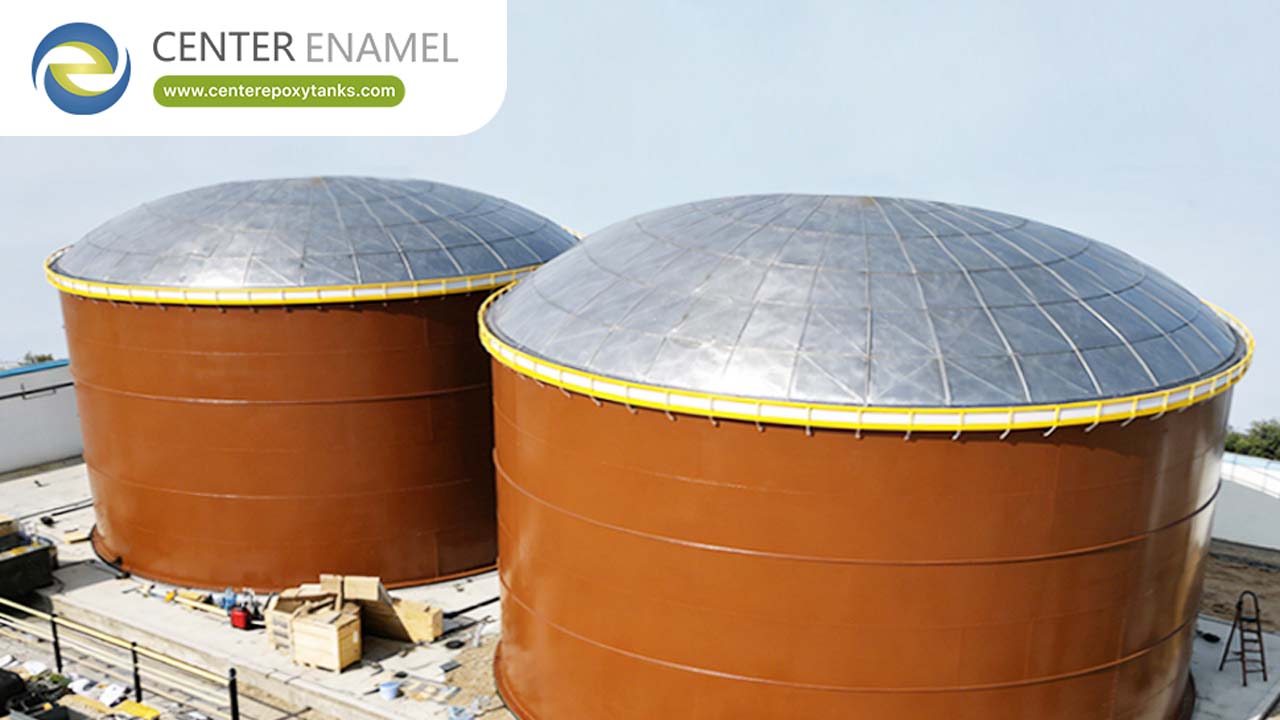
Design Considerations for Aluminum Geodesic Dome Roofs: A Technical Overview
Aluminum geodesic dome roofs have become the industry gold standard for large-scale liquid storage, providing a self-supporting, corrosion-resistant, and high-strength enclosure. For engineers and facility managers, specifying a dome roof requires balancing complex structural physics with environmental and operational demands.
Whether designing for petrochemical storage, municipal water, or industrial wastewater treatment, the following design considerations are critical to ensuring a safe, compliant, and durable asset.
1. Structural Loading and Environmental Stress
The dome’s structural grid must be engineered to withstand dynamic forces. Unlike flat roofs, the geometry of a geodesic dome allows for efficient load distribution, but calculations must be rigorous.
● Snow & Live Loads: Domes must be designed to accommodate peak snow loads, including unbalanced snow loads where accumulation is heavier on one side of the structure. This is often dictated by ASCE 7 or local building codes.
● Wind Loads: Given their spherical profile, domes are susceptible to wind uplift and pressure. Engineers must conduct Finite Element Analysis (FEA) to ensure the dome can withstand regional wind speed requirements without deflection or skin disengagement.
● Seismic Considerations: Because the dome’s low mass reduces the lateral force transferred to the tank shell during an earthquake, they are preferred in seismic zones. However, the connection to the tank rim must be designed to handle these base shear forces.
2. Geometric Engineering and Finite Element Analysis (FEA)
A successful dome design hinges on its triangular lattice framework. The design must optimize the triangulation to ensure strength while minimizing material cost.
● Self-Supporting Geometry: The primary design advantage of a geodesic dome is its ability to span large diameters without internal columns. This requires a tension ring at the perimeter to contain horizontal thrust and prevent the dome from "pushing" the tank walls outward.
● Computational Analysis: Modern design requires 3D CAD modeling combined with FEA to simulate how the structure reacts to stress. This software-driven approach identifies potential failure points and optimizes beam thickness.
3. Material Selection and Corrosion Resistance
The longevity of the roof is dictated by the materials specified. Marine-grade aluminum alloys are the standard because they form a natural, self-healing oxide layer that prevents oxidation.
● Alloy Specifications: Structural frame members are typically extruded from 6061-T6 or 6005A-T6 aluminum alloys, which provide excellent strength-to-weight ratios.
● Fastener Compatibility: A critical design flaw to avoid is galvanic corrosion. Any fasteners used to attach aluminum to carbon steel must be high-grade stainless steel or specifically isolated to prevent electrolytic reaction.
4. Watertightness and Sealing Systems
One of the most frequent operational issues in tank roofs is water ingress, which can compromise the product or damage internal components.
● Batten Bar Systems: The design must incorporate an interlocking batten bar system that secures closure panels firmly in place. These should be sealed with high-performance, UV-resistant sealants that remain flexible across extreme temperature ranges.
● Thermal Expansion: The roof must allow for thermal contraction and expansion of the panels without losing its watertight seal, requiring specialized gasket design.
5. Regulatory Compliance and Standardization
Infrastructure projects must be built to recognized international standards. Design considerations must align with the specific requirements of the intended application:
● API 650 (Appendix G): The standard for aluminum dome roofs on oil and chemical storage tanks. It details the requirements for structural strength, load combinations, and safety.
● AWWA D108: The standard governing aluminum structures specifically for water and wastewater applications.
Technical Comparison: Dome Roof Engineering
Design Factor | Aluminum Geodesic Dome | Carbon Steel Cone Roof |
Support Structure | Clear-span (No columns) | Usually requires columns |
Maintenance | Virtually none (Non-corrosive) | Frequent (Requires painting/blasting) |
Installation | Modular (Zero Hot-Work) | Heavy (Requires welding) |
Weight | Lightweight (Low foundation load) | Heavy (High foundation load) |
Asset Service Life | 40+ Years | 20–25 Years |
Designing for the Future
The move toward aluminum geodesic dome roofs is driven by the need for low-maintenance, emission-compliant, and structurally superior storage. By prioritizing rigorous structural analysis, selecting appropriate aluminum alloys, and ensuring strict adherence to API 650 or AWWA D108 standards, designers can create infrastructure that protects assets for decades.
As a global leader in storage infrastructure, Center Enamel provides custom-engineered, API 650-compliant aluminum dome roofs tailored to the specific environmental and load-bearing requirements of your project. Contact our engineering team today to discuss your site-specific design needs.


