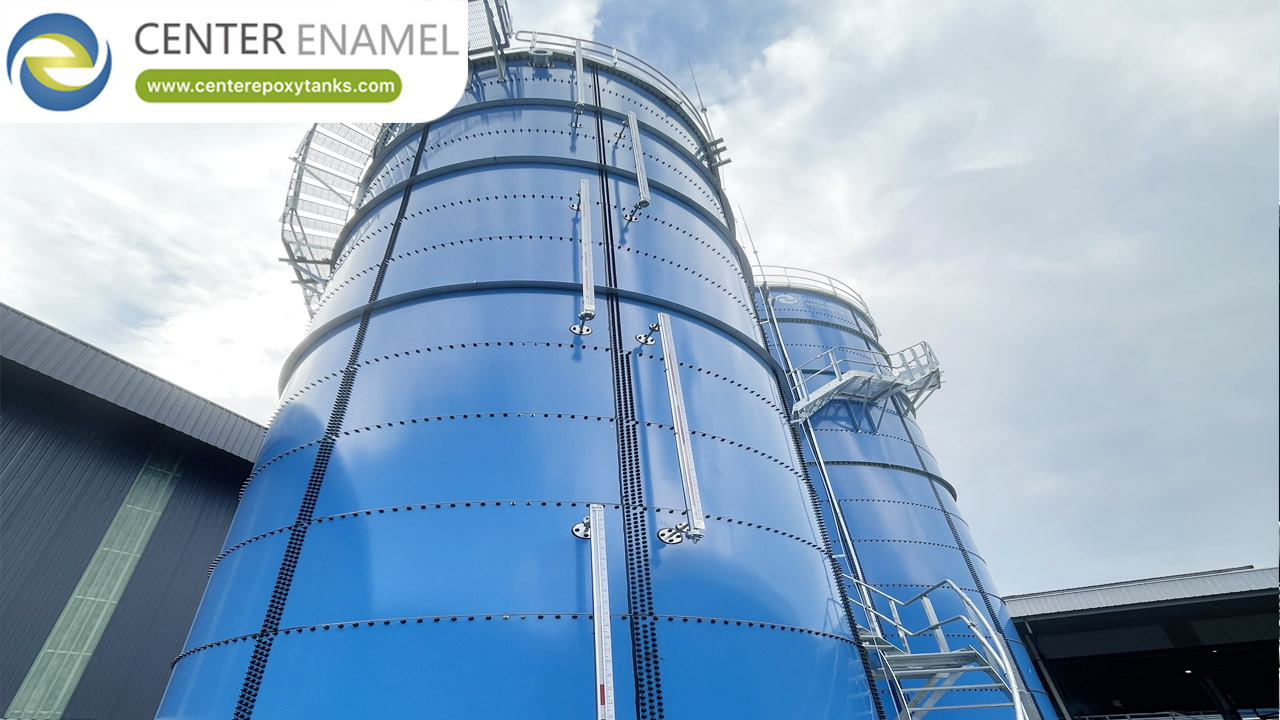
Data Center Demineralized Water Tank: Pretreatment and Storage
A demineralized water tank stores water that has had hardness and dissolved salts removed, typically by softening, reverse osmosis and ion exchange working in sequence. Where the tank sits in that chain determines what it has to protect: upstream storage holds raw water and must tolerate variable quality, while downstream storage holds treated water and must avoid re-contaminating it. For downstream duty, stainless steel or a factory-applied epoxy coating is normal; for raw water ahead of treatment, a glass-fused-to-steel bolted tank with a coating selected for the source water chemistry is a practical and economical option.
Water treatment on a data center site is a chain of stages, and storage appears at more than one point in it. Each storage location has a different water chemistry, and therefore a different tank requirement - which is why a single tank specification applied throughout the chain causes problems.
This article maps the treatment chain, explains what each storage point has to withstand, and sets out the material and provision decisions for each. It covers hardness removal through to demineralized water storage, including the practical question of where treatment should sit relative to storage.
Technical Explanation
The treatment chain and its storage points
A typical sequence on a data center site proceeds through several stages, and storage can sit before, between or after them:
• Raw water intake: source water from municipal supply, borehole or surface source, usually held in a raw water tank to buffer supply variation.
• Softening: hardness ions removed by ion exchange or membrane process, protecting downstream equipment from scale; often a separate vessel rather than a storage tank.
• Reverse osmosis: bulk dissolved solids removed, producing permeate that is stored before polishing.
• Ion exchange polishing: residual ions removed to reach the required quality, with the polished water stored for use.
• Where storage sits matters: the further downstream it is, the more the tank has to protect quality rather than simply hold volume.
What each storage point requires
The specification difference between stages is greater than the difference in size:
• Raw water storage: tolerates variable turbidity and chemistry, requiring a coating selected for the worst credible water quality and provisions for sediment removal and periodic cleaning.
• Permeate storage: low in dissolved solids and therefore aggressive, requiring a material or coating that will not leach ions, plus filtered venting to limit carbon dioxide uptake.
• Polished water storage: the most demanding quality target, conventionally stainless steel, with closed construction and dedicated sampling.
• Break tank duty: where a tank provides hydraulic separation or protects against backflow, it may store intermediate-quality water and needs the material suited to that stream.
Softening, and what it does not do
Softening is frequently confused with demineralization, and the distinction affects the tank:
• Softening removes hardness ions and replaces them with sodium, so the water is no longer scale-forming but still carries dissolved solids and has a higher sodium content.
• Demineralization removes dissolved salts more completely, producing water with low conductivity that behaves very differently towards materials.
• The consequence for storage is that softened water is closer to ordinary water in behaviour, while demineralized water is aggressive and requires a purity-conscious tank specification.
Provisions across the chain
Four provisions apply to treated water storage at any stage, with the emphasis shifting by position in the chain:
• Covered or closed construction with filtered venting, to limit contamination and carbon dioxide uptake.
• Level indication and control, so that treatment can respond to demand and the plant does not run dry.
• Sampling points before and after storage, which is how the tank's own contribution to water quality is verified rather than assumed.
• Drainage and cleaning access, since every stage of the chain will eventually need cleaning, and provisions installed at build stage cost far less than ones added later.
Technical Specifications
Table 1 - Storage points in a demineralization chain
Storage point | Water quality | Practical tank material | Main provisions |
Raw water | Variable, may be turbid | Glass-fused-to-steel bolted with a coating suited to the source water | Sediment removal, cleaning access, level control |
Softened water | Hardness removed, sodium raised | Coated steel | Cover, level control, treatment connections |
RO permeate | Low dissolved solids, aggressive | Stainless steel or epoxy coated steel | Filtered vent, closed construction, sampling |
Polished demineralized water | Very low conductivity | Stainless steel 316L | Closed construction, dedicated sampling, no stagnant volume |
Break tank | Intermediate | Material suited to the stream it holds | Hydraulic separation, overflow, access |
Project Case Study
Project Case Summary - treated water storage delivered
The deliveries below cover treated water storage in both coated steel and stainless steel, cited because the same material split applies across a demineralization chain.
Project | Application | Capacity | Construction | Roof | Completion |
Chile | Desalinated water | 6,578 m3 | Fusion bonded epoxy | Aluminium dome | 2025-03 |
Congo | Industrial water | 1,398 m3 | Glass-fused-to-steel bolted | Aluminium flat roof | 2026-01 |
Malaysia | Industrial water | 815 m3 | Stainless steel | Not applicable | 2026-04 |
Company Expertise
Center Enamel manufactures tanks for raw, treated and high-purity water stages in glass-fused-to-steel, fusion bonded epoxy and stainless steel construction, so the material can be matched to each point in the treatment chain rather than standardised across it.
As an outstanding containment and cover system provider with decades of industry experience, Center Enamel sincerely expects to establish long-term cooperation with local partners throughout the world and to make continuous contribution to the development of the industry.
Shijiazhuang Zhengzhong Technology Co., Ltd is not only the first manufacturer in China to produce Glass-Fused-to-Steel tanks, but also the most experienced professional bolted tank manufacturer in Asia. The engineering, design, product testing and quality system of Center Enamel Glass-Fused-to-Steel tanks are in strict accordance with AWWA D103-09, OSHA, ISO 28765, NSF/ANSI 61 and NFPA. By 2023, Center Enamel bolted tanks had been exported to more than 100 countries, including the USA, Australia, Canada, Malaysia, Indonesia, Russia, the UAE, Panama, Brazil and South Africa.
Shijiazhuang Zhengzhong Technology Co., Ltd (Center Enamel) is a professional manufacturer dedicated to the design and fabrication of bolted storage tanks since 2008. Our product range includes Glass-Fused-to-Steel (GFS) tanks, fusion bonded epoxy tanks, stainless steel tanks, galvanized steel tanks and aluminum geodesic dome roofs. With a professional enameling R&D team and nearly 200 enameling patents, Center Enamel has become a leader in the bolted tank industry in Asia. Our products are certified to ISO 9001, NSF 61, EN 1090, ISO 28765, WRAS, FM, LFGB, BSCI and ISO 45001.
Shijiazhuang Zhengzhong Technology Co., Ltd (Center Enamel) is a professional manufacturer dedicated to the design and fabrication of bolted storage tanks since 2008. Our product range includes Glass-Fused-to-Steel (GFS) tanks, fusion bonded epoxy tanks, stainless steel tanks, galvanized steel tanks and aluminum geodesic dome roofs. With a professional enameling R&D team and nearly 200 enameling patents, Center Enamel has become a leader in the bolted tank industry in Asia. Our products are certified to ISO 9001, NSF 61, EN 1090, ISO 28765, WRAS, FM, LFGB, BSCI and ISO 45001.
Shijiazhuang Zhengzhong Technology Co., Ltd is not only the first manufacturer in China to produce Glass-Fused-to-Steel tanks, but also the most experienced professional bolted tank manufacturer in Asia. The engineering, design, product testing and quality system of Center Enamel Glass-Fused-to-Steel tanks are in strict accordance with AWWA D103-09, OSHA, ISO 28765, NSF/ANSI 61 and NFPA. By 2023, Center Enamel bolted tanks had been exported to more than 100 countries, including the USA, Australia, Canada, Malaysia, Indonesia, Russia, the UAE, Panama, Brazil and South Africa.
As an outstanding containment and cover system provider with decades of industry experience, Center Enamel sincerely expects to establish long-term cooperation with local partners throughout the world and to make continuous contribution to the development of the industry.
Frequently Asked Questions (FAQ)
Q: What is the difference between softened and demineralized water?
A: Softening removes hardness ions and replaces them with sodium, so the water stops forming scale but still contains dissolved solids. Demineralization removes dissolved salts much more completely, producing low-conductivity water that is chemically aggressive towards many materials.
Q: Where should storage sit in a demineralization chain?
A: Storage usually appears at two points: ahead of treatment to buffer supply variation, and after treatment to hold the produced water for use. More storage means more buffering capacity and more water that has to be kept in condition, so the volume at each point should follow the demand and treatment capacity.
Q: Can a glass-fused-to-steel tank store demineralized water?
A: It can store treated water and is widely used for potable and industrial supply. For the most demanding purity targets, stainless steel or a factory-applied epoxy coating is the more conventional specification, and the choice should be made against the water quality requirement rather than assumed.
Q: Do softening and demineralization tanks need different materials?
A: The materials differ in how much they have to protect water quality rather than in structural terms. Softened water behaves more like ordinary water; demineralized water is aggressive and needs a surface that will not contribute ions, with a covered tank and filtered vent.
Q: How is the tank's effect on water quality verified?
A: By sampling before and after storage and comparing the results. That isolates the tank's contribution from the treatment plant's performance and shows whether cleaning or a material change is needed.
Q: What treatment chemicals affect the tank specification?
A: Regeneration chemicals from ion exchange, antiscalant dosing before reverse osmosis, and any post-treatment pH adjustment all reach the tank at some concentration or during some operating condition. Those chemicals should be listed in the specification so the coating and sealant selection can be checked against them.
Demineralized water storage has to be specified stage by stage. Raw, softened, permeate and polished water place different demands on the tank, and applying one specification across the chain either wastes money upstream or risks quality downstream. Match the material to each storage point, and provide venting, sampling and cleaning access at every one.
Talk to the Engineering Team
Send the treatment chain, the water quality target at each storage point and the volumes required. We will recommend the tank material and provisions for each stage, with the coating system documented for your specification.


