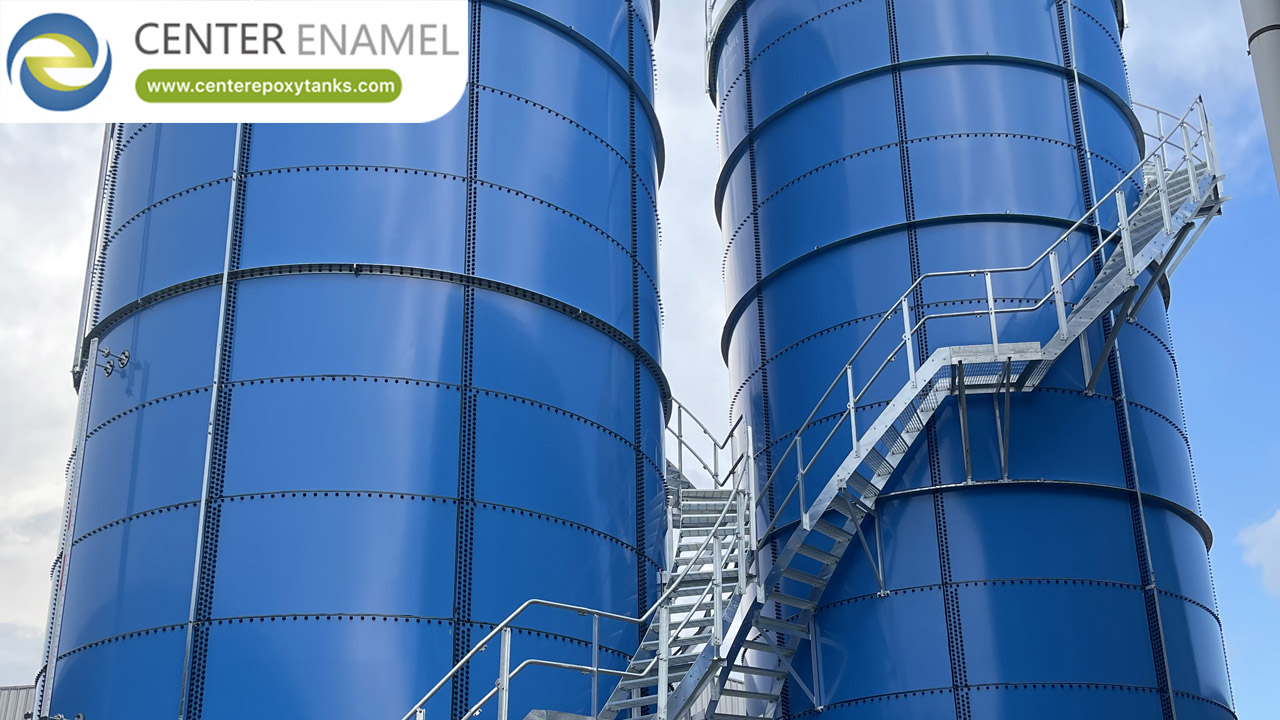
Data Center Dual Purpose Water Tank: Domestic and Fire Storage Combined
A dual purpose water tank holds the domestic water supply and the fire reserve in one vessel, with the fire volume protected so that domestic drawdown cannot consume it. It is permitted only where the applicable fire protection requirements and the local authority allow the arrangement, and it demands three things: a fire volume that remains permanently available; a potable water certified coating for the whole vessel, since domestic water contacts every surface; and control provisions that make the fire reserve visible and verifiable rather than assumed. Where the arrangement is not permitted, the domestic and fire stores must be separate tanks.
Combining domestic water and fire reserve storage in one tank looks like an obvious saving: one foundation, one plot, one vessel to maintain. In practice it is a compliance arrangement with operating obligations, and whether it is acceptable is decided by the fire protection requirements and the local authority rather than by the designer's preference.
This article explains when a dual purpose tank is used, what has to be protected if it is, and how to specify and operate one. It also sets out the cases where separation is required, because a dual purpose design that is not permitted becomes an expensive mistake.
Technical Explanation
What the two duties demand
Domestic and fire storage have obligations that point in different directions:
• Fire reserve: a fixed volume that must remain available at all times, with no dependence on how the rest of the system has been used.
• Domestic supply: continuous drawdown at a rate that varies through the day, with water quality requirements that apply to the entire wetted surface.
• Turnover: domestic supply benefits from regular turnover, while a fire reserve can sit unchanged for long periods - a combination that has to be managed deliberately.
• Certification: potable water contact requirements apply to the whole vessel once domestic water is stored in it, including the fire reserve portion.
How the fire volume is protected
The engineering problem is preventing domestic consumption from reaching into the fire reserve:
• Reserve elevation: the fire volume is held in the lower part of the tank, with the domestic draw-off connection placed above the reserve level so that domestic supply cannot draw below it.
• Level control: domestic make-up controlled to maintain the combined level, with the fire reserve level protected by the physical position of the connections rather than only by control logic.
• Monitoring: alarms for the fire reserve level, so the operator knows immediately if it falls, which is the practical way to satisfy a requirement for a protected fire volume.
• Refill capacity: the fill arrangement must be able to restore the fire reserve within the time the fire protection requirements specify, which depends on the supply connection and not on the tank.
Water quality and certification
Once the vessel carries domestic water, quality requirements extend to every surface in contact with it:
• Coating certification: the coating must be certified for drinking water contact across the whole vessel, so the fire reserve portion is coated to the same standard.
• Stagnation management: the fire reserve sits idle, so water quality has to be maintained through treatment, periodic circulation or monitored turnover rather than assumed.
• Sampling: domestic supply sampling points on the tank, with results recorded, connected to the site's water safety plan.
• Access and cleaning: the vessel needs internal access for inspection and cleaning that meets the standard for potable water storage.
When to keep the stores separate
Separation is the right answer in three common situations:
• Where the fire protection requirements or the local authority do not permit a combined arrangement.
• Where the fire reserve is large relative to domestic demand, so the domestic turnover would be too low to maintain quality in the combined volume.
• Where the insurer requires a dedicated fire reserve that is not affected by any other system, which is a common condition on high-value sites.
Technical Specifications
Table 1 - Combined and separate domestic and fire storage compared
Aspect | Dual purpose tank | Separate tanks | Consideration |
Plot and foundation | One vessel, one foundation | Two vessels, or one vessel and a pump chamber | Principal reason for combining |
Fire volume guarantee | Requires physical protection by connection position plus alarms | Inherent, since the fire tank is dedicated | The critical compliance point |
Potable certification | Applies to the whole vessel, including the fire reserve | Applies to the domestic tank only | Coating cost implication |
Water quality management | Stagnant fire volume must be managed | Each tank managed for its own duty | Operating effort |
Maintenance | One vessel, one inspection, but the fire reserve is affected by any work | Work on one tank leaves the other in service | Availability during maintenance |
Permitted by authority | Only where accepted by the fire protection requirement and local authority | Always acceptable | Check before designing |
Project Case Study
Project Case Summary - potable water storage delivered
The deliveries below are potable water tanks with coatings certified for drinking water contact, which is the certification requirement that governs a combined domestic and fire vessel.
Project | Application | Capacity | Construction | Roof | Completion |
Namibia | Potable water | 44,900 m3 | Glass-fused-to-steel bolted | Aluminium flat roof | 2022-09 |
Costa Rica | Potable water | 12,650 m3, 2 x 40.49 m diameter | Glass-fused-to-steel bolted | Aluminium dome | 2025-06 |
Indonesia | Potable water | 21,099 m3 | Glass-fused-to-steel bolted | Aluminium dome | 2025-06 |
Company Expertise
Center Enamel supplies bolted water tanks with coatings certified to NSF/ANSI 61 for potable water service, in configurations with the roof, access and sampling provisions that domestic water storage requires, and designed to AWWA D103-09.
As an outstanding containment and cover system provider with decades of industry experience, Center Enamel sincerely expects to establish long-term cooperation with local partners throughout the world and to make continuous contribution to the development of the industry.
Shijiazhuang Zhengzhong Technology Co., Ltd is not only the first manufacturer in China to produce Glass-Fused-to-Steel tanks, but also the most experienced professional bolted tank manufacturer in Asia. The engineering, design, product testing and quality system of Center Enamel Glass-Fused-to-Steel tanks are in strict accordance with AWWA D103-09, OSHA, ISO 28765, NSF/ANSI 61 and NFPA. By 2023, Center Enamel bolted tanks had been exported to more than 100 countries, including the USA, Australia, Canada, Malaysia, Indonesia, Russia, the UAE, Panama, Brazil and South Africa.
Shijiazhuang Zhengzhong Technology Co., Ltd (Center Enamel) is a professional manufacturer dedicated to the design and fabrication of bolted storage tanks since 2008. Our product range includes Glass-Fused-to-Steel (GFS) tanks, fusion bonded epoxy tanks, stainless steel tanks, galvanized steel tanks and aluminum geodesic dome roofs. With a professional enameling R&D team and nearly 200 enameling patents, Center Enamel has become a leader in the bolted tank industry in Asia. Our products are certified to ISO 9001, NSF 61, EN 1090, ISO 28765, WRAS, FM, LFGB, BSCI and ISO 45001.
Shijiazhuang Zhengzhong Technology Co., Ltd (Center Enamel) is a professional manufacturer dedicated to the design and fabrication of bolted storage tanks since 2008. Our product range includes Glass-Fused-to-Steel (GFS) tanks, fusion bonded epoxy tanks, stainless steel tanks, galvanized steel tanks and aluminum geodesic dome roofs. With a professional enameling R&D team and nearly 200 enameling patents, Center Enamel has become a leader in the bolted tank industry in Asia. Our products are certified to ISO 9001, NSF 61, EN 1090, ISO 28765, WRAS, FM, LFGB, BSCI and ISO 45001.
Shijiazhuang Zhengzhong Technology Co., Ltd is not only the first manufacturer in China to produce Glass-Fused-to-Steel tanks, but also the most experienced professional bolted tank manufacturer in Asia. The engineering, design, product testing and quality system of Center Enamel Glass-Fused-to-Steel tanks are in strict accordance with AWWA D103-09, OSHA, ISO 28765, NSF/ANSI 61 and NFPA. By 2023, Center Enamel bolted tanks had been exported to more than 100 countries, including the USA, Australia, Canada, Malaysia, Indonesia, Russia, the UAE, Panama, Brazil and South Africa.
As an outstanding containment and cover system provider with decades of industry experience, Center Enamel sincerely expects to establish long-term cooperation with local partners throughout the world and to make continuous contribution to the development of the industry.
Frequently Asked Questions (FAQ)
Q: Is a combined domestic and fire water tank allowed?
A: It depends on the applicable fire protection requirements and on the local authority. Many projects use combined arrangements where the fire volume is reliably protected and the potable certification extends to the whole vessel; others require a dedicated fire reserve. The question should be settled with the authority and the insurer before the design is fixed.
Q: How is the fire reserve kept available in a combined tank?
A: By positioning the domestic draw-off connection above the fire reserve level, so domestic supply physically cannot draw into the reserve, supported by level alarms that make any reduction in the reserve visible. Refill capacity then has to be able to restore the reserve within the specified time.
Q: What coating is needed for a dual purpose tank?
A: The coating must be certified for drinking water contact across the entire vessel, because domestic water contacts every wetted surface. Glass-fused-to-steel systems with certification for potable water service are commonly used for this duty.
Q: Does the fire volume need to be turned over?
A: The fire reserve can remain static for long periods, which is exactly why water quality management matters in a combined tank. Treatment, periodic circulation or monitored replacement of the reserve volume keeps the stored water in condition, and it is an operating commitment rather than a design feature.
Q: What are the disadvantages of combining?
A: The fire reserve is affected by any maintenance or repair to the vessel, the potable certification requirement applies to the whole tank, and the stagnant fire volume has to be managed for water quality. Those are manageable, but they are real, and they should be weighed against the capital saving of one vessel.
Q: Can a dual purpose tank be converted to separate storage later?
A: That would normally require an additional tank rather than a modification, because the combined arrangement is built around shared connections and a single vessel. If separation is likely in future, designing two tanks from the outset is usually the better decision.
A dual purpose water tank saves a foundation and a footprint in exchange for obligations: a fire reserve that must be physically protected and monitored, potable certification across the entire vessel, and water quality management for a stagnant reserve. Confirm that the arrangement is permitted first, then design the connections and monitoring to make the guarantee real.
Talk to the Engineering Team
If you are considering combined domestic and fire storage, send the required fire volume, the domestic demand and the potable certification requirement. We will advise on the arrangement, the coating certification and the level control provisions.


