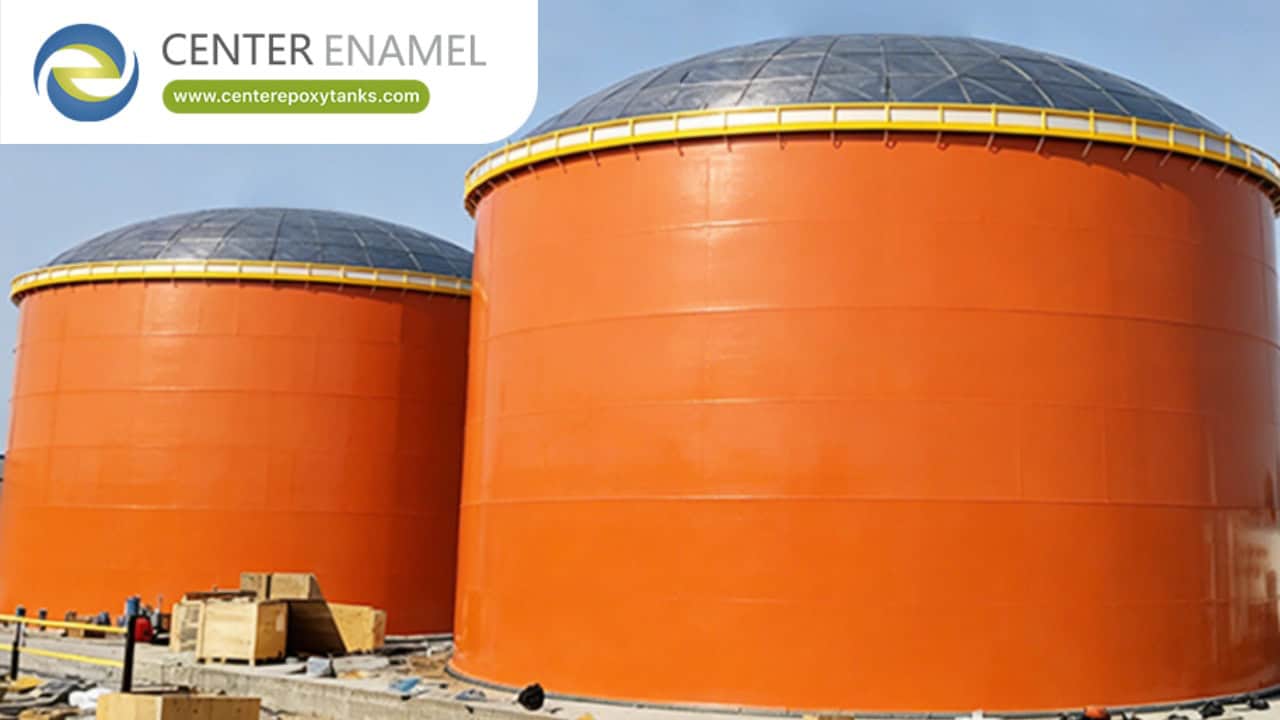
Data Center Cold Water Tank: Standby Chilled Water Storage
A data center cold water tank holds chilled water in reserve so that the cooling loop keeps supplying the IT load when a chiller, a pump or the incoming power fails. It is sized from the ride-through period the design must cover and the load served during that period: volume equals stored cooling energy divided by the energy per unit volume at the design temperature spread, which is about 1.163 kWh per cubic metre per kelvin. Because the tank must deliver cold water immediately, stratification, insulation and instrumentation matter as much as the volume itself.
Cooling continuity on a data center is a resilience question. Air handling or liquid cooling can tolerate only a short interruption before temperatures rise, which means standby cooling has to be available within seconds of a power event. Stored chilled water is one of the few ways to provide that without starting a machine.
This article explains how standby chilled water storage works, how to size it from a ride-through requirement, how it interacts with the chiller plant and the electrical system, and what the tank must provide to deliver cold water on demand. It addresses resilience duty rather than load shifting.
Technical Explanation
What standby storage has to deliver
The requirement is defined by the events the design must survive and by how quickly the plant can recover:
• Event types: chiller trip, chilled water pump failure, switchgear operation, or a utility interruption before generators take load.
• Ride-through period: the time from the event until mechanical cooling is restored, which for a generator-backed site is the generator start and transfer sequence plus chiller restart.
• Load served: whether the whole hall must be maintained or only a priority subset, which changes the stored energy requirement directly.
• Temperature limit: the maximum supply temperature at which the load can still operate, since the stored water is useful only while it remains below that limit.
Sizing from the ride-through requirement
The calculation is a straightforward energy balance once the two governing numbers are agreed:
• Stored energy required equals the cooling load during the ride-through period multiplied by its duration.
• Energy per unit volume is approximately 1.163 kWh per cubic metre per kelvin of usable temperature spread.
• For example, covering 2,000 kW of cooling for 10 minutes requires about 333 kWh, which at a 7 K usable spread needs roughly 41 m3 of stratified volume - a modest tank, provided the water is genuinely cold when it is needed.
• Add allowances for thermocline degradation, for the unusable volume below the lower diffuser and for the possibility that the tank has not been fully charged when the event occurs.
Integration with the plant and the electrical system
Standby storage only works if the pumps that move the water also survive the event:
• Pump power: secondary pumps serving the load need to be on the backed-up supply, or the stored water cannot reach the load.
• Control response: valves and controls must fail to the correct position automatically, so the changeover does not depend on operator action.
• Charging strategy: the tank has to be kept charged as part of normal operation, with level and temperature monitoring that confirms readiness rather than assuming it.
• Recovery sequence: after the event, the plant recharges the tank while serving the load, so the charging capacity must be understood and verified by test.
Controlling thermal loss
Stored cold water loses value with every hour it sits in the tank:
• Insulation: applied to shell and roof, sized from the acceptable daily heat gain, with a continuous vapour barrier to prevent condensation within the insulation.
• Stratification: diffusers that introduce and withdraw water at low velocity so the cold volume stays intact between events.
• Temperature monitoring: sensors at multiple heights, so readiness can be demonstrated rather than inferred from a level reading.
• Roof detailing: the roof is the largest heat gain area on a large tank and needs the same insulation standard as the walls.
Technical Specifications
Table 1 - Standby cold water storage sizing example and inputs
Input | Value in the worked example | How it is established | Effect on volume |
Cooling load to be covered | 2,000 kW | Load served during the event | Directly proportional |
Ride-through period | 10 minutes | Generator start and chiller restart sequence | Directly proportional |
Stored energy required | About 333 kWh | Load multiplied by duration | Sets the calculation basis |
Usable temperature spread | 7 K | Supply limit against stored water temperature | Inverse: wider spread needs less volume |
Volume at the spread | About 41 m3 | Energy divided by 1.163 kWh/m3 per K | Add thermocline and dead volume allowances |
Readiness margin | Recommend 10-20 percent | Risk that the tank is partly discharged | Increases volume |
Project Case Study
Project Case Summary - large bolted tank deliveries
The records below are delivered bolted tanks in water service, cited for the vessel scale and the factory-coated construction that a standby cold water tank requires.
Project | Application | Capacity | Construction | Roof | Completion |
Cyprus | Industrial wastewater | 5,557 m3 | Glass-fused-to-steel bolted | Not applicable | 2025-11 |
South Africa | Industrial wastewater | 6,075 m3 | Glass-fused-to-steel bolted | Aluminium flat roof | 2026-03 |
Company Expertise
Center Enamel manufactures bolted water storage tanks with factory-applied coatings in glass-fused-to-steel and fusion bonded epoxy, and supports designers with the internal provisions - diffusers, instrumentation and insulation - that stratified and standby cold water duty requires.
As an outstanding containment and cover system provider with decades of industry experience, Center Enamel sincerely expects to establish long-term cooperation with local partners throughout the world and to make continuous contribution to the development of the industry.
Shijiazhuang Zhengzhong Technology Co., Ltd is not only the first manufacturer in China to produce Glass-Fused-to-Steel tanks, but also the most experienced professional bolted tank manufacturer in Asia. The engineering, design, product testing and quality system of Center Enamel Glass-Fused-to-Steel tanks are in strict accordance with AWWA D103-09, OSHA, ISO 28765, NSF/ANSI 61 and NFPA. By 2023, Center Enamel bolted tanks had been exported to more than 100 countries, including the USA, Australia, Canada, Malaysia, Indonesia, Russia, the UAE, Panama, Brazil and South Africa.
Shijiazhuang Zhengzhong Technology Co., Ltd (Center Enamel) is a professional manufacturer dedicated to the design and fabrication of bolted storage tanks since 2008. Our product range includes Glass-Fused-to-Steel (GFS) tanks, fusion bonded epoxy tanks, stainless steel tanks, galvanized steel tanks and aluminum geodesic dome roofs. With a professional enameling R&D team and nearly 200 enameling patents, Center Enamel has become a leader in the bolted tank industry in Asia. Our products are certified to ISO 9001, NSF 61, EN 1090, ISO 28765, WRAS, FM, LFGB, BSCI and ISO 45001.
Shijiazhuang Zhengzhong Technology Co., Ltd (Center Enamel) is a professional manufacturer dedicated to the design and fabrication of bolted storage tanks since 2008. Our product range includes Glass-Fused-to-Steel (GFS) tanks, fusion bonded epoxy tanks, stainless steel tanks, galvanized steel tanks and aluminum geodesic dome roofs. With a professional enameling R&D team and nearly 200 enameling patents, Center Enamel has become a leader in the bolted tank industry in Asia. Our products are certified to ISO 9001, NSF 61, EN 1090, ISO 28765, WRAS, FM, LFGB, BSCI and ISO 45001.
Shijiazhuang Zhengzhong Technology Co., Ltd is not only the first manufacturer in China to produce Glass-Fused-to-Steel tanks, but also the most experienced professional bolted tank manufacturer in Asia. The engineering, design, product testing and quality system of Center Enamel Glass-Fused-to-Steel tanks are in strict accordance with AWWA D103-09, OSHA, ISO 28765, NSF/ANSI 61 and NFPA. By 2023, Center Enamel bolted tanks had been exported to more than 100 countries, including the USA, Australia, Canada, Malaysia, Indonesia, Russia, the UAE, Panama, Brazil and South Africa.
As an outstanding containment and cover system provider with decades of industry experience, Center Enamel sincerely expects to establish long-term cooperation with local partners throughout the world and to make continuous contribution to the development of the industry.
Frequently Asked Questions (FAQ)
Q: How long can stored chilled water maintain a data center load?
A: It depends entirely on the load covered and the volume stored. A small volume can bridge a generator start sequence of a few minutes, while covering a large load for an extended period requires a very large stratified tank. The ride-through period should be defined by the plant recovery sequence, then sized against it.
Q: Is stored cold water a substitute for generator-backed chillers?
A: No. It bridges the interval between an event and mechanical cooling being restored. It complements generator and UPS provision rather than replacing it, and its value lies in covering the seconds and minutes when nothing else is available.
Q: What temperature should the stored water be?
A: At or below the supply temperature the load accepts. The usable energy is the difference between that limit and the stored water temperature, so storing water slightly colder than the supply setpoint increases the useful capacity for the same volume.
Q: Does the tank need to be kept fully charged?
A: Yes, and readiness should be monitored rather than assumed. Level indication shows the volume present, but only temperature measurement confirms that the water is still cold enough to be useful, which is why multi-point sensing matters for this duty.
Q: How is thermal loss controlled?
A: Through insulation with a continuous vapour barrier on the shell and roof, and through stratification that keeps the cold water concentrated at the bottom of the tank. Both reduce the rate at which stored capacity is consumed between events.
Q: Can the same tank serve load shifting and standby duty?
A: It can, and many projects use one stratified tank for both purposes. The sizing then has to satisfy the larger of the two requirements, and the control strategy has to keep a reserve available for standby duty rather than discharging it fully during normal peak shaving.
Standby cold water storage is an energy balance with a time limit attached: define the event to be covered, the load to be maintained and the duration, then size the stratified volume from the energy required. Insulation, diffusers and temperature instrumentation decide whether that volume is actually available when the event occurs.
Talk to the Engineering Team
If you are sizing standby cooling for a hall, send the load to be covered, the ride-through period and the supply temperature limit. We will provide the storage volume calculation and the tank configuration with the provisions needed to keep it charged and cold.


