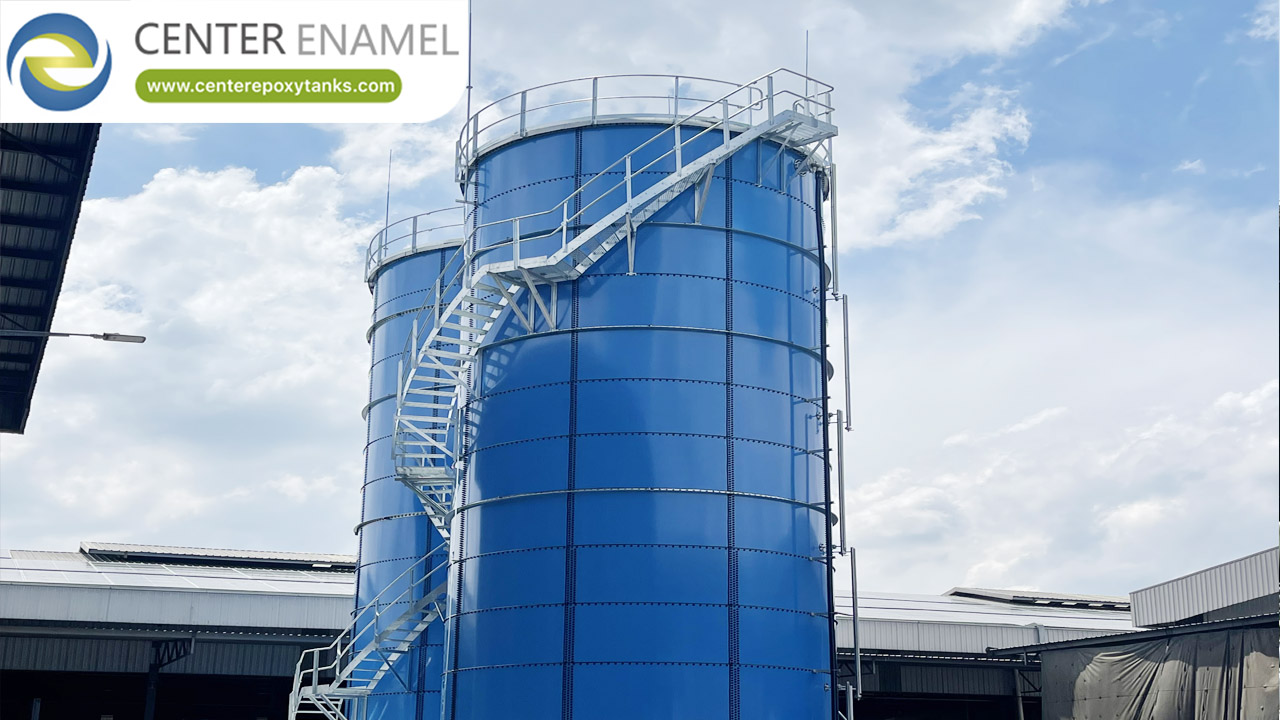
Data Center Cold Storage Tank: Stratification and Diffuser Design
A data center cold storage tank works by thermal stratification: cold, denser water collects at the bottom and warmer return water sits above it, separated by a thermocline. The stored capacity is usable only if that separation holds, which depends on the diffusers - inlet and outlet arrangements that introduce water at low velocity across the full tank cross-section - plus insulation to limit heat gain and instrumentation to monitor the thermocline position. A tank built as a plain water store will not perform as a cold store without those internal and thermal provisions.
Cold storage sounds like a volume question and is really a mixing question. Any tank can hold cold water; a stratified tank holds cold water and warm water at the same time without losing the difference between them.
This article focuses on the vessel side of thermal storage: how stratification behaves, how diffusers are designed to protect it, what insulation and vapour control the tank needs, and which provisions must be designed before fabrication. For the sizing calculation itself, see the companion article on chilled water thermal storage design.
Technical Explanation
How stratification behaves
Density difference is the mechanism that keeps cold water at the bottom, and several factors erode it:
l Thermocline growth: the transition layer between cold and warm water is never perfectly sharp, and it thickens as cycles proceed, consuming usable volume.
l Inlet momentum: water entering at high velocity creates mixing that destroys the separation faster than conduction does.
l Conduction and convection: heat moves across the boundary and along the shell, and any path that lets warmer water bypass the thermocline erodes it.
l Heat gain through the shell and roof: continuous, and directly subtracts from stored capacity.
Diffuser design
Diffusers are the component that makes stratified storage practical, and their design governs how much of the tank volume is usable:
l Low exit velocity: the water is introduced across a wide area so its momentum is dissipated before it can jet into the stored volume.
l Uniform distribution: slots or openings arranged so the flow spreads across the tank cross-section rather than concentrating in one region.
l Radial diffusers: an octagonal or circular arrangement close to the tank wall, giving a large discharge area in a compact footprint.
l Buoyant flow behaviour: because cold water entering at the bottom is denser than the water above it, correctly designed flow spreads horizontally along the floor rather than mixing upward.
l Maintainability: diffusers need to be inspectable and cleanable, which affects how they are supported inside the tank and how they are reached through nozzles and the manway.
Insulation, vapour control and roof detail
Thermal performance of the enclosure is as important as the internals once the tank is in service:
l Shell insulation: thickness selected from the allowable daily heat gain, since every kilowatt-hour of heat entering the tank is cooling capacity that cannot be delivered to the load.
l Vapour barrier: with chilled water inside and humid air outside, the insulation's cold surface sits below dew point, so a continuous vapour barrier is required to prevent moisture migrating into the insulation.
l Roof insulation: the roof is a large exposed area and should receive the same treatment as the shell, with the roof-to-shell junction detailed to keep the barrier continuous.
l Coating: factory-applied on the internal surfaces before assembly, because a coated tank cannot be field-lined once insulation and diffusers are installed.
Provisions to design in before fabrication
Four items are difficult or impossible to add later, so they belong in the original design:
l Diffuser support and access, including the nozzle sizes and positions needed for installation and future inspection.
l Temperature sensor pockets at multiple heights, with cable routing that does not compromise insulation or coating.
l Adequate manway size and position for entry with diffuser components.
l Structural allowance for insulation weight, diffuser loads and any internal support structure.
Technical Specifications
Table 1 - Cold storage tank design provisions and their purpose
Provision | Purpose | Design consequence | If omitted |
Low-velocity diffuser | Prevents mixing of stored cold water | Nozzle sizing, diffuser geometry, internal supports | Stored capacity lost within the first cycles |
Insulation with vapour barrier | Limits heat gain and prevents condensation damage | Shell and roof build-up, junction detailing | Continuous capacity loss and insulation deterioration |
Multi-point temperature sensing | Tracks thermocline position and usable capacity | Sensor pockets and cable routing through the shell | Capacity unverifiable in operation |
Coating selection | Protects steel and keeps water quality stable | Factory application before assembly | Cannot be applied after insulation and diffusers |
Roof detail | Reduces the largest single heat gain area | Insulated roof with sealed junction | Roof becomes the dominant heat path |
Access and manway | Allows inspection and diffuser maintenance | Manway sizing and internal access route | Difficult maintenance for the life of the tank |
Project Case Study
Project Case Summary - large diameter bolted tank deliveries
The deliveries below are large bolted tanks in water service, cited because the vessel scale and factory-coated construction are the same as a stratified cold storage tank requires.
Project | Application | Capacity | Construction | Roof | Completion |
Canada | Industrial water | 6,595 m3 | Glass-fused-to-steel bolted | Not applicable | 2025-11 |
Cyprus | Industrial wastewater | 5,557 m3 | Glass-fused-to-steel bolted | Not applicable | 2025-11 |
Company Expertise
Center Enamel manufactures large-diameter bolted tanks on a factory-coated panel system and works with designers on internal provisions such as diffusers, multi-point instrumentation and insulation, so that the vessel is built for its duty rather than adapted afterwards.
Shijiazhuang Zhengzhong Technology Co., Ltd (Center Enamel) is a professional manufacturer dedicated to the design and fabrication of bolted storage tanks since 2008. Our product range includes Glass-Fused-to-Steel (GFS) tanks, fusion bonded epoxy tanks, stainless steel tanks, galvanized steel tanks and aluminum geodesic dome roofs. With a professional enameling R&D team and nearly 200 enameling patents, Center Enamel has become a leader in the bolted tank industry in Asia. Our products are certified to ISO 9001, NSF 61, EN 1090, ISO 28765, WRAS, FM, LFGB, BSCI and ISO 45001.
Shijiazhuang Zhengzhong Technology Co., Ltd is not only the first manufacturer in China to produce Glass-Fused-to-Steel tanks, but also the most experienced professional bolted tank manufacturer in Asia. The engineering, design, product testing and quality system of Center Enamel Glass-Fused-to-Steel tanks are in strict accordance with AWWA D103-09, OSHA, ISO 28765, NSF/ANSI 61 and NFPA. By 2023, Center Enamel bolted tanks had been exported to more than 100 countries, including the USA, Australia, Canada, Malaysia, Indonesia, Russia, the UAE, Panama, Brazil and South Africa.
As an outstanding containment and cover system provider with decades of industry experience, Center Enamel sincerely expects to establish long-term cooperation with local partners throughout the world and to make continuous contribution to the development of the industry.
Frequently Asked Questions (FAQ)
Q: What is a thermocline?
A: It is the transition layer inside a stratified tank where water temperature changes from the cold stored temperature at the bottom to the warmer return temperature above. It is never a perfectly sharp boundary, and it thickens with each cycle, which is why practical storage capacity is lower than the theoretical volume.
Q: Why is diffuser design so important?
A: Because mixing destroys stored capacity faster than any other mechanism. A diffuser introduces water at low velocity across a wide area, so the incoming flow spreads horizontally instead of jetting into and mixing the stored volume. Poor diffuser design can waste a large part of the tank volume.
Q: How thick should the insulation be?
A: It is selected from the allowable heat gain over the storage period and the ambient conditions, not from a default. In humid climates the vapour barrier is as important as the thickness, because condensation inside the insulation degrades its performance and the underlying surface.
Q: Can a standard water tank be used for cold storage?
A: It can hold cold water, but it will not perform as a stratified store without low-velocity diffusers, multi-point temperature instrumentation and insulation. Those provisions are difficult to add to an existing tank, so they belong in the original specification.
Q: How is usable capacity verified in operation?
A: By temperature measurement at several heights in the tank. The profile shows where the thermocline sits, so the operator can see how much cold water remains available rather than relying on the water level alone.
Q: Does the tank need a roof?
A: Yes for this duty. An insulated roof limits the largest single heat gain path and protects the stored water from debris and rainfall. The roof-to-shell junction has to keep the vapour barrier continuous.
Conclusion
Cold storage performance lives in the details: diffusers that protect stratification, insulation that includes a vapour barrier, sensors that make capacity visible, and a coating applied in the factory before anything else is installed. Design those into the tank and the stored cooling is delivered; leave them out and the tank becomes an expensive volume of lukewarm water.
Talk to the Engineering Team
If you are designing a stratified cold storage tank, send the storage volume, supply and return temperatures and the tank geometry. We will advise on diffuser arrangement, instrumentation provisions and insulation detailing for the vessel.


