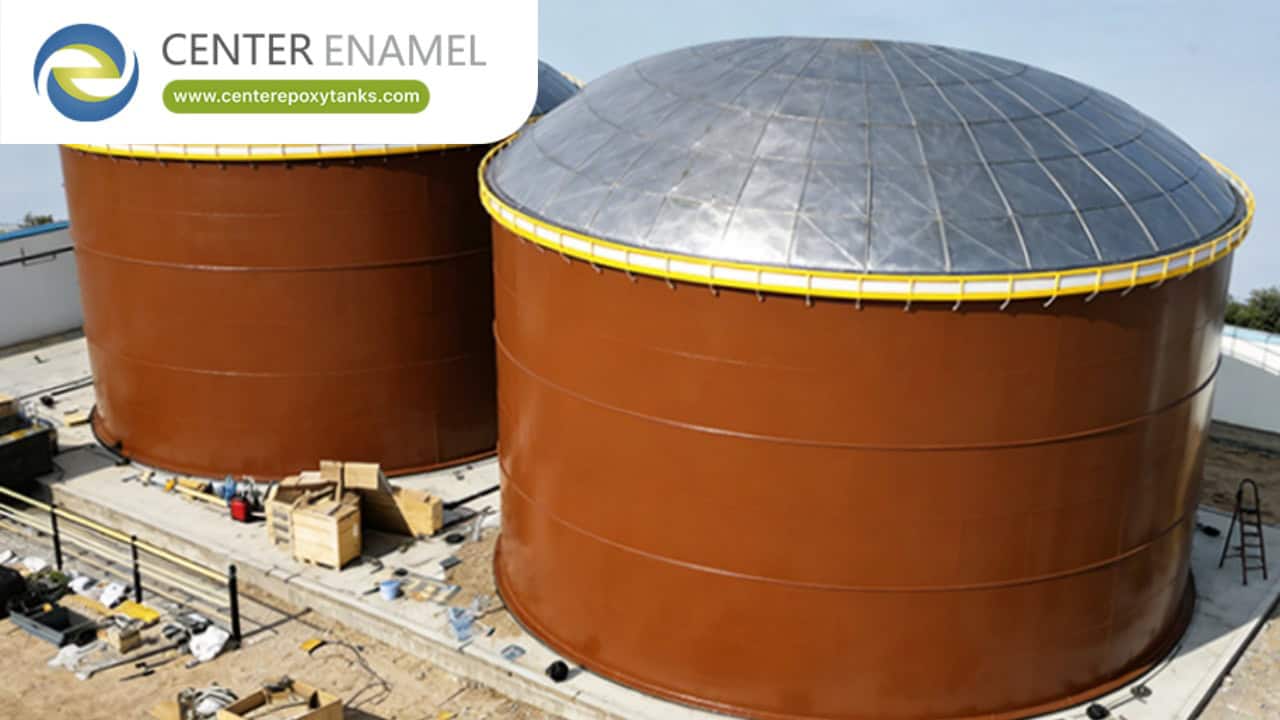
Czech Republic Oil Tank Roofs - Snow, Wind and Inspection Access on Inland European Tanks
Central European tanks live through a demanding annual cycle: snow accumulation in winter, freeze-thaw cycling, and wind exposure on open refinery and depot sites. Snow is the governing roof load case in much of the region, and it interacts badly with two things - a deflecting plate roof that opens seal gaps under load, and a coated surface that degrades under freeze-thaw. Winter also makes roof access difficult, which is precisely when inspection findings are hardest to act on.
A triangulated aluminium dome is dimensionally stable under snow, carries no coating to degrade under freeze-thaw, and can be supplied with walkways, handrails and tie-off points that make winter inspection practical. Engineered by Shijiazhuang Zhengzhong Technology Co., Ltd. (Center Enamel), the dome is designed to the site's own snow and wind values and to the project's chosen code set.
1. How Does Snow Load Govern the Design?
Snow is usually the dominant roof load case in Central Europe, and it must be applied together with wind and maintenance loads rather than in isolation. Dome rise is then chosen partly for structural efficiency and partly to discourage accumulation.
· Site Snow Value: The characteristic snow load for the locality is applied, including any drift and partial-loading cases required by the code.
· Load Combinations: Snow, wind, dead and maintenance loads are combined as the relevant Eurocode requires.
· Rise Selection: A steeper rise sheds snow more readily and improves structural efficiency under distributed load.
· Deflection Control: The triangulated frame maintains geometry under load, so roof-mounted seals and penetrations are not opened by deflection.
· Drainage in Freeze: Drainage is arranged to remain functional through freeze-thaw rather than icing up and creating a ponding load.
2. Which Codes Apply, and How Is Compliance Demonstrated?
Tanks are normally designed to EN 14015 with Eurocode load combinations and the Czech national annex, while the dome is checked against API 650 Appendix G or an equivalent Eurocode treatment. Compliance is demonstrated through calculation, material certification and erection records.
· EN 14015: The common European specification for site-built welded steel storage tanks.
· Eurocode with National Annex: Snow, wind, seismic and accidental actions taken from the relevant parts and the Czech national annex.
· API 650 Appendix G: Applied where the project specifies it for the aluminium dome.
· Material Certification: Mill certificates for extrusions and nodes, plus fastener and gasket documentation.
· Erection Records: Torque records, panel alignment checks and a final survey are issued at handover.
3. How Is Safe Inspection Access Provided?
By designing access in from the start rather than adding it later. That means walkways to every point that needs inspection, handrails to the applicable standard, and tie-off points for work at height - all integrated into the dome structure and its load model.
· Walkways to Key Points: Routes to vents, hatches, gauge points and the apex are included in the structural model, not bolted on afterwards.
· Handrails and Toe Boards: Supplied to OSHA or EN requirements depending on the project specification.
· Tie-Off Points: Certified anchorage points are integrated so maintenance can be carried out with fall protection.
· Non-Slip Surfaces: Walkway surfaces are specified for wet and icy conditions, which matters in Central European winters.
· Access Philosophy: Access is designed around the inspection tasks in the O and M manual so nothing is unreachable.
Evaluation Criterion | Aluminum Dome | Plate and Rafter Roof |
Behaviour under snow load | Stable triangulated frame | Deflection opens seal paths |
Coating under freeze-thaw | None required | Degrades and requires renewal |
Winter inspection access | Walkways and tie-offs designed in | Often improvised |
Load basis | Site snow and wind values | Sometimes generic |
Documentation | Full calculation and records package | Standard |
Engineering Assurance and Project Support
Every welded oil tank delivered by Shijiazhuang Zhengzhong Technology Co., Ltd. (Center Enamel) is designed to API 650 with shell courses sized by the one-foot method and checked for wind, seismic and hydrostatic load cases, or to EN 14015 and the Eurocodes where the site is European. Shell plate is shot-blasted to Sa 2.5 and coated to a documented dry film thickness, longitudinal and annular plate welds are examined by radiography or ultrasonic testing to the acceptance level written into the purchase order, and every tank is hydrostatically tested and dimensionally surveyed before hand-over. For Central European projects we apply the locality's own snow and wind values, design access and fall-protection into the structure, and issue the calculation, certification and erection records needed for the project's technical file.
Frequently Asked Questions (FAQ)
How is snow load handled on a dome roof?
The characteristic snow load for the locality is applied from the national annex, including drift and partial-loading cases where the code requires them, and combined with wind, dead and maintenance loads. Dome rise is chosen to shed snow and improve structural efficiency, and drainage is arranged to keep working through freeze-thaw so that icing cannot create a ponding load.
Which standards apply to a tank roof in the Czech Republic?
Tanks are normally designed to EN 14015 with Eurocode load combinations and the Czech national annex. The dome is checked to API 650 Appendix G or an equivalent Eurocode treatment depending on the project specification. Compliance is demonstrated through load calculations, mill certificates for the extrusions and nodes, fastener and gasket documentation, and erection and torque records.
Can an aluminium dome be retrofitted to an existing tank?
Yes. The shell and top course are surveyed, the compression ring is verified against the dome's thrust and the site's snow and wind loads, and strengthening is designed where needed. Because members arrive factory-cut and drilled, the retrofit is assembly work with no hot work, provided the tank is cleaned, gas-freed and ventilated first.
Can the dome be customised for our tank?
Yes. Span, rise, panel section, alloy and temper, gasket material for freeze-thaw, insulation, vents, manways, non-slip walkways, handrails, tie-off points and lightning protection are all engineered to your tank, product and site loads.


