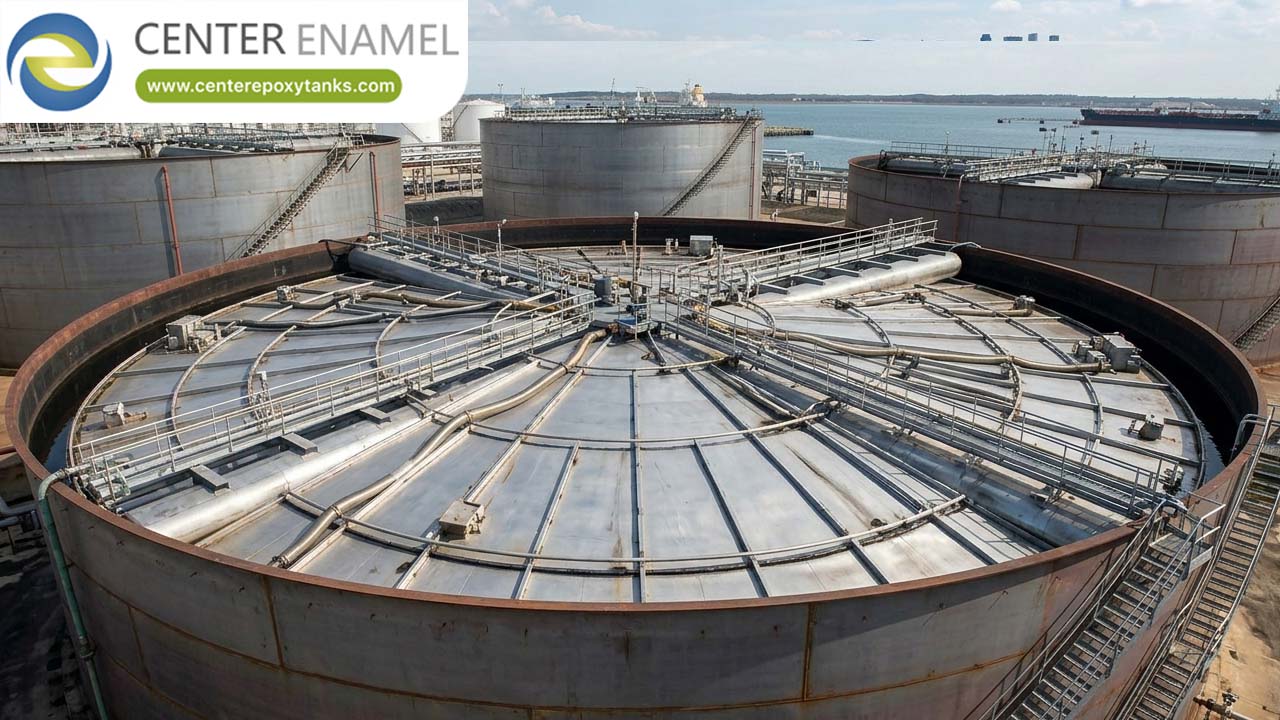
Crude Oil Storage Tanks for Food Waste Projects - Handling Recovered Fats and Oils
Food waste processing produces an oil stream that is valuable but difficult: recovered fats, oils and grease, often called brown grease when it comes from grease traps and food waste depackaging. It arrives warm, wet and full of solids, it solidifies as it cools, it separates slowly, and its free fatty acid content determines whether it goes to biodiesel or to anaerobic digestion as a co-substrate. Storage is where that value is either preserved or lost.
Engineered by Shijiazhuang Zhengzhong Technology Co., Ltd. (Center Enamel), tanks for food waste oil recovery are built as heated, mixed, separable vessels with the access that a stream carrying solids actually requires.
1. What Oil Comes Out of a Food Waste Project?
Recovered fats, oils and grease - a variable mixture whose value depends on its free fatty acid content and its water and solids content. The same stream can be a biodiesel feedstock or an anaerobic digestion co-substrate depending on how well it is handled.
· Brown and Yellow Grease: Trap and depackaging grease is higher in free fatty acids than virgin oil.
· Variable Composition: Composition shifts with the source material, so the tank must tolerate a range.
· Water and Solids: Both are present in quantity and both must be separable.
· Value Routing: Free fatty acid content determines whether the oil goes to biodiesel or to digestion.
· Odour Potential: Warm, degrading organic material generates odour that must be controlled.
2. Why Does Recovered FOG Need Heated Storage?
Because it solidifies. Fats and greases set as they cool, which makes them unpumpable, prevents separation, and turns a transfer into a manual cleaning job. Heating keeps the stream liquid and keeps separation working.
· Pour Point: Many recovered fats are semi-solid at ambient temperature, so heating is functional rather than optional.
· Separation Efficiency: Warm oil separates from water far faster than cold oil.
· Pumpability: Heating keeps the stream transferable without manual intervention.
· Fouling Control: Controlled, even heating avoids local overheating that fouls surfaces.
· Mixing Support: Gentle mixing keeps solids in suspension so they can be separated or removed.
3. How Is Feedstock Quality Protected?
By separating promptly, keeping water and solids out of the stored oil, and avoiding overheating. Quality deterioration is what moves a stream from biodiesel value down to digestion value.
· Prompt Separation: Separating water early limits the hydrolysis that raises free fatty acids.
· Water Draw-Off: Routine draw-off prevents a water layer from growing and degrading the oil.
· Temperature Control: Holding the lowest temperature that keeps the stream liquid limits degradation.
· Segregation: Keeping higher-quality streams separate preserves their value.
· Sampling: Regular sampling tracks free fatty acid content so routing decisions are based on data.
Evaluation Criterion | Purpose-Built FOG Tank | General Purpose Tank |
Heating provision | Sized to keep fats liquid | Absent or inadequate |
Separation support | Heated, mixed, draw-off | Gravity only |
Solids handling | Designed access for removal | Accumulates |
Odour control | Sealed and vented to treatment | Open vent |
Feedstock value protection | Sampling and segregation | Not considered |
Engineering Assurance and Project Support
Every welded oil tank delivered by Shijiazhuang Zhengzhong Technology Co., Ltd. (Center Enamel) is designed to API 650 with shell courses sized by the one-foot method and checked for wind, seismic and hydrostatic load cases, or to EN 14015 and the Eurocodes where the site is European. Shell plate is shot-blasted to Sa 2.5 and coated to a documented dry film thickness, longitudinal and annular plate welds are examined by radiography or ultrasonic testing to the acceptance level written into the purchase order, and every tank is hydrostatically tested and dimensionally surveyed before hand-over. FOG tanks are supplied with heating sized to the stream, mixing, water draw-off and solids access, sealed venting routed to odour treatment, and sampling points for free fatty acid tracking.
Frequently Asked Questions (FAQ)
What is brown grease and why is it hard to store?
It is recovered fats, oils and grease from grease traps and food waste depackaging - higher in free fatty acids than virgin oil, and carrying water and solids. It is hard to store because it solidifies as it cools, separates slowly, and degrades if it sits wet and warm, which moves it from biodiesel value down to digestion value.
How hot should recovered fats be stored?
At the lowest temperature that reliably keeps the stream liquid and separable. Overheating wastes energy and accelerates degradation, while underheating causes solidification and blocks transfer. The value comes from the specific stream, so heating is sized from its characteristics and controlled rather than left running.
How is odour controlled on a food waste oil tank?
By keeping the tank sealed and routing vent gas to treatment. Warm, degrading organic material generates odour continuously, so a fixed roof with sealed penetrations and a vent line to carbon treatment, scrubbing or the site's odour control system is the standard approach.
Can the tank be customised for our project?
Yes. Capacity and geometry, heating type and capacity, mixing provision, water draw-off and solids access, sealed venting to odour treatment, insulation, sampling points, instrumentation and cleaning access are all engineered to your stream and process.


