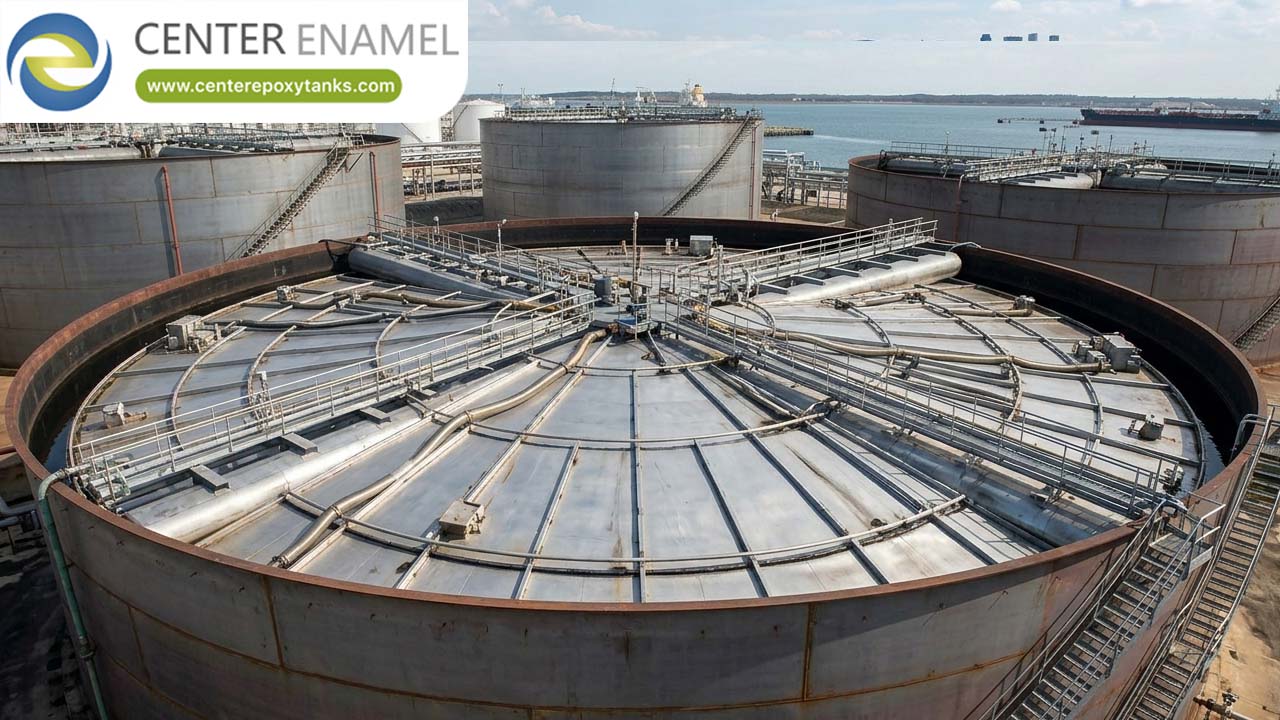
Crude Oil Storage Tanks Floating Roof - Sizing the Deck for Sour, Sediment-Bearing Service
Crude is the hardest common service for a storage tank roof. It is volatile enough to demand vapour control, sour enough to attack steel and seal materials, and dirty enough to lay down sediment that interferes with deck landing and bottom inspection. On top of that, crude tanks are large - often the largest assets on the site - so any roof-driven outage is expensive and slow.
The floating roof has to be designed for that combination, not for a generic hydrocarbon. Engineered by Shijiazhuang Zhengzhong Technology Co., Ltd. (Center Enamel), a crude-service floating roof is specified with sour-compatible seal materials, sufficient landing height to clear accumulated sediment, buoyancy reserve for a flooded compartment, and access that lets the tank be inspected on a realistic interval.
1. Why Do Crude Tanks Use Floating Roofs?
Because crude is volatile enough that the breathing loss from a fixed roof is both a product loss and an emission problem. A floating deck removes the vapour space, which removes breathing loss and greatly reduces the vapour inventory available to a fire.
· Loss Control: Removing the vapour space removes the daily breathing cycle that drives standing storage loss.
· Fire Consequence: With no large vapour space, the credible fire scenario becomes a rim seal fire rather than a full-surface fire.
· Large Diameter Suitability: Crude tanks are usually large, which is exactly where floating roofs deliver the biggest saving.
· Regulatory Expectation: Vapour control on volatile storage is the expected baseline in most jurisdictions.
· Product Quality: Less evaporation means less loss of light ends and less change in product characteristics over time.
2. How Does Sour Crude Affect Roof Selection?
Hydrogen sulphide and water attack both the steel and the seal materials, and heated or sour vapour accelerates underside corrosion. Seal fabric, foam, gaskets and any coating must be selected for the actual H2S and temperature exposure.
· Seal Material Compatibility: Fabric, foam and adhesive are selected for sour hydrocarbon exposure rather than for generic oil service.
· Underside Corrosion: The deck underside in sour vapour needs coating or alloy review, and ventilation is provided where the design allows.
· Gasket Selection: Deck-fitting gaskets are specified for H2S and temperature, not just for hydrocarbon Immersion.
· Fastener and Fitting Material: Compatibility is extended to fasteners, shunts and internal hardware.
· Corrosion Monitoring: Inspection intervals and examination methods are set with sour service in mind.
3. How Is Sediment Managed Under a Floating Roof?
By setting the deck's landing height above the expected sediment depth, providing adequate bottom access, and planning cleaning around the deck legs. Sediment that is deeper than the landing height will foul the deck and eventually prevent it from resting level.
· Landing Height: Support legs are set to clear the expected sediment depth with margin, so the deck can land without sitting in sludge.
· Sediment Survey: Bottom profiling at inspection establishes how much sediment actually accumulates between cleanings.
· Cleaning Access: Manways and the deck manhole are positioned so cleaning equipment can reach the floor.
· Mixing Where Required: Where the specification calls for it, mixing is arranged to keep solids in suspension rather than settled.
· Drain and Sump Design: Water and sludge draw-off are arranged so they can be operated without disturbing the deck.
Evaluation Criterion | Floating Roof on Crude | Fixed Roof on Crude |
Breathing loss | Eliminated | Continuous |
Vapour inventory for fire | Small - rim area only | Full vapour space |
Sour exposure management | Seal and underside materials specified | Vapour space and roof attacked |
Sediment interaction | Landing height set above sediment | No deck interaction |
Inspection planning | Deck and bottom must be coordinated | Bottom only |
Engineering Assurance and Project Support
Every welded oil tank delivered by Shijiazhuang Zhengzhong Technology Co., Ltd. (Center Enamel) is designed to API 650 with shell courses sized by the one-foot method and checked for wind, seismic and hydrostatic load cases, or to EN 14015 and the Eurocodes where the site is European. Shell plate is shot-blasted to Sa 2.5 and coated to a documented dry film thickness, longitudinal and annular plate welds are examined by radiography or ultrasonic testing to the acceptance level written into the purchase order, and every tank is hydrostatically tested and dimensionally surveyed before hand-over. For crude service we confirm H2S and temperature exposure before selecting seals and gaskets, set support leg landing height from the sediment profile, and supply the buoyancy and landing calculations with the roof.
Frequently Asked Questions (FAQ)
Why do crude oil tanks use floating roofs rather than fixed roofs?
Because crude is volatile enough that a fixed roof loses product to breathing every day and holds a large flammable vapour space. A floating deck rides on the liquid, so there is no vapour space to breathe and the credible fire scenario becomes a rim seal fire rather than a full surface fire. On large crude tanks the product saving alone usually justifies the roof.
How does sour crude change the specification?
Hydrogen sulphide attacks seal fabrics, foams and gaskets as well as steel, so every non-metallic component is selected for the actual H2S and temperature exposure. The deck underside is reviewed for coating or alloy protection, and fasteners, shunts and internal hardware are brought into the same compatibility review.
What happens if sediment builds up under the deck?
If sediment exceeds the deck's landing height, the deck cannot rest level and may foul or tilt when the tank is emptied. The answer is a landing height set above the expected sediment depth with margin, established from bottom profiling at inspection, plus manways positioned so the floor can be cleaned.
Can the floating roof be customised for our crude tank?
Yes. Deck type, buoyancy reserve, sour-compatible seals and gaskets, drain type, landing height set from your sediment profile, fittings, rolling ladder, gauging platform, grounding and anti-rotation arrangement are all engineered to your tank, crude assay and site conditions.


