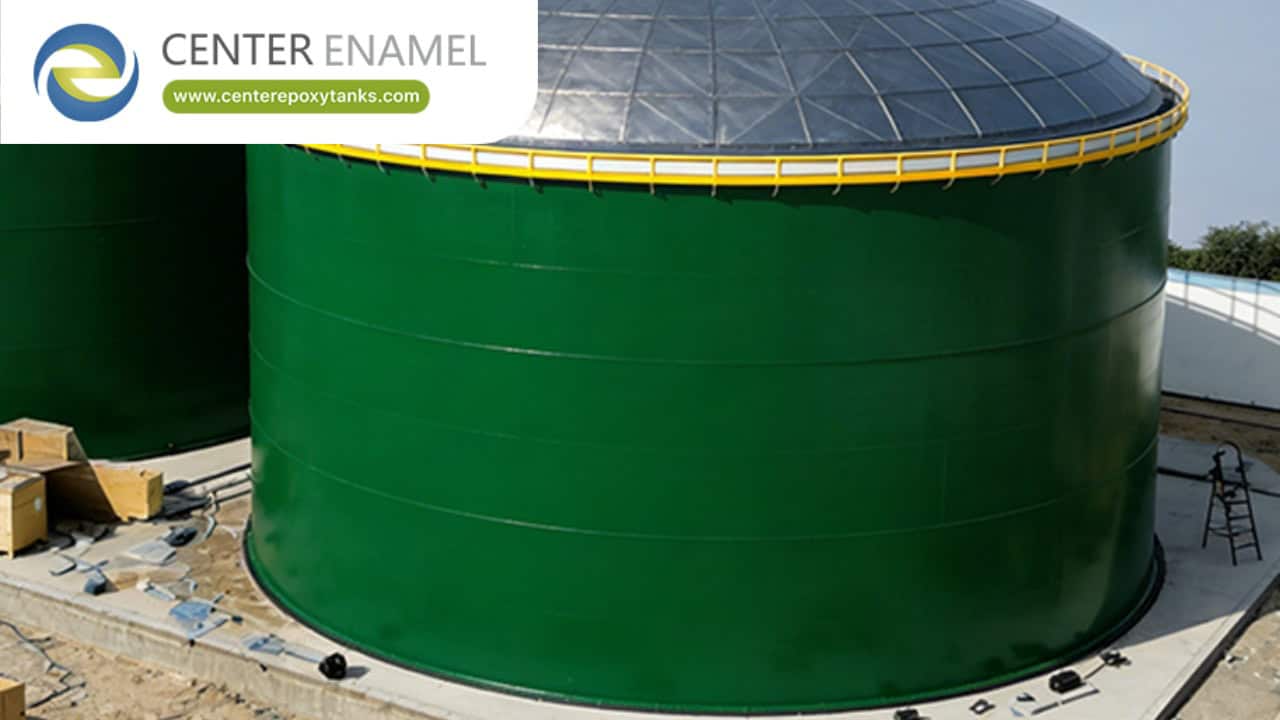
Crude Oil Liquid Storage Tanks - Sizing, Roofing and Operating a Crude Tank Properly
Crude storage looks simple - a large welded tank with a floating roof - until the details start to govern the operating cost. Sediment accumulates and interferes with deck landing. Water settles and corrodes the floor. Heavier crudes need heating to stay pumpable. And the tank is usually the largest single asset at the terminal, which means its outages are expensive and its inspection has to be planned years ahead.
Engineered by Shijiazhuang Zhengzhong Technology Co., Ltd. (Center Enamel), crude oil liquid storage tanks are designed to API 650 with the roof, heating, water and sediment provisions sized from the actual crude assay rather than from a generic crude duty.
1. How Is a Crude Storage Tank Sized?
From throughput, required working volume and the operational margin the terminal needs. Tank farms usually use several tanks rather than one, so that one can be taken out of service without stopping operations.
· Throughput and Turnover: Working volume is driven by receipts, deliveries and the turnaround the operation needs.
· Number of Tanks: Multiple tanks provide operational flexibility and allow maintenance without shutdown.
· Geometry: Diameter and height are balanced against foundation capacity, wind and seismic exposure.
· Future Expansion: Space and connections are often reserved for additional tanks.
· Product Segregation: Different crude grades are kept separate, which affects the number of tanks more than the total volume.
2. Which Roof Suits Crude Storage?
An external floating roof is the conventional choice; an internal floating roof is used where rainfall, dust or emission limits favour a covered deck. Fixed roofs are reserved for crudes with low volatility.
· External Floating Roof: The industry default; proven, inspectable from above, simple to repair.
· Internal Floating Roof: Preferred where heavy rainfall, airborne dust or tight emission limits justify a covered deck.
· Fixed Roof: Acceptable only where the crude's vapour pressure at storage temperature is genuinely low.
· Seal Selection: Driven by the shell's actual roundness and the crude's chemistry.
· Dome Retrofit Consideration: An aluminium dome can convert an open tank to a covered one where conditions favour it.
3. How Are Water and Sediment Managed?
By settling and routine removal. Water is drawn off at the lowest point, sediment is surveyed at inspection, and the floating roof's landing height is set above the expected sediment depth.
· Water Draw-Off: Located at the lowest point and used routinely so a water layer never establishes itself.
· Sediment Survey: Bottom profiling at inspection establishes the accumulation rate.
· Landing Height: Deck legs are set above the expected sediment depth with margin.
· Mixing Provision: Where specified, mixing keeps solids suspended rather than settled.
· Cleaning Access: Manways and cleanout doors are positioned for the cleaning the tank actually needs.
Evaluation Criterion | Crude-Specific Design | Generic Large Tank Design |
Roof basis | Vapour pressure at storage temperature | Default choice |
Landing height | Set from sediment profile | Standard |
Water draw-off | Designed and routinely used | Sometimes absent |
Heating provision | Sized from the crude assay | Assumed unnecessary |
Segregation | Planned for grade separation | Overlooked |
Engineering Assurance and Project Support
Every welded oil tank delivered by Shijiazhuang Zhengzhong Technology Co., Ltd. (Center Enamel) is designed to API 650 with shell courses sized by the one-foot method and checked for wind, seismic and hydrostatic load cases, or to EN 14015 and the Eurocodes where the site is European. Shell plate is shot-blasted to Sa 2.5 and coated to a documented dry film thickness, longitudinal and annular plate welds are examined by radiography or ultrasonic testing to the acceptance level written into the purchase order, and every tank is hydrostatically tested and dimensionally surveyed before hand-over. Crude tanks are delivered to API 650 with roof selection justified against vapour pressure, sediment- based landing heights, water draw-off, heating sized from the assay, and full testing and coating documentation.
Frequently Asked Questions (FAQ)
How large should a crude oil storage tank be?
It is driven by throughput, the working volume the operation needs and the number of tanks required for flexibility. Most terminals use several tanks rather than one so that a tank can be maintained without stopping operations, and so that different crude grades can be segregated. Geometry is then balanced against foundation capacity and wind and seismic exposure.
Does crude oil need to be heated in storage?
Some crudes do, some do not. Heavy or high-wax crudes may need heating to stay pumpable, while lighter crudes do not. The decision comes from the crude's viscosity and pour point at the site's ambient temperature, and if heating is needed it is arranged to avoid local overheating which degrades the product.
How often does a crude tank need cleaning?
It depends on the sediment accumulation rate, which is why bottom profiling at inspection matters. Cleaning is planned on the internal examination interval for the tank, and the practical constraint is usually the outage length rather than the sediment volume - which is why cleaning access and manway positioning are designed in from the start.
Can the tank be customised for our crude?
Yes. Capacity and geometry, roof type and seal specification, heating provision, water draw-off and sediment management, coating and cathodic protection, instrumentation, access and containment are all engineered to your crude assay, throughput and site conditions.
·


