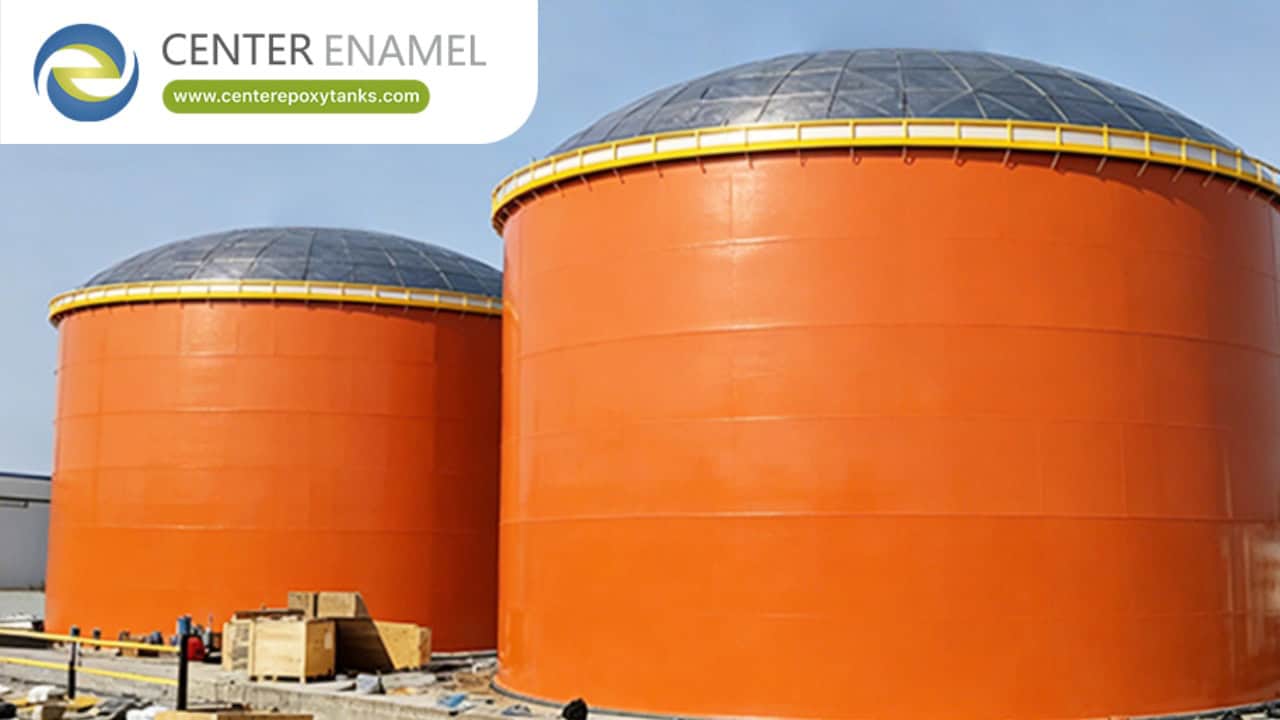
China Cooking Oil Tank Manufacturer - What Buyers Should Verify Before Ordering
Buying edible oil storage from China is now routine, and the gap between suppliers is wide. The difference is rarely the plate - it is whether the manufacturer owns its coating or lining process, whether it can evidence food-contact compliance rather than assert it, whether welds are documented, and whether the export package actually clears customs and satisfies the buyer's own quality system.
Shijiazhuang Zhengzhong Technology Co., Ltd. (Center Enamel) supplies cooking oil tanks as engineered packages, and the checks below are the ones we expect a serious buyer to apply to us and to every competitor on the list.
1. What Food-Contact Compliance Should Be Evidenced?
A documented basis for food contact, not a claim. That means the coating or alloy has a recognised food-contact position, the gaskets are food-grade, and the manufacturer can produce the certification behind each of them.
· Coating Compliance: The lining system should have a documented food-contact position for the oil and temperature in question.
· Alloy Certification: Where stainless is used, mill certificates evidence the grade supplied.
· Gasket Certification: Food-grade elastomer certificates for every product contact seal.
· Surface Finish Records: A specified and verified finish supports cleanability claims.
· Traceability: Material certificates are traceable to the plates and components actually used.
2. Which Quality Records Matter Most?
Welding documentation, coating or lining records, holiday or continuity testing, and dimensional control. These are the records that predict behaviour in service, and they are also the ones a buyer's quality system will ask for first.
· Welding Records: Qualified procedures, welder qualifications, weld maps and examination reports.
· Lining Records: Surface preparation standard, application conditions, dry film thickness and holiday testing.
· Passivation Records: For stainless, evidence that welds were pickled and passivated.
· Dimensional Control: A dimensional survey confirming the tank was built to the drawing.
· Hydrostatic Testing: Test records including any settlement monitoring where applicable.
3. What Should the Export Scope Include?
More than the tank. A complete export scope covers packing for sea transport, documentation for customs, erection guidance or supervision, and the spare parts and manuals that let the buyer commission and maintain the asset.
· Export Packing: Packing designed for the actual transport mode and handling equipment at both ends.
· Documentation Package: Certificates, drawings, test records and manuals in the required language.
· Erection Support: Drawings, sequences and, where specified, supervision or trained crews.
· Spares: A commissioning spares set for gaskets and wearing parts.
· After-Sales: A named contact, a response commitment and a warranty statement in writing.
Evaluation Criterion | Engineered Manufacturer | Trading Supplier |
Coating or lining process | Owned and controlled in-house | Subcontracted |
Food-contact evidence | Certificates provided | Asserted |
Weld documentation | Procedures, maps, examination reports | Limited or absent |
Export packing and documents | Complete package | Basic |
After-sales commitment | Written and named | Vague |
Engineering Assurance and Project Support
Every welded oil tank delivered by Shijiazhuang Zhengzhong Technology Co., Ltd. (Center Enamel) is designed to API 650 with shell courses sized by the one-foot method and checked for wind, seismic and hydrostatic load cases, or to EN 14015 and the Eurocodes where the site is European. Shell plate is shot-blasted to Sa 2.5 and coated to a documented dry film thickness, longitudinal and annular plate welds are examined by radiography or ultrasonic testing to the acceptance level written into the purchase order, and every tank is hydrostatically tested and dimensionally surveyed before hand-over. Cooking oil tanks are supplied with food-contact documentation, welding and lining records, hydrostatic test results, export packing, an erection package, commissioning spares and a written warranty.
Frequently Asked Questions (FAQ)
What should I check before buying cooking oil tanks from China?
Four things: whether the manufacturer owns its coating or lining process, whether it can evidence food-contact compliance with certificates rather than claims, whether welding is documented with procedures, maps and examination reports, and whether the export scope includes packing, documentation, erection support and spares.
Is Chinese-manufactured edible oil storage acceptable for food contact?
Yes, provided compliance is evidenced. Food-contact suitability is a property of the coating or alloy, the gaskets and the surface finish, not of the country of manufacture. What matters is that the manufacturer can produce the certification behind each of those and that it is traceable to the materials actually used.
Which is better for cooking oil - glass-fused-to-steel or stainless?
Both are used successfully. Glass-fused-to-steel gives a hard, inert, cleanable surface at significantly lower cost for large volumes, while stainless is preferred for smaller tanks, frequent campaign changes and the highest purity requirements. The choice usually comes down to capacity, changeover frequency and budget.
Can the tanks be customised for our product?
Yes. Capacity and geometry, glass-fused-to-steel or stainless construction, coating or alloy grade, surface finish, cone or flat bottom, blanketing provision, insulation and heating, nozzle schedule, access and instrumentation are all engineered to your oil and process.


