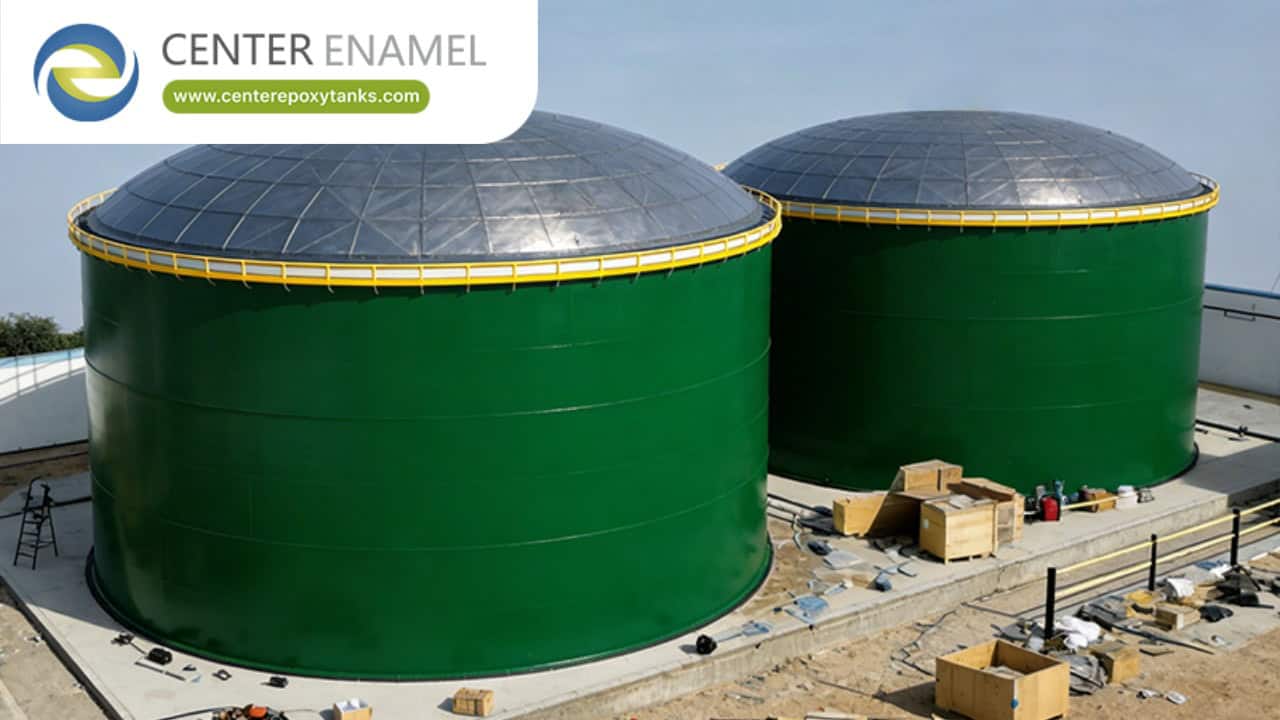
Custom-Designed Aluminum Dome Roofs for Oil Storage Tanks
In the global petroleum refining, crude oil extraction, and downstream fuel distribution sectors, aboveground storage tanks require robust overhead protection to prevent product evaporation, eliminate weather-induced contamination, and withstand aggressive industrial atmospheres. Traditional fixed steel roofs are notoriously vulnerable to vapor-space corrosion caused by sour crude and hydrogen sulfide (H2S), demanding continuous, expensive repainting and structural upkeep. To overcome these limitations, custom-designed aluminum dome roofs have emerged as the definitive global standard for modern oil terminal infrastructure.
As a globally recognized industry pioneer with over three decades of engineering excellence, Shijiazhuang Zhengzhong Technology Co., Ltd. (Center Enamel) specializes in delivering high-performance, custom-engineered aluminum geodesic dome roofs tailored to the exact specifications of oil and petrochemical storage facilities across more than 100 countries.
The Engineering Superiority of Custom Aluminum Domes
Center Enamel’s aluminum dome roofs are engineered as self-supporting, three-dimensional space frames that offer superior structural mechanics and complete material longevity:
High-Strength Aluminum Alloy Selection: Fabricated using premium-grade structural aluminum alloys (such as 6061-T6 for tension rings and structural struts, and 3003-H16 or 5086 series sheets for triangular closure panels), providing an exceptional strength-to-weight ratio that effortlessly bears heavy environmental loads without internal support columns.
Complete Corrosion Immunity: Unlike carbon steel that reacts with sulfur compounds and moisture in the tank vapor space, aluminum naturally forms a passive oxide layer that offers total resistance to atmospheric oxidation, acidic gases, and aggressive hydrocarbons.
Proprietary Batten Bar Sealing Technology: Engineered with a specialized batten bar and mechanical gasket clamping network that eliminates reliance on external silicone sealants, guaranteeing a 100% weather-tight and vapor-tight seal that suppresses volatile organic compound (VOC) emissions.
Technical Performance Matrix: Oil Storage Tank Roof Technologies
Technical Parameter | Center Enamel Custom Aluminum Dome Roofs | Traditional Carbon Steel Fixed Roofs | Cast-in-Place Concrete Tank Covers | Internal Floating Roofs (IFR) |
Corrosion Resistance & Lifespan | Superior; natural aluminum oxide layer ensures 30+ years of maintenance-free service | Low; highly vulnerable to vapor-space and atmospheric corrosion, requiring frequent recoating | Moderate; susceptible to concrete carbonation and chemical gas attack over decades | Moderate; vulnerable to rim-space vapor pocket corrosion and seal wear |
Structural Span & Footprint | Clear-span self-supporting structure; spans massive tank diameters (>100m) with zero internal columns | Requires intermediate support columns, rafters, and trusses for large tanks | Heavy structural support required; highly complex formwork for large-diameter spans | Requires an outer protective housing or fixed roof for complete environmental shelter |
Weight & Installation Velocity | Extremely lightweight; rapid modular on-site assembly without heavy crane fleets | Heavy; requires extensive field welding, plate rolling, and heavy lifting equipment | Extremely heavy; demands multi-week civil curing cycles and complex construction | Moderate installation speed; complex rolling ladder and deck alignment |
Global Standards Compliance | Engineered strictly to API 650 Appendix G, AWWA D108, ASCE 7, and ISO 9001 | Varies based on field-welding execution quality | Dependent on local civil engineering batch pours and site curing inspections | Industry-specific floating roof standards |
Key Customization and Safety Features for Oil Terminals
1. Bespoke Engineering and Finite Element Analysis (FEA)
Every oil storage project features unique meteorological and seismic conditions. Center Enamel utilizes advanced Finite Element Analysis (FEA) software to custom-design dome geometry, ensuring precise load-bearing capabilities against hurricane-force winds, unbalanced snow accumulations, and seismic shear displacement in strict accordance with API 650 Appendix G and ASCE 7 standards.
2. Seamless Integration with Tank Accessories
Custom-designed aluminum domes are engineered to accommodate complex oil terminal requirements, including top-mounted radar level gauges, emergency venting hatches, specialized foam fire suppression piping networks (compliant with NFPA standards), and lightning protection grounding systems.
Frequently Asked Questions (FAQ)
Q: Why choose a custom-designed aluminum dome roof over a traditional steel roof for oil tanks?
A: Aluminum geodesic domes are entirely self-supporting, eliminating internal support columns that can interfere with tank mixing or internal floating roofs. Furthermore, aluminum is completely immune to sulfur and vapor-space corrosion, eliminating the need for periodic repainting and extending service life beyond 30 years.
Q: How do custom aluminum domes account for thermal expansion on large oil storage tanks?
A: Because aluminum has a higher coefficient of thermal expansion than steel tank walls, premier manufacturers like Center Enamel incorporate specialized sliding or pivoting shoe support brackets along the perimeter tension ring to absorb thermal movement without stressing the tank shell.
Q: Do custom aluminum dome roofs help control VOC emissions in petroleum storage?
A: Yes. When combined with tight mechanical batten bar sealing systems and proper venting controls, aluminum domes create an airtight barrier that effectively suppresses volatile organic compound (VOC) emissions and prevents foul odor migration.
Q: What international engineering codes govern Center Enamel's aluminum dome roofs?
A: Center Enamel’s aluminum domes are custom-engineered and fabricated in strict accordance with major global standards, including API 650 Appendix G (Welded Tanks for Oil Storage), AWWA D108, ASCE 7, and ISO 9001 quality frameworks.


