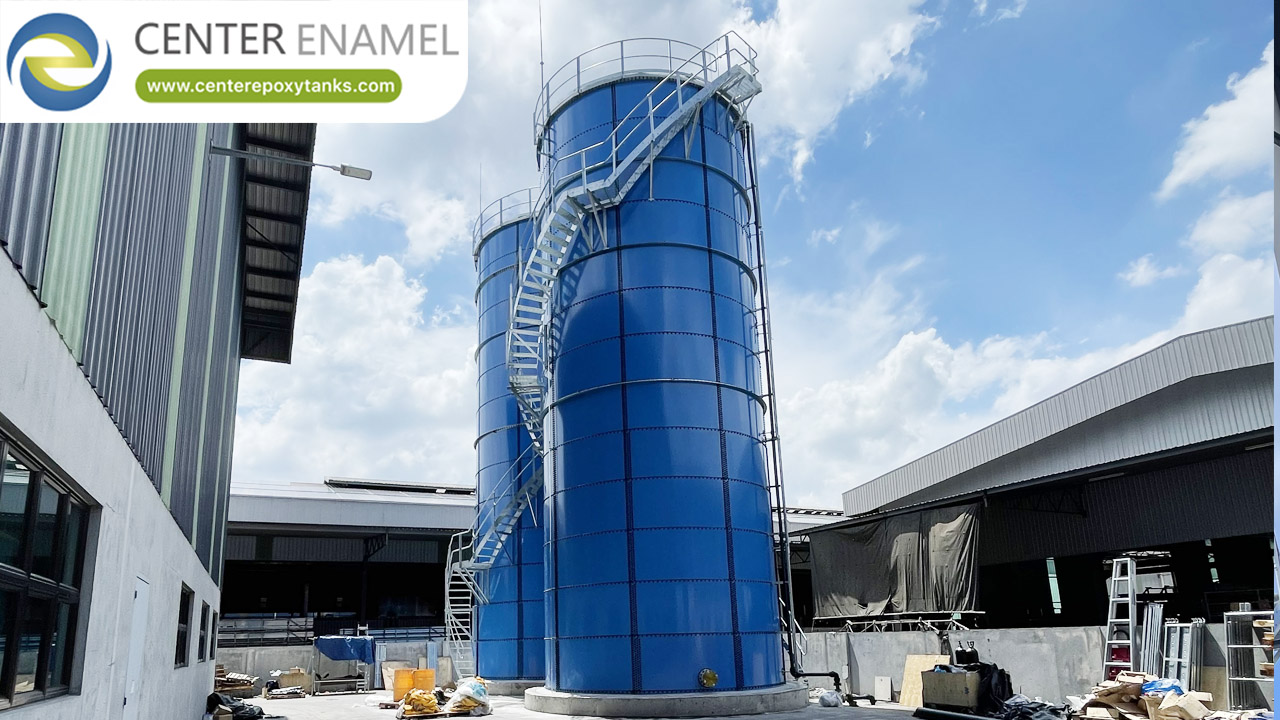
Cooling Water Tank for Data Centers: Loop, Capacity and Material
A cooling water tank on a data center site stores water for the heat rejection loop: makeup volume for evaporative equipment, supplementary storage for the tower basin, or reserve volume for the cooling system. Capacity follows the water balance - evaporation typically removes about 1% of the circulating flow per 6 to 7 K of cooling range, blowdown follows from the cycles of concentration, and storage is sized against the refill reliability the design assumes. Because the water is treated, aerated and continuously circulated, the tank requires a factory-applied coating such as vitreous enamel or cured epoxy.
Cooling towers consume water continuously, and the water they consume has to be stored, treated and accounted for. The storage tank is where the plant water balance becomes physical: it buffers between supply, treatment and evaporation.
This article explains how the loop works, how to calculate the makeup requirement from the cooling load, how to size storage against the reliability the facility needs, and what the tank itself has to provide. It deals with the heat rejection side rather than thermal storage, which is a separate duty.
Technical Explanation
The loop and where the tank sits
In an evaporative cooling system, water circulates from the tower basin through the condenser heat exchangers and back. Losses occur continuously:
• Evaporation: the mechanism that rejects heat, consuming water at a rate proportional to cooling load and range.
• Drift: droplets entrained in the exhaust air, small in volume but carrying dissolved solids.
• Blowdown: deliberate discharge to control cycles of concentration and prevent scale.
• The tank stores makeup water for these losses, provides reserve volume if supply is interrupted, and may supplement the tower basin volume itself.
Calculating the makeup requirement
The water balance is the sizing basis, and the calculation is straightforward once the cooling load is known:
• Evaporation: a commonly used rule of thumb is that about 1% of the circulating flow evaporates per 6 to 7 K of cooling range; confirm this against the tower manufacturer's performance data for the actual design conditions.
• Blowdown: calculated from the cycles of concentration as evaporation divided by (cycles of concentration minus one); higher cycles reduce blowdown and therefore total water consumption.
• Drift: taken from the tower manufacturer's specification, typically a small fraction of circulating flow.
• Makeup: the sum of evaporation, blowdown and drift, expressed as daily and annual volumes for the design load profile.
Sizing storage from reliability, not from habit
Storage volume is a reliability decision rather than a purely hydraulic one:
• Define the interruption to be tolerated: hours or days without municipal supply, or reduced supply during a restriction.
• Multiply the daily makeup requirement by that period, then confirm that the resulting volume fits the plot and the foundation budget.
• Account for treatment: where the water must be softened or filtered, decide whether treatment sits upstream of storage or between storage and the loop, because that changes both tank sizing and materials.
• Confirm the refill rate available, since a very large reserve with a slow refill connection only helps if the interruption is short or the refill genuinely independent.
Materials and provisions for a treated wet duty
The tank specification follows the water chemistry and the treatment regime:
• Coating: vitreous enamel fused at 820-930 C or factory-cured fusion bonded epoxy, both applied to panels before assembly, verified by holiday testing.
• Sealant and gaskets: selected for compatibility with the treatment chemicals at operating concentration.
• Level control: make-up valve, level indication and low-level alarm, so that a supply failure is detected before the loop is affected.
• Blowdown and overflow: discharge points arranged so that blowdown can be measured, which is how the water balance is verified in operation.
• Treatment connections: dosing and sampling points placed for proper mixing rather than short-circuiting to the outlet.
Technical Specifications
Table 1 - Cooling loop water balance and storage sizing inputs
Water balance term | How it is derived | Typical magnitude | Effect on storage |
Evaporation | Proportional to cooling load and range | About 1% of circulating flow per 6 to 7 K range | Dominant term in the makeup demand |
Blowdown | Evaporation / (cycles of concentration - 1) | Falls as cycles of concentration rise | Reduced by higher cycles, offset by scaling risk |
Drift | Tower manufacturer's data | Small fraction of circulating flow | Minor |
Makeup total | Sum of the three losses | Sets the daily demand | Basis for the reserve volume |
Reserve period | Required tolerance to supply interruption | Project specific | Multiplies daily demand into tank volume |
Fire reserve | Suppression design | Separate calculation | Usually a separate tank, not shared |
Project Case Study
Project Case Summary - industrial water storage delivered
The records below are delivered industrial water tanks. They are cited as the closest delivered comparable to a cooling loop storage tank, with capacity and completion date stated.
Project | Application | Capacity | Construction | Roof | Completion |
Turkey | Industrial water | 3,018 m3 | Glass-fused-to-steel bolted | Not applicable | 2025-07 |
Congo | Industrial water | 1,398 m3 | Glass-fused-to-steel bolted | Aluminium flat roof | 2026-01 |
Company Expertise
Center Enamel supplies bolted water tanks for industrial and cooling water duty with factory-applied vitreous enamel, fusion bonded epoxy and galvanized coatings, sized from the project water balance and designed to AWWA D103-09.
As an outstanding containment and cover system provider with decades of industry experience, Center Enamel sincerely expects to establish long-term cooperation with local partners throughout the world and to make continuous contribution to the development of the industry.
Shijiazhuang Zhengzhong Technology Co., Ltd is not only the first manufacturer in China to produce Glass-Fused-to-Steel tanks, but also the most experienced professional bolted tank manufacturer in Asia. The engineering, design, product testing and quality system of Center Enamel Glass-Fused-to-Steel tanks are in strict accordance with AWWA D103-09, OSHA, ISO 28765, NSF/ANSI 61 and NFPA. By 2023, Center Enamel bolted tanks had been exported to more than 100 countries, including the USA, Australia, Canada, Malaysia, Indonesia, Russia, the UAE, Panama, Brazil and South Africa.
Shijiazhuang Zhengzhong Technology Co., Ltd (Center Enamel) is a professional manufacturer dedicated to the design and fabrication of bolted storage tanks since 2008. Our product range includes Glass-Fused-to-Steel (GFS) tanks, fusion bonded epoxy tanks, stainless steel tanks, galvanized steel tanks and aluminum geodesic dome roofs. With a professional enameling R&D team and nearly 200 enameling patents, Center Enamel has become a leader in the bolted tank industry in Asia. Our products are certified to ISO 9001, NSF 61, EN 1090, ISO 28765, WRAS, FM, LFGB, BSCI and ISO 45001.
Shijiazhuang Zhengzhong Technology Co., Ltd (Center Enamel) is a professional manufacturer dedicated to the design and fabrication of bolted storage tanks since 2008. Our product range includes Glass-Fused-to-Steel (GFS) tanks, fusion bonded epoxy tanks, stainless steel tanks, galvanized steel tanks and aluminum geodesic dome roofs. With a professional enameling R&D team and nearly 200 enameling patents, Center Enamel has become a leader in the bolted tank industry in Asia. Our products are certified to ISO 9001, NSF 61, EN 1090, ISO 28765, WRAS, FM, LFGB, BSCI and ISO 45001.
Shijiazhuang Zhengzhong Technology Co., Ltd is not only the first manufacturer in China to produce Glass-Fused-to-Steel tanks, but also the most experienced professional bolted tank manufacturer in Asia. The engineering, design, product testing and quality system of Center Enamel Glass-Fused-to-Steel tanks are in strict accordance with AWWA D103-09, OSHA, ISO 28765, NSF/ANSI 61 and NFPA. By 2023, Center Enamel bolted tanks had been exported to more than 100 countries, including the USA, Australia, Canada, Malaysia, Indonesia, Russia, the UAE, Panama, Brazil and South Africa.
As an outstanding containment and cover system provider with decades of industry experience, Center Enamel sincerely expects to establish long-term cooperation with local partners throughout the world and to make continuous contribution to the development of the industry.
Frequently Asked Questions (FAQ)
Q: How much water does a cooling tower lose?
A: Evaporation is the dominant loss, at roughly 1% of circulating flow per 6 to 7 K of cooling range as a rule of thumb, with blowdown depending on the cycles of concentration and drift taken from the tower data. The actual figures should come from the tower manufacturer's performance data for the design conditions.
Q: How do cycles of concentration affect water consumption?
A: Higher cycles reduce blowdown, which reduces total makeup water and the volume that must be stored and treated. The limit is set by scaling and corrosion risk in the loop, so the achievable cycles depend on the makeup water chemistry and the treatment programme.
Q: Should cooling makeup water be stored raw or treated?
A: Either can work, and the choice affects the tank. Raw storage is cheaper per unit volume but needs treatment downstream; treated storage requires a coating and sealant compatible with the dosing chemicals. Most projects store raw or partially treated water and dose the loop.
Q: Can the fire reserve and the cooling makeup share a tank?
A: They should not. The fire reserve must remain available at all times and cannot be depleted by cooling makeup drawdown. Combined arrangements create a compliance risk that outweighs the capital saving.
Q: What happens to the tank when the plant is idle?
A: The water should be maintained with treatment to prevent biological growth and corrosion during low-load periods, and the tank inspected more closely after long idle periods. Level control and turnover provisions should be checked as part of the plant restart procedure.
Q: Does the tank need a liner or a coating?
A: A factory-applied coating is the practical answer for a bolted steel tank, because the coating is applied and tested before assembly. A field-applied liner would require a much larger site operation and would be harder to verify.
Cooling water storage is a water balance problem before it is a tank problem. Calculate evaporation, blowdown and drift, decide the interruption the design must tolerate, and size storage from that. Then specify a factory-applied coating that survives treated, aerated, continuously circulating water.
Talk to the Engineering Team
Send the cooling load, tower range, makeup water analysis and the interruption period to be covered. We will return the storage volume basis and the tank configuration with the coating, level control and blowdown provisions.


