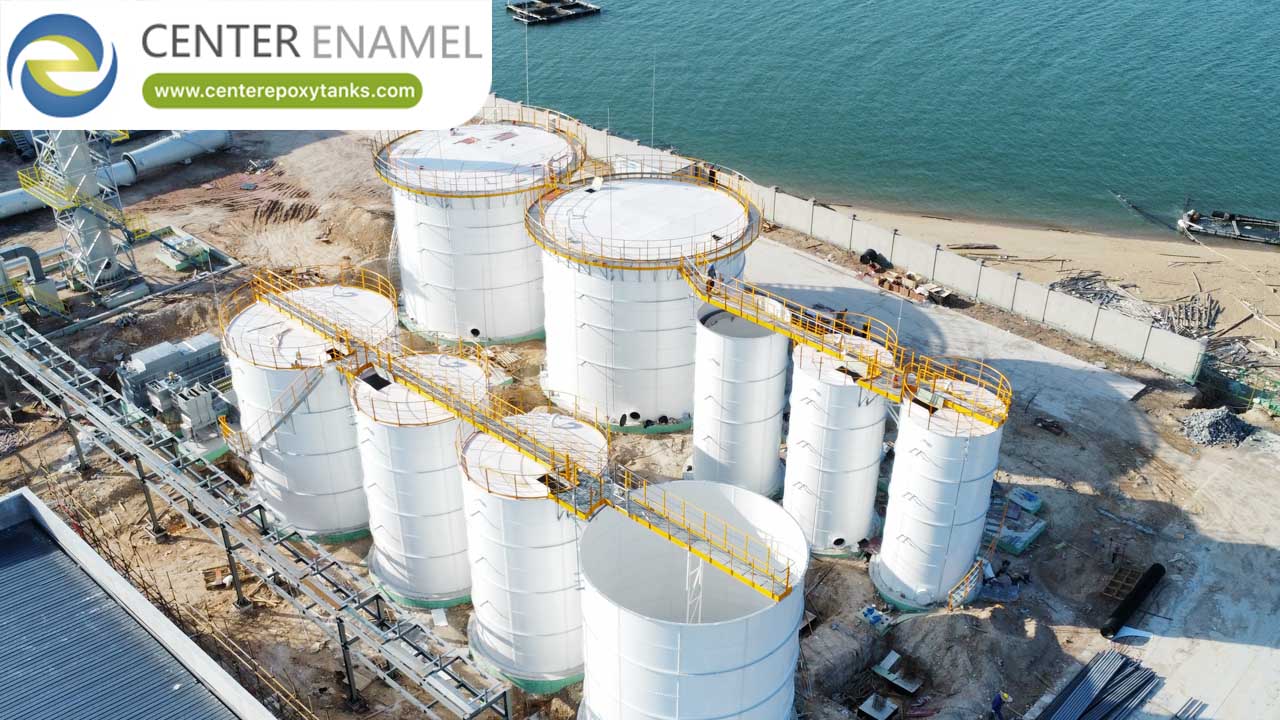
Center Enamel Delivers GFS Wastewater Storage Tanks for Eswatini Industrial Project
Shijiazhuang Zhengzhong Technology Co., Ltd. (Center Enamel) has successfully engineered and installed high-capacity Glass-Fused-to-Steel (GFS) Bolted Tanks for a major industrial wastewater treatment project in Eswatini (formerly Swaziland). By deploying two 1,338 m³ tanks—totaling 2,676 m³ of storage—equipped with advanced Aluminum Geodesic Dome Roofs, Center Enamel provided a robust, maintenance-free solution designed to withstand aggressive chemical environments and sub-tropical conditions for a 30-year service life.
Technical Specification Matrix: Eswatini Wastewater Infrastructure
Technical Parameter | Specification / Industrial Result |
Tank Technology | GFS (Glass-Fused-to-Steel) Bolted Steel |
Storage Capacity | 2 × 1,338 m³ (Total 2,676 m³) |
Dimensions | 13.76m Diameter × 9.0m Height |
Coating Range | pH 3–11 (Resistant to aggressive sewage & H2S) |
Design Standard | AWWA D103-09, ISO 28765, NSF/ANSI 61 |
Roof Type | Aluminum Geodesic Dome (Self-Supporting) |
Service Life | 30+ Years with near-zero maintenance |
Engineering Strategy: Solving Logistical & Climatic Hurdles
1. "Modular-First" Landlocked Logistics
Eswatini is a landlocked nation, which traditionally makes the transport of heavy pre-cast concrete or massive welded steel plates cost-prohibitive.
● The Solution: Center Enamel’s GFS tanks were shipped as high-density, flat-packed panels. This modular approach reduced shipping volume by approximately 60%, enabling seamless inland transport from the port, through the Eswatini border, and directly to the job site.
2. Eliminating High-Skill Field Welding
Remote industrial sites often face a shortage of certified field-welders and high-precision testing equipment required for traditional steel tank integrity.
● The Solution: The bolted design moved the quality-critical fabrication phase into our ISO-certified factory. On-site assembly utilized high-tensile bolts and specialized EPDM sealants, eliminating the need for "hot work" permits and ensuring that structural integrity remained independent of local weather or humidity conditions.
3. H2S and UV Resistance in Sub-Tropical Climates
Eswatini’s climate features high humidity and intense UV exposure, which can rapidly degrade standard liquid-applied epoxy coatings.
● The Solution: Our GFS coating is fired at 820°C–930°C, creating a molecular, ceramic-like bond between glass and steel. This inert surface is immune to UV radiation and highly resistant to Hydrogen Sulfide (H2S) gas—the primary byproduct of anaerobic wastewater processes.
Advanced Coverage: Aluminum Geodesic Dome Roofs
To maximize the efficiency of the wastewater system, Center Enamel integrated Aluminum Geodesic Dome Roofs. These covers are critical for:
● Total Odor Containment: Providing an airtight seal to manage noxious odors and hazardous vapors (H2S and methane).
● Clear-Span Design: The self-supporting structure eliminates internal columns, maximizing effective tank volume and preventing interference with internal mixers or aeration systems.
● Maintenance-Free Longevity: Unlike steel covers, aluminum requires no painting or re-coating, resisting atmospheric corrosion for decades.
Frequently Asked Questions (FAQ)
Q: Why was GFS technology chosen over concrete for the Eswatini project?
A: GFS offers superior chemical resistance (pH 3–11) and logistical efficiency. As a landlocked nation, Eswatini benefited from the "Modular-First" advantage, reducing inland transportation costs by roughly 30% compared to heavy concrete or welded steel alternatives.
Q: How does the bolted design improve safety in remote regions?
A: We utilize the "Jack-up Installation" method, allowing the tank to be assembled at ground level and lifted sequentially. This eliminates the need for high-altitude scaffolding and on-site welding, which are difficult to manage in high-wind or remote areas.
Q: What is the expected maintenance for these wastewater tanks?
A: Due to the glass-to-steel fusion, the surface is impermeable and self-cleaning. It requires only periodic external visual inspections and an internal high-pressure wash every 3–5 years, resulting in the lowest Total Cost of Ownership (TCO) in the industry.
Engineering Certainty for Your Project
Center Enamel’s success in Eswatini demonstrates that even the most remote and logistically challenging sites can benefit from state-of-the-art wastewater storage. By prioritizing modularity, chemical inertness, and factory-verified quality, we ensure your infrastructure investment is built to last for decades, regardless of global location.
Are you managing an industrial water treatment project in a logistically challenging region, or would you like to learn how our GFS modular solutions can reduce your total project cost?


